
Family Reunion Questions That Mix the Branches
By Mark Fulton · 2026-10-07 · 15 min read
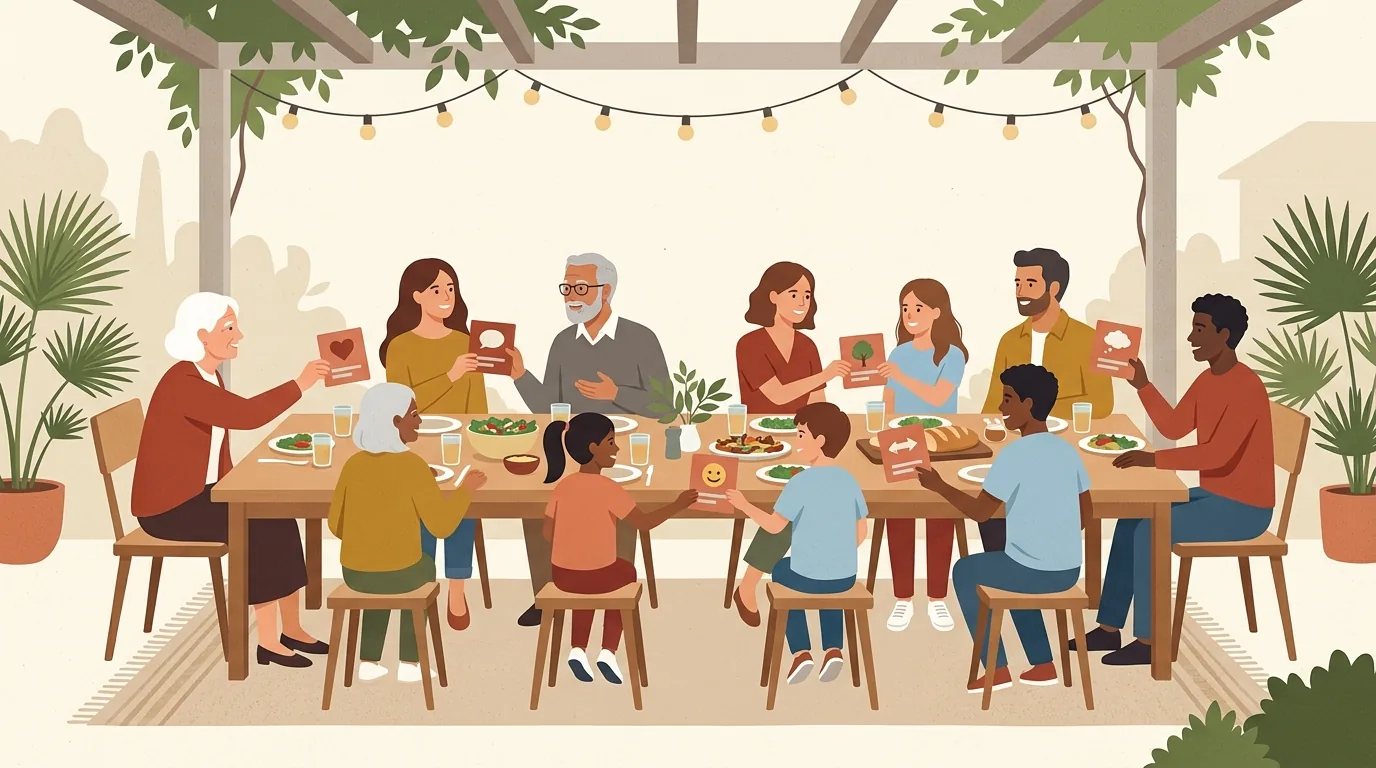
The best family reunion questions are concrete, easy to answer in two or three sentences, and asked across branches rather than within them. Pair people who do not already know each other, give each pair one question at a time, and keep the whole exercise to about forty minutes so nobody feels trapped in it. Questions about this year work between cousins who met once. Questions about the past work best when an older relative is the one being asked, and when a younger relative is the one asking. Below is a run sheet you can follow from the first pairing to the closing share, with 36 questions written fresh for this post and tagged by who asks whom.
Why do reunions split into the same tables every year?
Because the easiest conversation in any room is the one you already know how to have.
A reunion puts together people who share a surname, a few holidays and a lot of stories, but who may not share much else. Your own household sits together because it is comfortable. Your siblings sit nearby because you are fluent with each other. The branch that lives two states away clusters at the table closest to the food, because they all arrived in the same car and none of them knows where else to stand.
None of this is rude. It is what happens when a room has no reason to rearrange itself. Open seating plus a free afternoon produces the same map every year, and the map follows the family tree.
So the fix is not a better question. A better question asked to the person you always talk to produces a slightly better version of the same conversation. The fix is changing who talks to whom, then handing each new pair something specific to say. Everything below is built on that order: pairing first, questions second.
How do you pair relatives who don't know each other?
Use a method that looks like chance and is quietly designed. People accept a draw. They resist being told to go and meet someone.
The two-pile draw. Before the reunion, write a first name on each of two sets of slips, or use name tags with a small coloured dot on the back. Sort so that the two halves of each pair come from different branches and, where you can manage it, from different generations. Hand every guest one slip as they arrive. Their match is whoever holds the same symbol or colour.
A few practical rules make it work.
- Never pair a parent with their own child, or two siblings. The point is a new conversation, so remove the old one.
- Keep one pair of different ages at least ten years apart. A teenager and a great-uncle will often outdo two people of the same age, because neither has an assumed script.
- Make a trio for odd numbers. Do not leave one person standing alone with a slip nobody holds. Three people can share a question set perfectly well.
- Let the shy relatives look first. If you know someone dreads this kind of thing, put them with someone warm and patient, and tell the warm one quietly before the session.
- Do not announce it as an icebreaker. Call it "the pairing round" or "match up and swap". The word you want to avoid is the one that makes adults brace.
If you are running a big reunion, split into groups of twenty to thirty, each with its own leader and its own question cards. Forty minutes at a room of ninety people does not work. Forty minutes at a table of ten does.
Which questions work across three generations?
The ones that are about something a person can see, remember or name. Abstract questions ("What is your family's greatest strength?") get either silence or a speech. Specific questions ("What was the first job you ever had?") get an answer in under ten seconds and a follow-up after that.
A question has to pass four small tests to work between near-strangers.
- A stranger could answer it honestly without prior knowledge of the family.
- It has a short first answer and a long second one. "My first job was at a bakery" opens into the bakery.
- It has no wrong answer and nothing to judge. No questions about money, health, or who is not here.
- A ten-year-old and an eighty-year-old can both answer it, even if they answer differently.
Here is the full set, in the order you will use it. Each question is tagged with who asks whom. "Cousin" here means anyone from the same generation but a different branch, and "elder" means anyone older than the asker by a generation or more.
Round 1: The warm-up (minutes 5 to 15, same generation or mixed)
Short, present-tense and impossible to get wrong. The goal is to get each pair laughing at least once before you ask about anything that needs a memory.
| # | Question | Who asks whom |
|---|---|---|
| 1 | What did you eat for breakfast today, and was it a normal breakfast for you? | Cousin to cousin |
| 2 | What is the longest drive or trip you made to get here, and what did you do on the way? | Anyone to anyone |
| 3 | What is something you are looking forward to this month? | Adult to adult |
| 4 | What is one food you would be happy to eat every week for a year? | Cousin to cousin |
| 5 | What song or sound instantly makes you feel like it is the weekend? | Anyone to anyone |
| 6 | What is a small thing you are surprisingly good at? | Adult to adult |
| 7 | What was the last thing that made you laugh properly? | Cousin to cousin |
| 8 | What is the best place you have ever slept, and what made it good? | Anyone to anyone |
| 9 | If you could learn one skill in a month, what would it be? | Adult to adult |
| 10 | What is a job you thought you wanted when you were small? | Cousin to cousin |
| 11 | What is the most useful object you own that nobody else would guess? | Anyone to anyone |
| 12 | What do people usually get wrong when they first meet you? | Cousin to cousin |
Round 2: The elders' round (minutes 15 to 27, younger asks older)
This is the round that makes a reunion worth having. Switch roles: the older person in each pair becomes the guest of honour, and the younger one asks and listens. If a pair is two people of the same age, the person with the longer connection to the family goes first.
| # | Question | Who asks whom |
|---|---|---|
| 13 | What was the first house or flat you remember, and what did the front door look like? | Younger to elder |
| 14 | Who in the family did you most want to be like at ten years old? | Younger to elder |
| 15 | What was a normal Sunday like when you were growing up? | Younger to elder |
| 16 | Which relative at an earlier reunion made you laugh the most? | Younger to elder |
| 17 | What was the first thing you bought with money you earned yourself? | Younger to elder |
| 18 | What was the family recipe, trade or habit that you assumed everyone had? | Younger to elder |
| 19 | Where did you go on holiday as a child, if you went anywhere? | Younger to elder |
| 20 | What was your school day like, from waking up to coming home? | Younger to elder |
| 21 | Which of our relatives would I be surprised to learn used to be a rebel? | Younger to elder |
| 22 | What is one thing in your home that has a story attached to it? | Younger to elder |
| 23 | What did you do for fun before you had a phone or television? | Younger to elder |
| 24 | If I could meet one person from the family who is no longer here, who would you want me to meet and why? | Younger to elder |
A note on question 24. It is the one question in the set that can go somewhere heavy. Ask it last in the round and let the elder decide how far to go. If they say "That is a long story," treat that as an answer and move on gently. The Oral History Association's principles and best practices frame an interview as a collaboration that starts from respect for the person telling the story, and that is a good rule for a picnic table too. Anyone can pass on any question, with no explanation required.
Round 3: The crossover (minutes 27 to 37, anyone asks anyone)
Now reverse the roles again and loosen the structure. Elders ask the young ones, kids ask the adults, and mixed pairs draw from either set.
| # | Question | Who asks whom |
|---|---|---|
| 25 | What is something you know how to do that I probably do not? | Elder to younger |
| 26 | What is your favourite thing to do that costs nothing? | Elder to younger |
| 27 | What is a word or phrase your friends use that I should know? | Elder to younger |
| 28 | What is something you wish the older people in this family would ask you about? | Elder to younger |
| 29 | What is the strangest rule from your house when you were a kid? | Kid to adult |
| 30 | What did you get in trouble for when you were my age? | Kid to adult |
| 31 | What was your favourite toy, and where did it end up? | Kid to adult |
| 32 | What was the best thing about the place where you grew up? | Kid to adult |
| 33 | If our family had a team name or a flag, what should be on it? | Anyone to anyone |
| 34 | What is one thing every person in our family seems to be good at? | Anyone to anyone |
| 35 | What is a story about our family that you think people should hear again? | Anyone to anyone |
| 36 | If we held this reunion again in ten years, what would you want to be different or the same? | Anyone to anyone |
That is the whole set. If your reunion is mostly adults, drop the kid-to-adult questions in round 3 and replace them with number 9 or number 11 from round 1. If it is mostly kids, shorten round 2 to eight minutes and let round 3 run longer.
How do you let the older relatives lead a round?
By making the question theirs rather than yours.
An elder asked to "tell some stories" will either wave it away or perform. An elder asked a specific question by a specific younger person will usually just answer it. The difference is that the second version is a conversation and the first is a request to entertain a room.
Some small moves that help:
- Give the elder the first and last word. In round 2, the younger person asks, the elder answers, and the younger person is not allowed to move to the next question until they have asked one follow-up. "What did the door look like?" becomes "And who answered it?"
- Sit the pair somewhere comfortable. A chair with arms and a flat surface for a drink matters more than people expect. Nobody tells a good story while holding a paper plate.
- Give the younger person a job. Writing down one sentence from the elder's answer on a card gives them something to do with their hands and signals that the answer matters.
- Respect the pass. If the elder says "I would rather not say," the younger person moves to the next question without comment. Good interviewing, in any setting, depends on that. For a longer, more structured version of these conversations, questions to ask grandparents is a session plan built for a single person and a single sitting.
- Do not correct them. If Aunt Joan's version of the year the barn burned down differs from your uncle's, that is a finding, not a mistake. Write both down.
What do you do with the stories afterwards?
Capture them before the afternoon dissolves, in the simplest way that will actually get done.
Cards beat recordings at a party. Hand out one blank index card per pair. After round 3, each pair writes down the single best thing they learned: a name, a place, a sentence. Collect the cards in a box. Nobody has to learn software, nobody is being filmed, and you end the day with thirty or forty short entries.
Photograph the cards. At home, take a picture of each card the same evening. You now have a record that can be shared in the family group chat or printed, without retyping anything.
Pick one thread to follow up. Out of all the stories, one or two will have a loose end: an old address, a missing photo, a name nobody could place. Choose one and ask the person who told it for ten more minutes the following week. That small step is the one that turns a good afternoon into a family archive.
If you want to take any of it further, the National Archives genealogy resources are a useful place to start looking at records, and they sit alongside whatever your relatives remember. Memories tell you where to look. Records tell you whether the details hold.
And treat what people say as theirs. Before you share a story outside the family, such as in a printed booklet or a public online tree, ask the person who told it. A thirty-second "Is it all right if I write this down and share it with the family?" is cheaper than a hard conversation later.
How do you include kids without it feeling like school?
By giving them the power in the room, not a worksheet.
Children dislike questionnaires because they feel like being tested. They like being the one holding the cards. So change the role: in round 2 and 3, the kid is the interviewer, with a deck in their hand and the right to pick the next question.
- Let them choose from three. A seven-year-old who picks question 31 out of a fan of three cards feels in charge. Handing them a printed list does not.
- Give them a stopwatch. Kids love the timer. Let them call "switch" at the end of each round.
- Offer a drawing option. Some children would rather draw what an elder describes than say much. A sketch of the childhood front door is a better record than most written notes.
- Keep it to about ten minutes of their time. After round 2, let anyone under twelve go off to play. The elders' stories will still be there.
- Give teenagers a real job. A fifteen-year-old scribe or a photographer for the cards will stay engaged far longer than one who has been told to join in.
For the youngest group, the question sets in dinner table questions for kids work well as a side game while the adults run round 2.
The 40-minute run sheet
| Minutes | What happens | Who runs it |
|---|---|---|
| 0 to 5 | Hand out the slips, find your match, get a drink, sit down together | Host |
| 5 to 15 | Round 1: warm-up questions 1 to 12, one question every two minutes or so | Pairs, with the host calling "switch" |
| 15 to 27 | Round 2: the elders' round, younger partner asks, elder answers | Pairs |
| 27 to 37 | Round 3: the crossover, questions 25 to 36 in any order | Pairs |
| 37 to 40 | Closing share: each pair says one thing they learned, in one sentence, and drops their card in the box | Host collects |
Keep the host short. Three minutes of introduction is plenty, and say the rules once: ask one question at a time, pass on anything you like, no wrong answers.
Put the whole set on cards
Questions read aloud from a sheet get lost. Questions on cards get passed around and picked up. You can build all 36 of these in the QuestionCard builder in a few minutes, sort them into your three rounds, and pass one phone around each table so every pair can draw the next question. The free tier holds one deck of up to 20 cards, so for the full 36 you can split them into two decks, or use the most useful 20 and keep the rest on paper. Your decks are stored in your own browser rather than on our servers, and you can export a deck as a file to keep a copy. If you want other readymade sets to run alongside, the question cards hub has free decks you can play right away with no account.
FAQ
What are good questions to ask at a family reunion?
Good reunion questions are specific, easy to answer in a sentence or two, and answerable by someone who does not know the family well. "What was the first job you ever had?" works. "What do you value most about our family?" does not. Start with present-tense questions, move to memories, and finish with questions about the family's future.
How do you get family members to mingle at a reunion?
Change who talks to whom, because a better conversation topic rarely changes who someone sits with. Draw pairs by chance across branches and ages, give each pair one question at a time, and keep the exercise short. People will mix if mixing is easy and has an end time.
What games work for a family reunion with all ages?
Games where every age can answer from their own life work best. The pairing method and the three rounds above are one example. Any format that lets the oldest and youngest answer the same prompt, such as "what is something you can do that others do not know about," will work across generations without separating the kids from the adults.
How do you collect family stories at a reunion?
Use one index card per pair and ask each pair to write down the best thing they learned, then photograph the cards that evening. It takes seconds, asks nothing technical of anyone, and gives you a clear record. For a fuller account from a single relative, schedule a separate, longer conversation afterwards, and always ask permission before sharing a story beyond the family.