
Free French Flash Cards: The First 100 Words
By Mark Fulton · 2026-09-30 · 18 min read
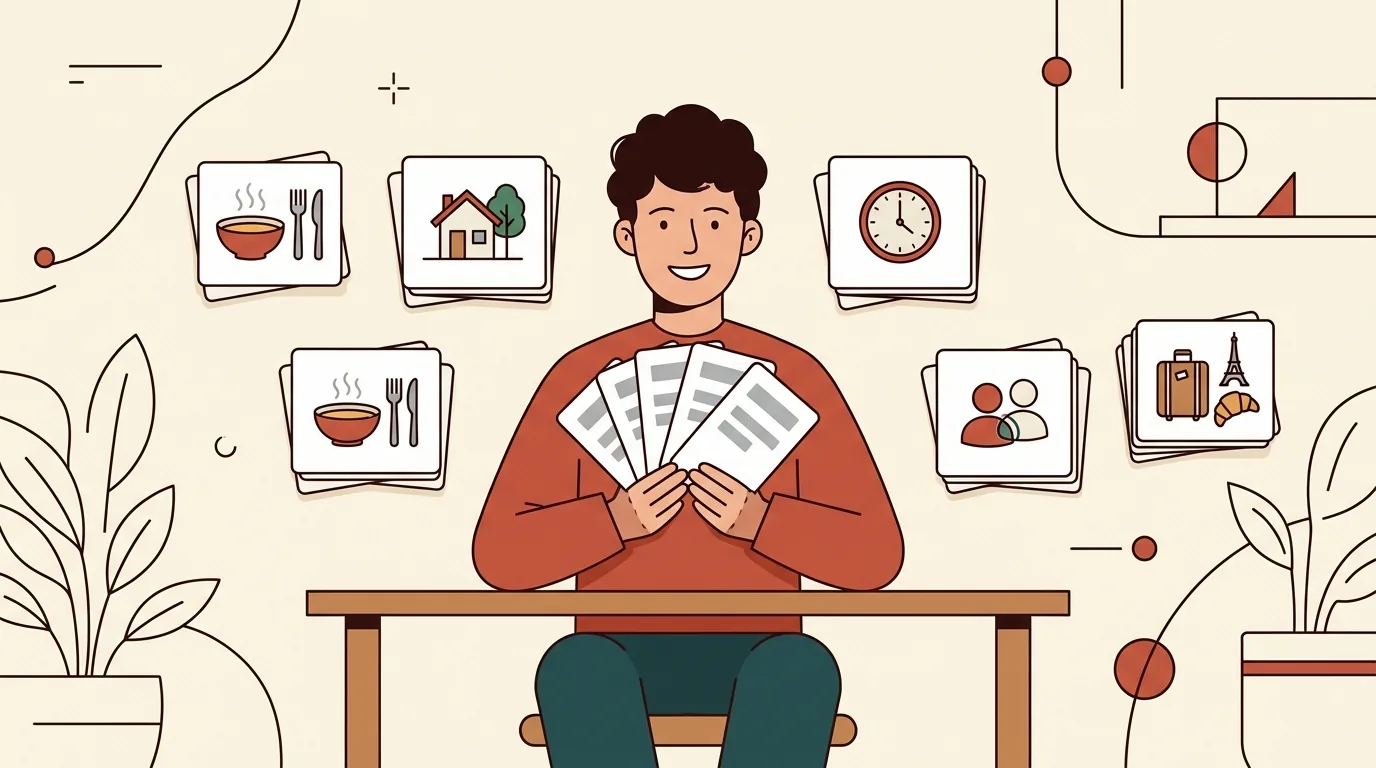
Free French flashcards are easy to find. A useful first hundred is harder, because most sets are either a thousand cards in no particular order or a user upload that stops halfway through the verbs.
The first 100 French words should be picked for everyday usefulness, studied in batches of twenty, and written so that each card teaches what a French beginner actually trips on: the gender, which lives in the article, and the sound, which the spelling often hides. Below is a bank of 100 in five themed batches, with the article attached to every noun and a note on each word whose written form will mislead your ear. Batch one gets you through a first exchange, batch two hands you être, avoir, aller and faire plus the verbs that carry most sentences, and batches three to five fill in actions, people, places, time and description.
That is the core of it. After the bank: why the article belongs on the card, which words you have to hear rather than read, how to card the four irregular verbs, and what a hundred words honestly gets you.
Which French words should a beginner learn first?
Start from what people actually say, then apply judgment. The French word list built from OpenSubtitles film and television subtitles on Wiktionary is a good reality check. Its first row is je. Its top 100 is thick with de, le, la, que, ne, pas and ça, and it counts written forms rather than dictionary words, so est, suis, sont and été each get their own row.
Read that list with the four big verbs in mind and something jumps out. Nineteen of the top 100 rows are forms of être, avoir, aller or faire: est, a, ai, as, suis, va, fait, être, faire, était, es, sont, vais, avez, ont, allez, êtes, été and fais. Nearly one row in five is one of four verbs. That is the argument for putting them in batch two, not batch nine.
A raw frequency list is still not a study deck. You cannot flip a card for ne and learn anything, and subtitles reach words like le pain and écrire later than a person ordering breakfast does. So this bank starts from frequency and then filters for what a beginner can use in a real exchange.
Batch 1: the first five minutes
Greetings, politeness, the question words, and the first three pronouns.
| French | English | Note |
|---|---|---|
| bonjour | hello, good day | The default greeting until evening. The n is not pronounced as an n; it nasalizes the vowel. |
| bonsoir | good evening | Said on arrival in the evening. |
| bonne nuit | good night | Only at bedtime. Here the n of bonne is pronounced, unlike in bon. |
| salut | hi, bye (informal) | Final t is silent. Friends only. |
| au revoir | goodbye | Au is one sound, like "oh". |
| s'il vous plaît | please (formal) | Final t silent. S'il te plaît is the informal version. |
| merci | thank you | |
| de rien | you're welcome | Rien ends in a nasal vowel, no n sound. |
| oui | yes | One syllable, close to "wee". |
| non | no | Nasal vowel. Also "not" in some phrases, but negation is usually ne ... pas. |
| pardon | sorry, excuse me | Stress on the last syllable, nasal ending. |
| comment ? | how? | Final t silent. Also the polite way to say "sorry, what?" |
| quoi ? | what? | Casual on its own. "What is it?" is qu'est-ce que c'est ? |
| qui ? | who? | Qu is a plain k sound. |
| où ? | where? | The accent is the only difference from ou, "or". Same sound. |
| quand ? | when? | The d is silent, but sounds as a t before a vowel: quand il. |
| pourquoi ? | why? | The answer word is parce que, "because". |
| je | I | Shrinks to j' before a vowel: j'ai, j'aime. |
| tu | you (informal) | Vous is the formal or plural "you", and you will need it with strangers. |
| il | he, it | Also "it" for masculine nouns. |
Batch 2: the verbs that carry the sentence
| French | English | Note |
|---|---|---|
| elle | she, it | "It" for feminine nouns. Elles sounds identical. |
| nous | we | Silent s, until a vowel follows: nous avons has a z sound. In speech, on often replaces it. |
| ils | they | Sounds exactly like il. Only liaison tells ils ont from ils sont. |
| être | to be | Irregular. Je suis, tu es, il est. Full table below. |
| avoir | to have | Also carries age and feelings: j'ai vingt ans, j'ai faim, j'ai froid. |
| faire | to do, to make | The weather verb: il fait froid, il fait beau. |
| aller | to go | Aller plus an infinitive is the everyday future: je vais manger. Also ça va ? |
| venir | to come | Venir de plus an infinitive means "to have just": je viens de manger. |
| vouloir | to want | Je voudrais, "I would like", is the polite way to ask for anything. |
| pouvoir | can, to be able to | Je peux ? on its own asks "may I?" |
| savoir | to know (facts, how to) | Je sais nager. Je ne sais pas is worth owning early. |
| connaître | to know (people, places) | Je connais Paris. Spelled connaitre under the 1990 spelling reform; both are accepted. |
| parler | to speak | The model regular verb. Parle, parles and parlent all sound the same. |
| comprendre | to understand | Je ne comprends pas. Final ds silent. |
| dire | to say, to tell | Irregular in one form to watch: vous dites. |
| donner | to give | Regular -er. |
| voir | to see | Perceiving. Pairs with regarder in batch three. |
| aimer | to like, to love | With people, aimer is love. Aimer bien softens it to "like". |
| aider | to help | Takes a direct object: vous pouvez m'aider ? |
| vivre | to live | Living in the sense of life. For where you live, habiter is common too. |
Batch 3: everyday actions, and what you do them to
| French | English | Note |
|---|---|---|
| manger | to eat | Keeps an e before o to keep the soft g: nous mangeons. |
| boire | to drink | Irregular: je bois, nous buvons, ils boivent. |
| dormir | to sleep | |
| regarder | to look at, to watch | No preposition, unlike English: regarder la télé. |
| écouter | to listen to | Same pattern: écouter la radio, no "to". |
| lire | to read | Je lis. |
| écrire | to write | J'écris. |
| acheter | to buy | Gains an accent in some forms: j'achète. |
| payer | to pay (for) | Payer le café is paying for the coffee. No "for". |
| ouvrir | to open | Ends in -ir but takes -er endings in the present: j'ouvre. |
| fermer | to close | |
| travailler | to work | The ill is a y sound, not an l. |
| étudier | to study | |
| la nourriture | the food | Food in general. A meal is le repas. |
| l'eau (f.) | the water | Feminine: l'eau froide. Three vowels, one sound: "oh". |
| le pain | the bread | Nasal vowel, no n sound. |
| le lait | the milk | Final t silent. |
| le café | the coffee | Also the place you drink it. |
| l'argent (m.) | the money | Also "silver". Final t silent. |
| le livre | the book | La livre is a pound. Gender changes the meaning. |
Batch 4: people, places and time
| French | English | Note |
|---|---|---|
| la maison | the house, home | À la maison means "at home". |
| la ville | the city, town | Here ll is an l sound, unlike famille. En ville is "in town". |
| la rue | the street | The French u has no English equivalent. Needs audio. |
| l'ami (m.) | the friend | L'amie for a female friend sounds identical. |
| la famille | the family | Here ll is a y sound. |
| l'homme (m.) | the man | The h is silent, so the article elides. |
| la femme | the woman, wife | Pronounced like "fam". The spelling gives no hint. |
| l'enfant (m. or f.) | the child | Un enfant or une enfant, depending on the child. |
| le temps | the time, the weather | Sounds like the nasal "tan"; p and s silent. Clock time is l'heure. |
| le jour | the day | La journée is the day as a stretch of time. |
| la nuit | the night | |
| la semaine | the week | |
| l'année (f.) | the year | L'an is used for counting: trois ans. |
| aujourd'hui | today | One word, with an apostrophe inside. |
| demain | tomorrow | Nasal ending. |
| hier | yesterday | Silent h, pronounced r. |
| maintenant | now | Two nasal vowels, final t silent. |
| après | after, later | |
| avant | before | |
| ici | here |
Batch 5: describing things
| French | English | Note |
|---|---|---|
| là | there | The accent is the only difference from la, "the". |
| beaucoup | a lot, much | P silent. Takes de with no article: beaucoup de temps. |
| peu | little, few | Un peu is "a little". |
| plus | more | Three pronunciations. See the section below. |
| moins | less, fewer | Nasal vowel, silent s. |
| grand | big, tall | Before a vowel, the d sounds as t: un grand homme, which means a great man. Un homme grand is a tall one. |
| petit | small | Final t silent. In petite it is pronounced. |
| bon | good | The adverb is bien. Bonne loses the nasal vowel. |
| mauvais | bad | Silent s. In mauvaise it sounds as z. |
| nouveau | new | Becomes nouvel before a vowel: un nouvel ami. Feminine nouvelle. |
| vieux | old | Becomes vieil before a vowel: un vieil homme. Feminine vieille. |
| joli | pretty | |
| heureux | happy | Feminine heureuse. Silent h. |
| triste | sad | Same for both genders. |
| chaud | hot, warm | For your own body use avoir: j'ai chaud. Je suis chaud is slang for "I'm up for it". |
| froid | cold | J'ai froid for you, il fait froid for the weather. |
| facile | easy | Same for both genders. |
| difficile | difficult | Same for both genders. |
| rapide | fast | |
| lent | slow | Final t silent. In lente it is pronounced. |
Why should every noun card carry its article?
Because in French the gender is not in the noun. It is in the word in front of it. Maison tells you nothing. La maison tells you the noun, the gender, and which form every adjective and pronoun that touches it will take. Learning that attached costs nothing. Learning it separately, after a year of saying le maison, costs a great deal.
The ending patterns help, but less than beginners hope. Nouns ending in -tion are feminine, and nouns ending in -ment are usually masculine. Nouns ending in -age are mostly masculine, with common exceptions like la page, la plage and l'image. A final -e is a weak hint at best: le livre, le café and l'homme are all masculine.
Then there is the trap French adds that Spanish does not. Before a vowel or a silent h, le and la both shrink to l', and the gender disappears from the front of the card. L'eau, l'argent, l'année and l'homme look identical in shape. That is why the tables above mark those nouns (f.) or (m.). On your own cards, do the same, or write the indefinite article instead: une année, un homme. Better still, add a short phrase that shows the gender in the adjective: l'eau froide.
One card, one gender marker. If your existing cards are bare nouns, do not rebuild the deck. Add the article as you review, a card at a time.
Which words can't be learned from spelling alone?
Many of them, and this is where a card needs help from your ears. French spelling is regular in its own way, but it carries letters the voice has dropped, and it changes how words join together.
Four patterns do most of the damage:
| Pattern | Examples from the bank | What happens |
|---|---|---|
| Silent final consonants | petit, lait, beaucoup, temps, mauvais | Written, not said. Adding -e for the feminine often brings the consonant back: petite, mauvaise. |
| Silent verb endings | parle, parles, parlent | Three spellings, one sound. The ending tells the reader who is speaking; the listener relies on the pronoun. |
| Liaison | nous avons, ils ont, un grand homme | A silent final consonant is sounded when the next word starts with a vowel. Ils ont (they have) and ils sont (they are) differ only by a z sound against an s sound. |
| Letter groups that mislead | femme, eau, ville vs famille, travailler | Femme sounds like "fam". Ll is an l in ville and a y sound in famille. |
Liaison is the one to take seriously, because it is not optional everywhere and not required everywhere either. French grammar sorts it into contexts where it is mandatory, contexts where it is impossible, and contexts where it varies by style, a three-way split set out in this overview of liaison in French. For a beginner the mandatory cases worth knowing early are the ones in this bank: a pronoun before a verb (nous avons, ils ont, vous avez) and an article before a noun (les amis, un enfant).
Then there is plus, which earns its own paragraph. In je n'en veux plus (I don't want any more) the s is silent. Standing for "more" at the end of a phrase, it is usually sounded. Before a vowel in liaison, it becomes a z. Casual speech often drops the ne, so j'en veux plus can mean "I want more" or "I don't want any more", and the sounded or silent s is what tells them apart.
The honest conclusion: a text card cannot teach these. What it can do is flag them. Put a one-word reminder on the back ("silent t", "sounds like fam") and then hear the word said by a native speaker, from any dictionary with audio. Do that once per flagged card and you will not have to unlearn a pronunciation later.
How do you card the core irregular verbs?
Not as one card per verb. A card reading "être = to be" teaches you the least useful form of être. What you will say and hear is je suis, c'est, ils sont.
Here are the present-tense forms of the four verbs that fill so much of that frequency list:
| être | avoir | aller | faire | |
|---|---|---|---|---|
| je | suis | ai (j'ai) | vais | fais |
| tu | es | as | vas | fais |
| il, elle, on | est | a | va | fait |
| nous | sommes | avons | allons | faisons |
| vous | êtes | avez | allez | faites |
| ils, elles | sont | ont | vont | font |
The practical way to card them is one card per form, with the pronoun on the front: je suis on the front, "I am" on the back. Four verbs times six forms is 24 cards. If you want to keep it to twenty, drop the nous row for now. In everyday speech on usually stands in for nous (on est, on a, on va, on fait), and the on forms are the same as the il forms you are already learning.
Twenty cards is also the size of one batch, and it happens to be the free limit in our deck builder, so this is a set you can build yourself in a few minutes and study the same evening. Study the four verbs as their own batch, after batch two, and before you move on to conjugating the regular verbs.
How many words before a basic conversation?
Fewer than a thousand and more than a hundred, and anyone quoting you a precise number is guessing.
What the frequency list shows is the shape of the curve, not a threshold. The words at the top are short, grammatical and everywhere. Knowing them lets you recognize the skeleton of almost any sentence. It does not let you understand the sentence, because the words you are missing are the ones that carry the meaning. Knowing je, est, pas and le in a sentence about a train strike does not tell you there is a train strike.
So here is the checkable version of what these hundred words let you do: greet someone and say goodbye at the right time of day, ask who, what, where, when, why and how, say what you want, can, know and understand, talk about eating, drinking, buying and paying, name the day, the time and the place, and describe something as big, small, good, bad, new, old, easy, hard, fast or slow. That is enough to order breakfast, buy a ticket, ask directions and apologise for your French. It is not enough to follow two native speakers at full speed, and nothing at the hundred-word mark is.
For the sequencing arithmetic, the four-week routine for memorizing vocabulary works out what a new word costs you in attention across a month, and the spaced repetition schedule covers when each batch of twenty should come back.
What comes after the first 100?
Three things, in roughly this order.
Conjugation before more nouns. You already own some thirty verbs. Learning the present-tense endings of a regular -er verb like parler turns every -er verb in the bank into six usable forms, and most French verbs follow that pattern. Then the aller plus infinitive future, which you already have. Then the passé composé, which is built from avoir or être, both of which you now know.
The small connecting words. Mais, et, ou, aussi, très, avec, pour, dans, sur, tout, rien, encore, toujours, jamais. They are all near the top of the frequency list, they have no picture attached, and they are what turn a list of nouns into speech.
Numbers, and then your own life. One to twenty, then the tens, then the hundreds. French counting has its own quirks from seventy upward, so give numbers their own batch. After that, the most valuable vocabulary is personal: your job, your family, your city, the thing you actually want to talk about. No general list can guess those, and that is the point where writing your own cards beats studying someone else's.
If you are learning Spanish alongside, the free Spanish flash cards post follows the same five-batch structure. The traps are different: Spanish splits "to be" into two verbs, while French hides gender behind l' and hides sound behind spelling.
Frequently asked questions
What are the most common French words?
In spoken French, the most common words are small grammatical ones: je, de, le, la, pas, que, tu, vous, il, et, à, and the forms of être and avoir. Subtitle-based frequency lists put je in first place. For a beginner, the most common words are not quite the same as the most useful first words, which is why the bank above mixes the top grammatical words with greetings, the key verbs and concrete nouns you can use on day one.
Are flashcards good for learning French?
For vocabulary, yes. Flipping a card makes you pull the word out of memory before you see the answer, and that act of recall strengthens memory more than rereading a list, a finding summarized in the retrieval practice research collected by cognitive scientist Pooja Agarwal. Cards are weaker at pronunciation, which French makes especially hard to learn from text, and at grammar, which is a system rather than a set of items. Use cards for the word bank, audio for the sounds, and real conversation for everything else.
Should French flashcards include le and la?
Yes, on the front, for every noun: la maison, not maison. The article is where French keeps the gender. For nouns that start with a vowel or a silent h, where the article shrinks to l', add (m.) or (f.), use un or une instead, or pair the noun with an adjective that shows the gender, such as l'eau froide.
How many French words do you need to know?
There is no honest single number. What a word count buys you depends on which words they are, and frequency lists show that the first few hundred do far more work than any later few hundred. Treat the first 100 as the point where you can handle simple transactions, expect everyday conversation to need a good deal more than that, and expect the stretch in between to take longer than the first hundred did.
Ready to run them? The French Essential Words deck is these 100 words as free flash cards, with no account needed and all 100 cards open. French is on the front and English on the back. You grade each card yourself as "knew it" or "still learning", the ones you miss come back around later in the same run, and the end-of-session report shows which words tripped you, so you know exactly what your next batch of twenty looks like.