
How to Memorize Vocabulary: A Four-Week Routine
By Mark Fulton · · 15 min read
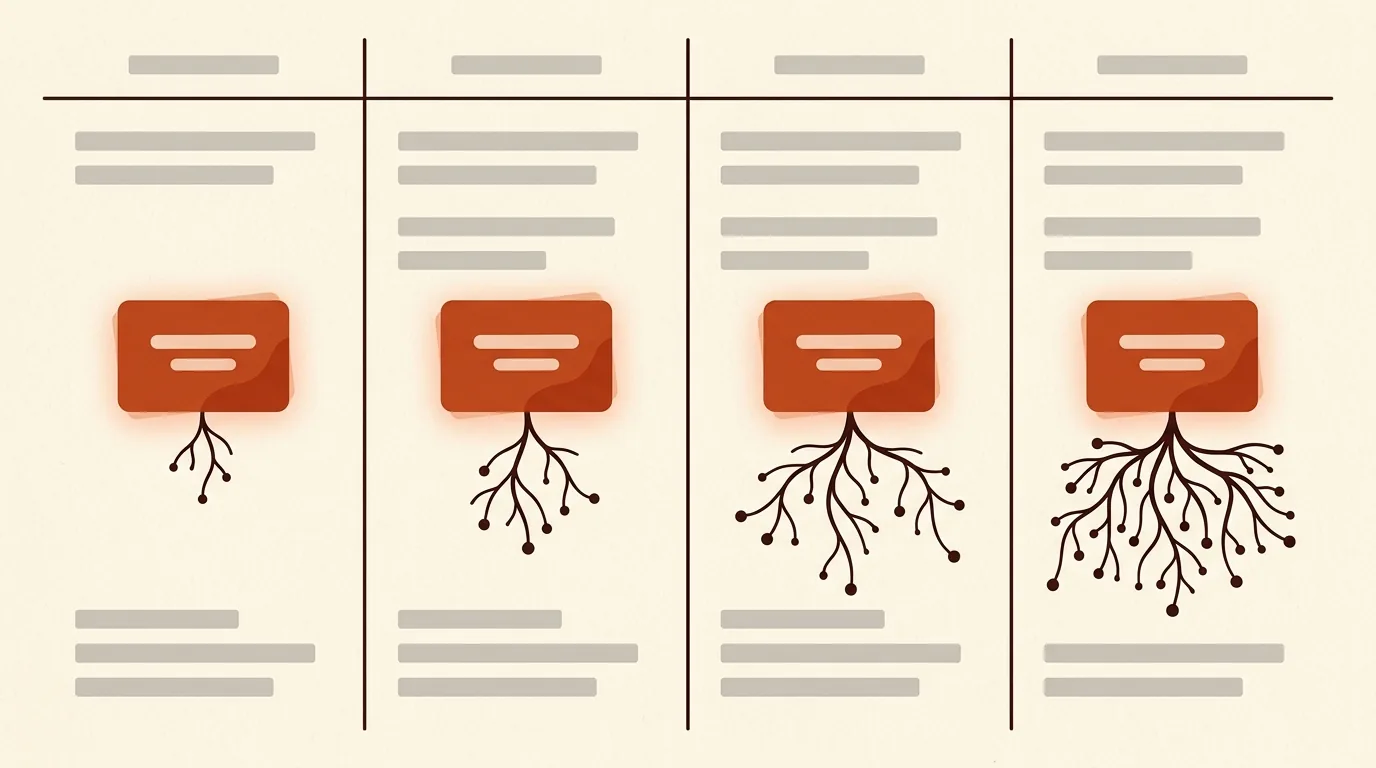
The fastest honest way to memorize vocabulary is a routine, not a trick: take in a small number of new words each day, use each one in a sentence you write yourself on the day you meet it, retrieve it cold on a widening schedule, and retire it only when you can produce it in both directions and build a fresh sentence with it on the spot. A single word costs roughly two and a half to three minutes of attention spread across a month, which is what actually caps your daily intake. Nobody can honestly tell you it makes you a specific percentage faster, and the routine below is written so that every number in it is either arithmetic you can check or a finding you can go and read.
That is the whole method. The rest of this covers why the fast framing keeps failing, what the research does and does not support, the day-by-day version, and the retirement test that most people get wrong in a way that has actually been measured.
Why does "memorise vocabulary fast" usually fail?
Three things go wrong, and they go wrong in a predictable order.
The intake is set by ambition rather than by arithmetic. Fifty words on a Sunday afternoon feels productive. Nobody plans for the fact that those fifty words will still be asking for attention in three weeks, on top of the fifty from the Monday after, and the fifty after that. The intake number is not really a decision about today. It is a decision about your workload a month from now, and almost nobody makes it that way.
Recognition gets mistaken for knowledge. You read conocer, you see "to know (people and places)" underneath it, and there is a click of familiarity. That click is real, and it is not the same skill as producing conocer when you want it. Reading the pair over and over reliably strengthens the recognition and does very little for the production, which is why so much vocabulary study feels like it is working right up until the moment you need the word.
The word gets dropped the instant it comes back once. This is the expensive one. You test yourself, you get it, you cross it off, you move on to words you have not got yet. It feels efficient. It is the single most damaging habit in the whole business, and unusually for this topic, there is a clean experiment that shows exactly how damaging.
There is also the matter of the speed claims. Pages promising that a technique makes you some specific multiple faster at vocabulary are not reporting a measurement. There is no experiment those percentages trace back to. What has been measured is narrower and more useful, and it is worth knowing what it actually says before you build a routine on top of it.
How many new words a day can you actually hold?
There is no published daily cap, and anyone quoting you one has made it up. What exists is a measurement of how much repeated exposure contributes, and it is more modest than the "just read more" advice implies.
Uchihara, Webb and Yanagisawa pooled 45 effect sizes from 26 studies covering 1,918 learners and found a medium correlation of r = 0.34 between how often a learner met a word and whether they picked it up. Repetition matters. It also leaves most of the variance to other things: how much attention the encounter got, whether the meetings were spaced, whether the learner did anything with the word.
So the honest constraint on daily intake is not memory capacity. It is time, and you can calculate it.
Work backwards from what one word costs. In the routine below, a single word gets five touches spread over thirty days: about 60 seconds on the day you meet it, then roughly 10, 20, 40 and 30 seconds on its review days. That is about 160 seconds of attention per word, total, spread across a month.
Once the routine is running at a steady state, every day you are paying the full per-word cost for one day's intake, because one cohort of words is hitting each rung at once. So:
| New words per day | Daily time at 160s per word |
|---|---|
| 5 | about 13 minutes |
| 8 | about 21 minutes |
| 15 | about 40 minutes |
| 30 | about 80 minutes |
| 50 | over two hours |
That table is the entire argument against fast. Fifty words a day is not hard because your brain cannot hold fifty words. It is hard because six weeks in, it is a two-hour daily commitment that has to happen whether or not you feel like it, and the day you skip is the day the whole backlog starts compounding.
Five to ten new words a day is where most people's routine survives contact with a real month. That is an operating recommendation from the arithmetic above, not a research finding, and I would rather say so than dress it up. If you want the general version of this compounding problem across any deck, the time math for daily card loads works the same way.
Why does using a word beat re-reading it?
Because retrieving a word is the thing that builds the memory, and re-reading it after you already know it does close to nothing. That is not a framing. It is the result of an experiment run on exactly this material.
Jeffrey Karpicke and Henry Roediger taught university students 40 Swahili-English word pairs and then split what happened after a pair was first recalled correctly into four conditions. Once you got a pair right, it was either kept in both the study rounds and the test rounds, kept in the tests but dropped from study, kept in study but dropped from the tests, or dropped from both.
All four groups learned the list to the same point. By the end of the session, nearly everyone could recall all 40 words, and the learning curves were indistinguishable.
A week later they were tested again. The two groups that kept being tested on words they had already got right recalled about 80 percent of the pairs. The two groups that stopped being tested recalled 36 percent and 33 percent. The score distributions did not overlap at all: 63 to 95 percent in the repeated-testing groups, 10 to 60 percent in the others. Extra study rounds after a first successful recall produced, in the authors' words, no measurable learning a week later.
The part that should genuinely unsettle you is what the students predicted. Asked at the end of the session how many of the 40 they would recall in a week, every group said roughly half: 20.8, 20.4, 22.0 and 20.3 words. The predictions were flat across conditions that were about to differ by a factor of two. They could not feel the difference, and neither can you.
Translate that into vocabulary practice. Reading a word list over is the repeated-study arm. Being asked "how do you say to close?" and having to produce cerrar from nothing is the test arm. One of those arms did nothing measurable and the other more than doubled retention.
None of this is fringe advice, incidentally. University study-skills centres have been saying the same thing for years: UNC's own guide calls self-testing an active strategy and recommends reviewing flash cards periodically through the day rather than in one long memorisation session. The retrieval and the spacing are the two parts everyone agrees on.
Writing a sentence is retrieval with extra work attached. You have to produce the word from a meaning, pick a form for it, and put it next to other words that have to agree with it. The retrieval part is what the experiment directly supports. The rest is a reasonable extension, and I will flag it as an extension rather than pretend the study tested sentence writing, because it did not.
What does the four-week routine look like?
Here is what one word does from the day you meet it. The clock starts on day 1, and the days are the word's own days, not calendar days of the week.
| Day | What the word does | Time |
|---|---|---|
| Day 1 | Meet it. Write the meaning in your own words, not the dictionary's, then write one sentence of your own using it. About something real. | ~60s |
| Day 2 | First cold retrieval, meaning to word. You see "to close", you produce cerrar. No looking. Grade honestly. | ~10s |
| Day 5 | Retrieve it in both directions, then say your day-1 sentence from memory. If the sentence is gone, the word is shakier than the card suggests. | ~20s |
| Day 12 | Retrieve cold, then write a new sentence in a different context or tense from the first one. This is the session that decides the word. | ~40s |
| Day 30 | The ownership test, below. Cold, no warm-up, no looking at the deck first. | ~30s |
A worked example, using a word from our Spanish deck. On day 1 you meet estar, and the deck gives you "to be (states and places)". You write your own version: "to be, but only for where something is or how it is right now". Then your sentence: Estoy en la cocina. You are in the kitchen. Real place, real moment.
Day 2, you see "to be (states and places)" and produce estar. Ten seconds.
Day 5, both directions, then you try to say Estoy en la cocina from memory. If you produce "estoy en la... casa?" then the sentence has decayed and the word is less yours than the flip-card grading suggested.
Day 12, cold retrieval, then a fresh sentence in a new frame: Mi hermana está triste hoy. Different subject, different conjugation, different adjective hanging off it.
Day 30, the ownership test. That is roughly two and a half minutes of your life for one permanent word.
Four operating rules make the timeline hold up.
One sentence, written, on day 1, without exception. Not read, not copied, written. This is the difference between the word entering your vocabulary and entering your deck.
Day 2, not the next morning. Reviewing eight hours later is the cheapest review on the ladder, because nothing has faded and there is no retrieval to do. The gap between day 1 and day 2 is where the work happens.
Grade the first attempt, not the second. If you had to think for four seconds, that is a miss. Cards you got on the second look are not cards you know, and if you grade them as known your accuracy number stops telling you anything.
Batch the intake, not the reviews. Meet your five to ten new words in one sitting. Let the review days fall where they fall. The general schedule for building these gaps around a deadline covers what to do when the date is fixed and the runway is short.
How do you handle words that refuse to stick?
Every batch produces two or three of them. Words that come back missed on day 5, missed on day 12, missed again on the retry. The instinct is to hammer them harder, and hammering is almost always the wrong move, because a word that will not stick after four honest retrievals is usually broken rather than difficult.
Diagnose it first. There are four common causes and they need different fixes.
Interference. Two words that mean almost the same thing and arrived in your head on the same day will fight, indefinitely. Ser and estar. Saber and conocer. Ver and mirar. French does the same with savoir and connaître. The fix is separation, not repetition: pull one of them out of the deck entirely for two weeks, let the other one become unambiguous, then bring the second back and learn it explicitly as the contrast to the first. Studying them side by side to "compare them" is what created the collision.
Abstractness with no hook. Concrete nouns take care of themselves because they arrive with a picture. La leche is milk, and milk looks like something. Después is "after or later", and it looks like nothing. Give the abstract ones a scene with a person in it and a specific place, because that is what makes them retrievable. Not "después means later" but a specific sentence about a specific person doing something later, in a room you can picture.
The card is asking the wrong question. If your card shows the foreign word and asks for the English, you are practising the easy direction. Recognition comes for free from reading; production does not. Flip the stubborn ones so the prompt is the English and the answer is the word you have to build. That single change is often the whole fix, and there is more on card construction in writing cards that stick.
The word is not worth it yet. Some words are stubborn because you have never once needed them. A word you have not met outside your own deck has no reason to become automatic. Demote it: move it to a list you look at monthly, and let a real encounter promote it back.
Mnemonics belong here, as a tool for the stubborn few rather than a system for everything. A vivid hook that links the sound of the foreign word to an image of its meaning is genuinely useful for getting a resistant word in the door. Two honest limits. The hook is itself a thing you have to remember, so building forty of them costs more than it saves. And a hook helps you produce the word; it does not make the word automatic, which only comes from using it. Use mnemonics on the three words that keep failing, not on the batch.
When can you retire a word from review?
Not when you first get it right. That is precisely the strategy that came out at 33 percent in the experiment above, and the students running it were confident they were doing fine.
Sit with that for a second, because it is the most counter-intuitive part of this. "Study it until you can recall it, then stop and put your effort into the words you have not got" is the standard advice, it is what most study guides say, and it is what the fourth condition in that experiment did. It finished a week later on a third of the list while the group that kept testing words it had already got finished on four fifths, from identical performance on the day.
So a single correct recall is not the retirement test. Here is one that is.
A word is retired when, on day 30, with no warm-up and no glance at the deck beforehand, you can do both of these in one go:
- Produce it cold in the hard direction. English prompt, foreign word out, correctly spelled, with its article or gender if the language has one. The street gives you la calle, not calle, and not "something with a c".
- Build a sentence with it on the spot that you have not written before, in a form other than the one you first learned it in. Not your day-1 sentence and not your day-12 sentence. A new one, now, correctly inflected.
Both, or the word goes back in with a fresh day-12 and day-30 pair. One out of two is the same trap as one correct recall.
Retired does not mean gone forever, it means it leaves the daily routine. Two things keep it alive after that. A monthly confirmation pass over everything you have retired, which is fast because most of it will come straight back. And actual use: reading, listening, speaking, anything where the word turns up because someone else chose it rather than because your deck served it to you. A word that shows up in real input is being reviewed on a schedule you do not have to maintain, which is the only sustainable end state.
Frequently asked questions
How many new words can you learn a day?
There is no established limit and any specific number quoted as a limit is invented. The practical cap comes from review load rather than memory. At roughly 160 seconds of total attention per word spread over a month, five words a day settles at about 13 minutes daily, eight at about 21 minutes, and 30 words a day at over an hour that has to happen every day indefinitely. Pick the intake whose steady-state cost you will still pay in week six, which for most people is between five and ten.
What's the fastest way to memorise vocabulary?
Retrieve rather than re-read, keep retrieving after you first get it right, and space the retrievals out. Those are the parts with direct experimental support, and the difference between doing them and not doing them was 80 percent versus 33 percent recall a week later in the Karpicke and Roediger study. Everything else in a routine, including the specific days, is scheduling around those three facts. There is no version of this that is fast in the sense of finishing in a weekend, because the spacing is the mechanism and spacing takes calendar time.
Do mnemonics work for foreign vocabulary?
They work well for getting a specific resistant word into memory, and they are worth using on the two or three words per batch that keep failing. They are a poor system for a whole vocabulary, for two reasons. Each hook is an extra thing to remember, so the overhead scales badly. And a hook gets you to the word by a detour, which is not the same as the word being available directly, so it is a starting aid rather than an end state. Build the hook, then retrieve the word normally on its scheduled days until you no longer need the hook.
How long until a new word feels automatic?
Longer than a month for production, and considerably less for recognition. The four-week routine reliably gets a word to the point where you can produce it deliberately when you go looking for it. Automatic, in the sense of the word arriving on its own while you are saying something else, comes from meeting it in real input and real conversation afterwards. That is why the retirement condition includes real use rather than just a passing score. The deck's job is to get the word to the point where you can recognise it in the wild, and the wild does the rest.
Pick the first ten words and start today's day 1 rather than planning the month. The 100 essential Spanish words and 100 essential French words decks are free with no account, and both run as self-graded flash cards: you flip, you decide whether you knew it, and anything you mark "still learning" comes back later in the same run rather than disappearing. The session report gives you first-try accuracy separately from what you eventually got, which is the number worth writing down. Ten words tonight, one sentence each, and the first review is tomorrow. If you are studying for a test rather than a language, the same routine runs on SAT vocabulary, and every study deck on the site grades the same way.
Sources
- Karpicke & Roediger, The Critical Importance of Retrieval for Learning, Science, 319(5865), 2008
- Uchihara, Webb & Yanagisawa, The Effects of Repetition on Incidental Vocabulary Learning: A Meta-Analysis of Correlational Studies, Language Learning, 69(3), 2019
- UNC Learning Center, Studying 101: Study Smarter Not Harder