
How to Memorize the Periodic Table by Chunking
By Mark Fulton · 2026-09-22 · 11 min read
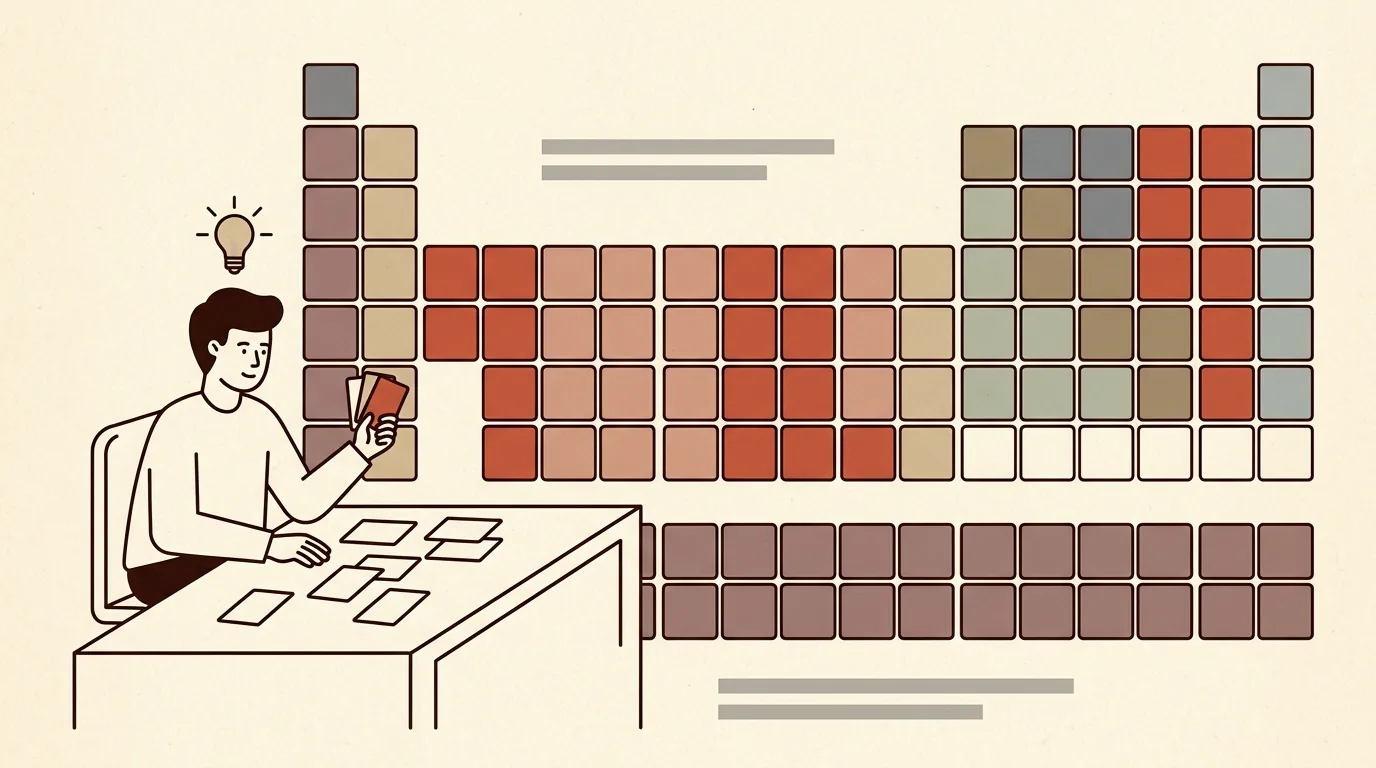
To memorize the periodic table, first decide how much of it you actually need. For a chemistry class that is usually the first 36 elements, hydrogen through krypton, with their symbols and their place in the table, not all 118 names. Learn those 36 in small chunks by period and group, save your memory hooks for the handful of symbols that don't match their English names (Na, K, Fe, Cu), test yourself instead of rereading, and spread the work over a week. Six short sessions and a final check will get you there, and a few spaced reviews afterward will keep it.
Most advice on this topic starts with a song or a 118-element story and never asks the obvious question: what is the table for? A chemistry student and a pub quiz regular need very different things. Get that part right and the job shrinks to something you can finish in a week of evenings.
Do you need all 118 elements, or the first 36?
The full table has 118 named elements. The last four, including oganesson at 118, had their names and symbols approved by IUPAC in November 2016, and the IUPAC periodic table page is the reference for the current, official version. So "the whole table" is a fixed and fairly large target.
Here is the honest split by goal:
| Your goal | What to learn | Rough size of the job |
|---|---|---|
| High school or intro college chemistry | Elements 1 to 36: name, symbol, position | One week of short sessions |
| Understanding trends (reactivity, ions, electron shells) | Elements 1 to 36 plus the group numbers | Same week, with the grid drawn out |
| A later course that uses heavier metals | The first 36, then the famous heavy ones (Ag, Sn, I, Pt, Au, Hg, Pb, U) | A second week of add-ons |
| A party trick or a timed full-table quiz | All 118 in order | Weeks, and a dedicated memory system |
The first 36 cover the first four rows of the table. That includes the elements in water, air, salt, sand, bones and steel, and the first full row of transition metals. For most coursework, knowing those cold is worth far more than a shaky recital of all 118. Everything below is built around that set, and the same method scales if you later want more.
How do you chunk the table by group and period?
Rows are called periods and columns are called groups. Since 1988, IUPAC has recommended numbering the groups simply 1 to 18, which is the numbering used here.
The periods give you your chunks, and they come in a pattern worth knowing: the first row holds 2 elements, the second 8, the third 8 and the fourth 18. Each row ends on a noble gas, so helium (2), neon (10), argon (18) and krypton (36) are your four anchor points. If you can place those four, you can count to any element in between.
The chunking map: elements 1 to 36
Symbols marked with an asterisk do not match their English names. Those are the only four in this set that need a memory hook. Everything else you learn by testing.
| Period | Group 1 | Group 2 | Groups 3 to 12 (transition metals) | 13 | 14 | 15 | 16 | 17 | 18 |
|---|---|---|---|---|---|---|---|---|---|
| 1 | H | He | |||||||
| 2 | Li | Be | B | C | N | O | F | Ne | |
| 3 | Na* | Mg | Al | Si | P | S | Cl | Ar | |
| 4 | K* | Ca | Sc, Ti, V, Cr, Mn, Fe*, Co, Ni, Cu*, Zn | Ga | Ge | As | Se | Br | Kr |
That grid breaks into six chunks, each small enough for one sitting:
- Period 1 and period 2 (10 elements): H, He, Li, Be, B, C, N, O, F, Ne. You already know half of these from everyday life.
- Period 3 (8 elements): Na, Mg, Al, Si, P, S, Cl, Ar. Say them as a run beside period 2 so each one sits under its partner (Na under Li, Cl under F).
- The start and end of period 4 (8 elements): K, Ca on the left; Ga, Ge, As, Se, Br, Kr on the right. Again, learn each one under the element above it.
- The first five transition metals: Sc, Ti, V, Cr, Mn.
- The last five transition metals: Fe, Co, Ni, Cu, Zn.
- Groups as columns: read each group top to bottom (Li, Na, K; F, Cl, Br; He, Ne, Ar, Kr) so you know the families, not just the rows.
Chunk 6 is what separates a memorized list from a usable table. When a question asks why sodium and potassium behave alike, the answer is that they sit in the same column, and you'll see it instantly.
Which symbols don't match their names, and how do you remember them?
Across the whole table, eleven common elements have symbols taken from an older name, mostly Latin, plus one German. Four of them fall inside the first 36; the other seven are heavy metals you'll meet later.
| Element | Symbol | Older name | Atomic number | In the first 36? |
|---|---|---|---|---|
| Sodium | Na | natrium | 11 | Yes |
| Potassium | K | kalium | 19 | Yes |
| Iron | Fe | ferrum | 26 | Yes |
| Copper | Cu | cuprum | 29 | Yes |
| Silver | Ag | argentum | 47 | No |
| Tin | Sn | stannum | 50 | No |
| Antimony | Sb | stibium | 51 | No |
| Tungsten | W | wolfram | 74 | No |
| Gold | Au | aurum | 79 | No |
| Mercury | Hg | hydrargyrum | 80 | No |
| Lead | Pb | plumbum | 82 | No |
Tungsten is the odd one out: the Royal Society of Chemistry notes that many European countries still call it wolfram, which is where the W comes from. Mercury's older name means "liquid silver".
Hooks work best when they link the symbol to something you already know:
- Fe: ferrous metals, the iron-based ones. "Ferrous wheel" if you want an image.
- Cu: a copper cup (Cu is a cup missing its P).
- Na: table salt is NaCl, sodium chloride. Think "Na, the salt one."
- K: the K in "kalium". Picture a banana, famous for potassium, bent into a K.
- Au: "Ay, you stole my gold!"
- Ag: "argentum" gave Argentina its name, the land of silver.
- Pb: plumbers, because old pipes were lead.
- Hg: "hydrargyrum", or just "Hot Gray liquid".
Write your own if these don't land. A hook you invented is easier to recall than one you read.
The look-alikes that cost more marks than the Latin
Inside the first 36, the bigger problem is often symbols that look too similar. These are the pairs to drill on purpose:
- Mg and Mn: magnesium (12) versus manganese (25). Magnesium is the lighter, earlier one.
- The C family: C, Ca, Cl, Cr, Co, Cu. Six symbols starting with C in 36 elements.
- S, Si, Sc, Se: sulfur, silicon, scandium, selenium.
- P and K: potassium is K, not P. P is phosphorus.
- Al and Ar: aluminum (13) and argon (18) sit in the same row.
- B, Be, Br: boron, beryllium, bromine.
If the session report keeps flagging the same pair, put the two cards next to each other and quiz only those until they separate.
Should you learn atomic numbers at all?
Yes, but not as a separate list. If you learn the elements in order within the grid above, you get the atomic numbers for free. Hydrogen is 1, and each step to the right adds one. The noble-gas anchors (2, 10, 18, 36) let you check yourself: magnesium is two after neon, so it's 12. Chlorine is one before argon, so it's 17.
Memorizing 36 numbers as isolated facts is the slow way. Counting from an anchor is the fast way, and it's also how you'll use the numbers later when you work out electron arrangements.
What does a one-week schedule look like?
Two principles drive the schedule. The first is testing rather than rereading. In a well-known study by Karpicke and Roediger published in Science, students who kept retrieving word pairs recalled about 80% of them a week later, while groups that stopped being tested on pairs they had already recalled managed 36% and 33%. Extra study of those pairs added almost nothing. The second is spacing: a review of the spacing-effect research describes it as repetitions spread out in time tending to produce stronger memories than repetitions massed together, a finding that goes back to Ebbinghaus in 1885.
So every session starts by testing the old chunks cold, then adds one new chunk.
| Day | New chunk | Warm-up (test first, no peeking) | Time |
|---|---|---|---|
| 1 | Periods 1 and 2 (H to Ne) | None | 10 to 15 min |
| 2 | Period 3 (Na to Ar) | Periods 1 and 2 | 15 min |
| 3 | Period 4 edges (K, Ca, Ga to Kr) | Periods 1 to 3 | 15 min |
| 4 | Transition metals Sc to Mn | Everything so far, plus the four Latin hooks | 15 to 20 min |
| 5 | Transition metals Fe to Zn | Everything so far | 15 to 20 min |
| 6 | Groups as columns, look-alike pairs | Full 36, name to symbol | 20 min |
| 7 | No new material | Full 36 in both directions, then a blank grid from memory | 20 min |
After day 7, run the full set again at roughly three days, a week and two weeks out. If you miss a day in the middle, don't restart. Pick up where you stopped and do the warm-up first. For more on setting review gaps around a real test date, see the spaced repetition schedule guide. The same block-by-block approach works for other big lists too, like the states and capitals in a week.
How do you test recall in both directions?
"Sodium" to "Na" and "Na" to "sodium" are different skills, and exams ask for both. Recognizing a symbol on the page is the easy direction. Producing it from the name, or placing it on a blank grid, is the hard one.
A simple three-part check for the end of each session:
- Name to symbol: see "manganese", say or write "Mn" before flipping.
- Symbol to name: cover the names on your grid and read the symbols back.
- Position: draw the empty four-row grid (2, 8, 8, 18) and fill in all 36 from memory.
Grade yourself honestly. "I sort of knew it" counts as a miss. The cards you mark as misses are exactly the ones worth another pass, and nothing else is.
The blank-grid test is the one that proves you know the table and not just a list. Once you can fill it in cleanly two sessions in a row, you're done with the first 36.
Try it on a real deck
The free Periodic Table flash cards cover exactly the first 36 elements: the name on the front, the symbol and atomic number on the back. You self-grade each card, missed cards come back at the end of the run, and the session report shows which ones you still need. No account, nothing to install.
For the symbol-to-name direction, make a reverse deck in the free builder with the 20 symbols you miss most (the free tier holds one deck of 20 cards, which is the right size for this). When the chemistry side feels solid, the science and nature quiz is a good mixed check.
FAQ
How long does it take to memorise the periodic table?
For the first 36 elements with symbols and positions, about a week of 15 to 20 minute sessions, followed by a few short reviews over the next couple of weeks. All 118 in order takes much longer and usually a dedicated memory system, and most students don't need it.
Do you need to memorise the whole periodic table for chemistry?
Usually not. Most courses expect you to know the common elements, mainly the first 36, and to read the rest from a provided table. What matters more is knowing where elements sit, because position explains behavior. Check your own course or exam guidance to confirm what you'll be given on test day.
What's the easiest way to remember element symbols?
Learn them in small chunks by row, test yourself instead of rereading, and only build memory tricks for the symbols that don't match their names. Most symbols are the first one or two letters of the name, so testing handles them. Hooks are for the exceptions and the look-alikes like Mg and Mn.
Which elements have symbols that don't match their names?
The common ones are sodium (Na), potassium (K), iron (Fe), copper (Cu), silver (Ag), tin (Sn), antimony (Sb), tungsten (W), gold (Au), mercury (Hg) and lead (Pb). All come from older names, mostly Latin; tungsten's W comes from wolfram. Only the first four fall within the first 36 elements.