
How to Memorize States and Capitals in a Week
By Mark Fulton · 2026-09-14 · 11 min read
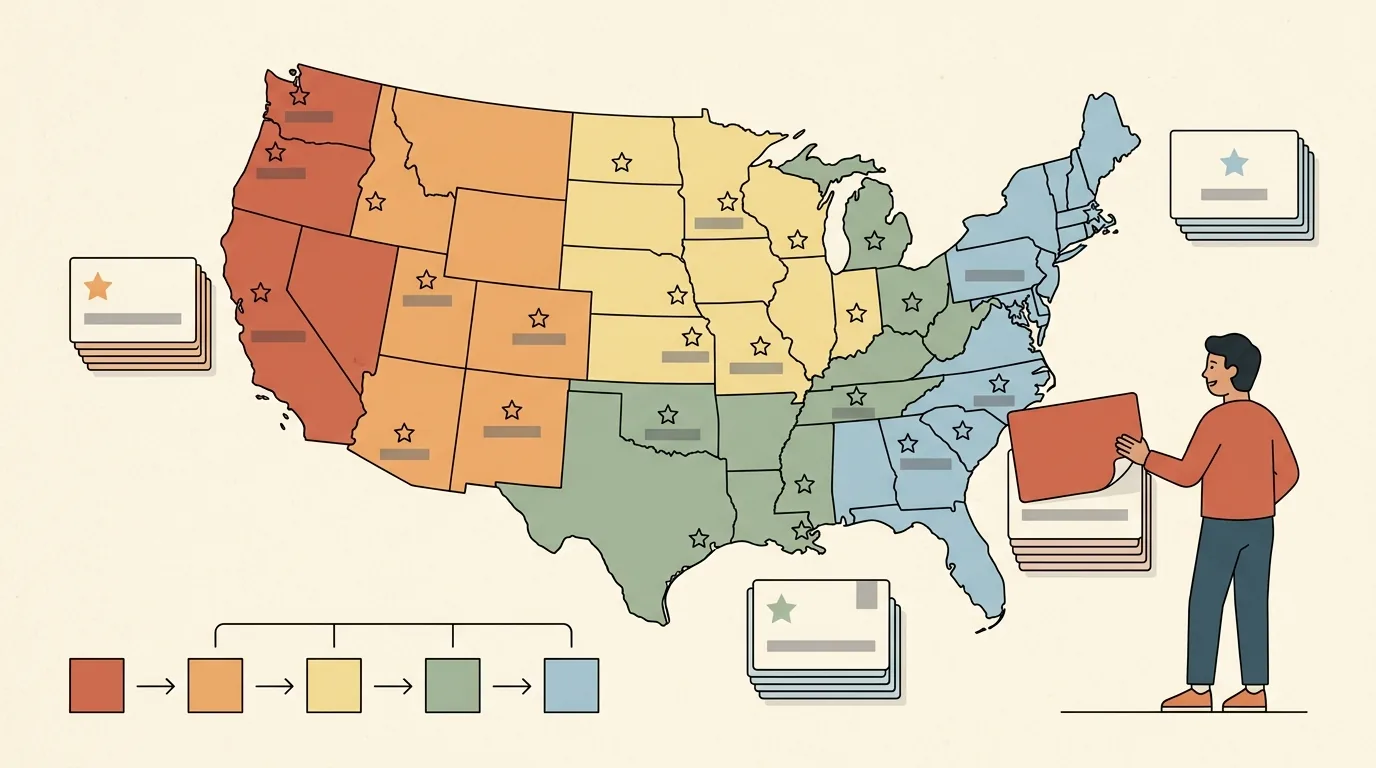
The fastest reliable way to memorize the states and capitals is to stop treating them as one list of 50. Split the states into five regional blocks of 8 to 13, learn one block a day by testing yourself rather than reading, start every session by recalling the earlier blocks cold, and save memory tricks for the dozen capitals that genuinely collide with a bigger or more famous city. Five short days covers all 50, a sixth day tests the whole set in both directions, and a few spaced check-ins over the next month keep them.
Fifty pairs is a small job. It feels big because most people attack it the way it is usually printed: an alphabetical table, Alabama to Wyoming, read top to bottom until it sticks. It rarely does. Here is the version that works, with the blocks, the schedule, and the twelve hooks worth your time.
Why does learning all 50 at once fail?
Three reasons, and none of them is a bad memory.
Alphabetical order puts unrelated states side by side. Eight states in a row start with M: Maine, Maryland, Massachusetts, Michigan, Minnesota, Mississippi, Missouri and Montana. They span the country from the Atlantic to the Rockies, and their capitals have nothing in common. A list in that order gives your memory nothing to hold on to except the letter M, which is exactly the thing they all share.
Reading feels like learning when it isn't. You look at "Pennsylvania, Harrisburg", you nod, and the next row is already in view. Recognizing a pair on the page is a much easier skill than producing Harrisburg when someone says Pennsylvania. That gap is not a hunch. In a well-known study published in Science, students who kept being tested on word pairs they had already recalled correctly remembered about 80% of the pairs a week later, against 36% and 33% for the groups that stopped being tested, and extra study of pairs already recalled produced no measurable gain. Re-reading a capitals table is the extra-study arm.
Most of the list is easy, so the hard ones hide. Nobody needs a trick for Oklahoma City or Indianapolis. The trouble comes from roughly a dozen pairs where the capital is not the city you would guess. In one long list, those dozen get the same attention as the 38 easy ones, and they keep failing.
How should the states be chunked?
By region, because neighbours on a map give each capital a place to live. The US Census Bureau already groups the states into four official regions and nine divisions: Northeast, Midwest, South and West. The South is the largest at 16 states, so it splits cleanly along the Bureau's own division lines into an Atlantic block and an inland block. That gives five blocks, none bigger than 13.
The starred capitals are the twelve that get a memory hook in the next section.
Block 1: Northeast (9)
| State | Capital |
|---|---|
| Connecticut | Hartford |
| Maine | Augusta * |
| Massachusetts | Boston |
| New Hampshire | Concord |
| New Jersey | Trenton |
| New York | Albany * |
| Pennsylvania | Harrisburg * |
| Rhode Island | Providence |
| Vermont | Montpelier |
Block 2: Atlantic South (8)
| State | Capital |
|---|---|
| Delaware | Dover |
| Maryland | Annapolis |
| Virginia | Richmond |
| West Virginia | Charleston * |
| North Carolina | Raleigh |
| South Carolina | Columbia * |
| Georgia | Atlanta |
| Florida | Tallahassee |
Block 3: Inland South (8)
| State | Capital |
|---|---|
| Kentucky | Frankfort * |
| Tennessee | Nashville |
| Alabama | Montgomery |
| Mississippi | Jackson |
| Arkansas | Little Rock |
| Louisiana | Baton Rouge |
| Oklahoma | Oklahoma City |
| Texas | Austin |
Block 4: Midwest (12)
| State | Capital |
|---|---|
| Illinois | Springfield * |
| Indiana | Indianapolis |
| Iowa | Des Moines |
| Kansas | Topeka |
| Michigan | Lansing |
| Minnesota | Saint Paul |
| Missouri | Jefferson City |
| Nebraska | Lincoln |
| North Dakota | Bismarck |
| Ohio | Columbus |
| South Dakota | Pierre * |
| Wisconsin | Madison |
Block 5: West (13)
| State | Capital |
|---|---|
| Washington | Olympia * |
| Oregon | Salem * |
| California | Sacramento * |
| Nevada | Carson City * |
| Idaho | Boise |
| Montana | Helena |
| Wyoming | Cheyenne |
| Utah | Salt Lake City |
| Colorado | Denver |
| Arizona | Phoenix |
| New Mexico | Santa Fe |
| Alaska | Juneau |
| Hawaii | Honolulu |
Notice how many capitals carry their state's name or a clue to it: Oklahoma City, Indianapolis, and Salt Lake City in the state with the Great Salt Lake. Those take care of themselves. Spend nothing on them.
Which capitals actually need a mnemonic?
The ones where a bigger, more famous, or same-named city gets in the way. A hook costs effort to build and is one more thing to remember, so it only pays on a pair you would otherwise keep getting wrong. These twelve fall into two kinds of trap: the famous city is not the capital, or the capital's name belongs to a better-known place somewhere else.
| State | Capital | The trap | The hook |
|---|---|---|---|
| New York | Albany | New York City | The city gets the skyline. The state sends ALL its Bills to ALbany. |
| Pennsylvania | Harrisburg | Philadelphia, Pittsburgh | Two famous P cities argue, and Harrisburg holds the capital between them. |
| Maine | Augusta | Augusta, Georgia; Portland | Georgia's Augusta has the golf. Maine's Augusta has the capitol. Georgia's capital is Atlanta. |
| West Virginia | Charleston | Charleston, South Carolina | The Charleston swap: the famous one is in South Carolina, the capital one is in West Virginia. |
| South Carolina | Columbia | Columbus, Ohio | CarolinA ends in A, and so does ColumbiA. Ohio keeps ColumbUs. |
| Kentucky | Frankfort | Louisville, Lexington | Louisville gets the Derby. Frank guards the fort, and the capital is inside it. |
| Illinois | Springfield | Chicago | Lincoln lived in Springfield, Illinois. Nebraska named its capital after him: Lincoln. |
| South Dakota | Pierre | Sioux Falls | Say it "peer". The Dakotas stack: Bismarck on top in the North, Pierre below in the South. |
| Washington | Olympia | Seattle; Washington, DC | The Olympic Mountains are in Washington state, and so is Olympia. |
| Oregon | Salem | Portland; Salem, Massachusetts | The famous Salem is in Massachusetts. The capital Salem is in Oregon. Neither Portland is a capital. |
| California | Sacramento | Los Angeles, San Francisco | No beach, no Hollywood. The capital is sacked inland to Sacramento. |
| Nevada | Carson City | Las Vegas, Reno | Vegas has the cars on the Strip. Carson City has the Car in its name. |
Three of these hooks do double duty. Augusta also fixes Georgia, Columbia also fixes Ohio, and Springfield also fixes Nebraska. That is why they earn a place.
If a different capital keeps failing for you, Montpelier and Tallahassee are the usual next candidates. Build it a hook of your own on the day it misses twice. Your own hook, made from something you already know, will beat anyone else's.
What does a five-day schedule look like?
One block a day, fifteen minutes or so, in the same order every session: old blocks first, cold, then the new block.
| Day | Warm-up (cold, no peeking) | New block | Hooks to learn |
|---|---|---|---|
| Day 1 | None | Northeast (9) | Albany, Harrisburg, Augusta |
| Day 2 | Northeast | Atlantic South (8) | Charleston, Columbia |
| Day 3 | Northeast, Atlantic South | Inland South (8) | Frankfort |
| Day 4 | All three earlier blocks | Midwest (12) | Springfield, Pierre |
| Day 5 | All four earlier blocks | West (13) | Olympia, Salem, Sacramento, Carson City |
| Day 6 | All 50, mixed, state to capital, then capital to state | None | Re-drill every miss |
| Day 7 | Only the misses from Day 6 | None | Build a new hook for any pair that missed twice |
The order follows the map rather than difficulty: down the Atlantic coast, inland across the South, up through the Midwest, then out West. Each new block borders one you already know, so every capital lands next to something familiar. The West goes last because it is the biggest block and holds the most traps, and by Day 5 you are practised at the routine.
Inside each new block, the routine is short. Read the pairs once with the hooks. Then close the table and go through the block as flash cards, state on the front, saying the capital out loud before you flip. Anything you miss comes back around until you get it. A pass over ten cards takes a minute or two, which is why a whole day's session fits in a quarter of an hour.
The warm-up is the part people skip, and it is the part that does the work. By Day 5 the warm-up covers 37 states you learned earlier in the week, and recalling them without looking is exactly the repeated testing that held up at a week's delay in the study above.
How do you test yourself honestly?
Four rules keep the score meaningful.
Say the answer before you flip. Out loud or written down. "I knew that" after seeing the back of the card is recognition, and it will flatter you every time.
Grade the first attempt only. If you had to think for several seconds, or you said Portland and then corrected to Salem, it is a miss. A pair you got on the second try is a pair you do not know yet.
Test both directions on Day 6. State to capital is the common quiz direction. Capital to state is harder and catches the swaps: say "Charleston" and you should produce West Virginia, not South Carolina. For the reverse pass, write the 50 capitals on a sheet in a shuffled order and name each state.
Keep the misses as a list, not a feeling. Write down exactly which pairs failed. Your list after Day 6 is the whole plan for Day 7, and it is usually short.
How do you keep them a month later?
Space the check-ins out. Learning all 50 in a week is the easy part. Keeping them is a question of coming back after gaps that get longer each time. The UNC Learning Center describes this as distributed practice, spacing study over several short periods across days and weeks, and recommends reviewing flash cards periodically rather than in one long memorization session.
A plan that fits the week above:
- Day 10: one full mixed pass of all 50, first-try grading.
- Day 17: another full pass. Re-drill only the misses.
- Day 30: a full pass in both directions.
Each pass takes about ten minutes. A pair that fails at one of these check-ins goes back into a short daily drill until it comes back clean, then rejoins the longer gaps. If you want the logic behind picking those gaps, the spaced repetition schedule guide walks through building one around a date, and the Leitner system is a simple box method for sorting the pairs you know from the ones still failing.
Once the states hold, the same regional approach works for the rest of the map. The free World Capitals deck runs 45 national capitals as self-graded cards, and the World Geography Trivia Quiz mixes in rivers, mountains and borders.
Frequently asked questions
How long does it take to memorise all 50 state capitals?
Split into regional blocks, the learning takes five short sessions of around fifteen minutes each, plus a sixth day to test the full set in both directions. The honest variable is the dozen tricky pairs, not the other 38. Many people know a good share of the easy ones already, which shortens the early blocks. Keeping them long term takes a few spaced passes over the following month, each about ten minutes.
What's the easiest way to learn states and capitals?
Learn them by region, one block at a time, and test yourself instead of reading. Saying each capital before you check it, grading only your first attempt, and starting every session by recalling the earlier blocks without looking will do more than any song or trick. Save memory hooks for the capitals that clash with a bigger or better-known city.
Which state capitals are hardest to remember?
The ones where a famous city gets in the way or a name belongs to somewhere else. Albany (not New York City), Sacramento (not Los Angeles), Springfield (not Chicago), Harrisburg (not Philadelphia), Olympia (not Seattle) and Carson City (not Las Vegas) are the big-city traps. Charleston, Columbia, Augusta and Salem are name collisions. Pierre and Frankfort round out the list because the larger cities in their states are far better known.
What order should you learn the states in?
Geographic order, one region at a time, not alphabetical. Alphabetical order lines up states like the eight that start with M, which sit in completely different parts of the country and give your memory nothing to connect. Following the map, with each new block bordering one you already know, lets every capital land next to something familiar. Starting with the region you live in is a sensible alternative if it is the one you already half know.
Start Day 1 tonight. Open the free US State Capitals deck, no account needed, and run it once to see where you stand. You flip each state, grade yourself honestly, and any card you mark "still learning" comes back before the run ends. The session report lists exactly which capitals are still to learn, with a button to study just those, so Day 7 builds itself.