
Question Games for Couples
By Mark Fulton · · 5 min read
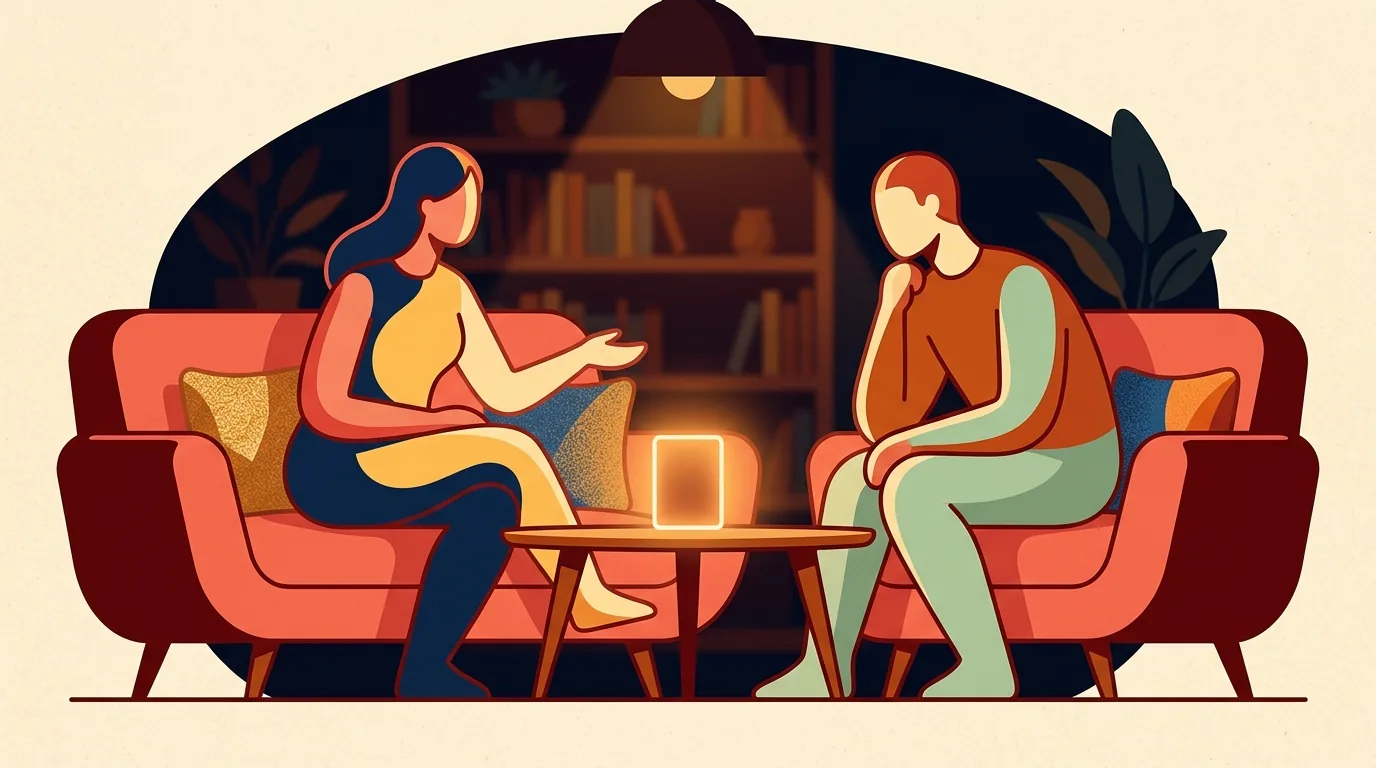
Every long relationship converges on the same six conversations: logistics, dinner, work, the group chat, the thing one of you forgot, and "how was your day" answered on autopilot. This isn't a failure of love. It's a failure of prompting. Two people who live together stop asking discovery questions because the discovery feels finished, and it never actually is.
Question games fix the prompting problem with almost embarrassing efficiency. A card asks the thing neither of you would think to ask, and suddenly you're hearing a story from before you met, or an opinion your partner formed last month and never mentioned. The card takes the blame for the question being unusual, which frees both of you to actually answer it.
Why a game works when "let's talk more" doesn't
Resolving to have deeper conversations is like resolving to be more spontaneous: the intention dissolves on contact with a normal Tuesday. A deck of questions works because it removes the two real obstacles:
Someone has to think of the question. After years together, your question-generating machinery goes quiet. The deck is an external generator that never runs dry and never defaults to logistics.
Someone has to risk asking it. "When do you feel closest to me?" is a lovely question that almost nobody asks cold, because asking it cold feels loaded. When a card asks, it's the game's question. The stakes drop, and the honesty rises to fill the space.
There's also a fairness mechanism built in: both people answer every card. No interviewer, no witness stand. That symmetry matters more than it sounds: the game fails fast if one person is mining and the other is deflecting.
There's an actual experiment behind this
The idea that a structured question list generates closeness is not folk wisdom. It was tested.
In 1997, Arthur Aron and colleagues published The Experimental Generation of Interpersonal Closeness in Personality and Social Psychology Bulletin. Pairs of strangers spent 45 minutes working through 36 questions that escalate in intimacy across three sets. A control group spent the same 45 minutes on 36 superficial small-talk questions. The structured-question pairs reported significantly greater closeness afterward.
Two design details from that study transfer directly to a couples deck, and they're the reason a deck beats a resolution to "talk more":
- The escalation is deliberate. The questions are ordered in three sets of increasing intensity. You don't open with the hard one. You earn it.
- Reciprocity is enforced. Both people answer every question. The disclosure is mutual by construction, not by good manners.
One honest caveat, because the study is usually quoted without it: Aron's later studies in the same paper found no significant closeness effect from matching pairs on attitudes, from expecting mutual liking, or from making closeness an explicit goal. What worked was the escalating, reciprocal questions themselves, not the framing around them. Which is a useful warning against announcing "let's do something to feel closer tonight" before you deal the first card.
What a good couples question looks like
Having written a few hundred of these for the decks on this site, I can report the pattern. A good couples question:
- Has no right answer. "What's a tradition we should invent?" opens territory. "Do you love me?" closes it.
- Produces information. The best cards end with one partner saying "I didn't know that." Questions both of you can already answer for each other are warm-up, not payload.
- Reaches backward or forward. The daily middle is well-covered by normal life. Cards about the early days ("what was your honest first impression of me?") or the future ("where do you hope we are in five years?") go where ordinary conversation doesn't.
- Leaves the depth dial with the answerer. A question like "what's something you want to be asked about more?" can be answered lightly or seriously. Cards that demand vulnerability get walls; cards that invite it get doors.
How to actually run this at home
The failure mode is turning date night into a structured interview with agenda items. Avoid that with four habits:
Three cards, not thirty. One question given ten minutes beats ten questions given one. When a card opens something real, abandon the deck and follow it. That's the deck succeeding.
Answer second, listen first. Whoever didn't draw the card answers first; the drawer answers after, without rebutting anything they just heard. Curiosity first, response later. This one rule prevents most of the ways these games can go sideways.
Pick the register on purpose. There are date-night questions and there are 11pm questions, and they don't mix well. The free couples deck is built for the first: playful, warm, occasionally deep. The premium Closer deck is built for the second: slower questions about trust, wants, and the interior stuff, still tasteful throughout. Know which evening you're having.
Let silence work. The pause after a real question isn't awkwardness; it's the other person deciding to answer honestly. Filling that pause is the most common way partners accidentally buy the shallow answer.
When it's especially worth doing
Couples reach for question decks at predictable moments, and the moments are telling: long drives, when the phone-scrolling-in-parallel evenings start outnumbering the talking ones, early in a relationship when everything is discovery anyway, and (more touchingly) deep into one, when someone realizes they've stopped being curious about the person across the table and wants the curiosity back.
It's also the cheapest date upgrade in existence. A deck on a phone turns a mediocre restaurant into a good evening, and a good couch into a better one. No booking, no babysitter math changed. Same night, better conversation.
The honest pitch for couples question games isn't that they're profound. It's that they're a small, repeatable ritual that keeps two people interviewing each other on purpose, years after they've technically run out of official reasons to. The people we love keep changing. The questions are how you keep up.
Sources
- Aron, Melinat, Aron, Vallone & Bator, The Experimental Generation of Interpersonal Closeness: A Procedure and Some Preliminary Findings, Personality and Social Psychology Bulletin, 23(4), 1997