
First Date Questions That Aren't an Interview
By Mark Fulton · · 14 min read
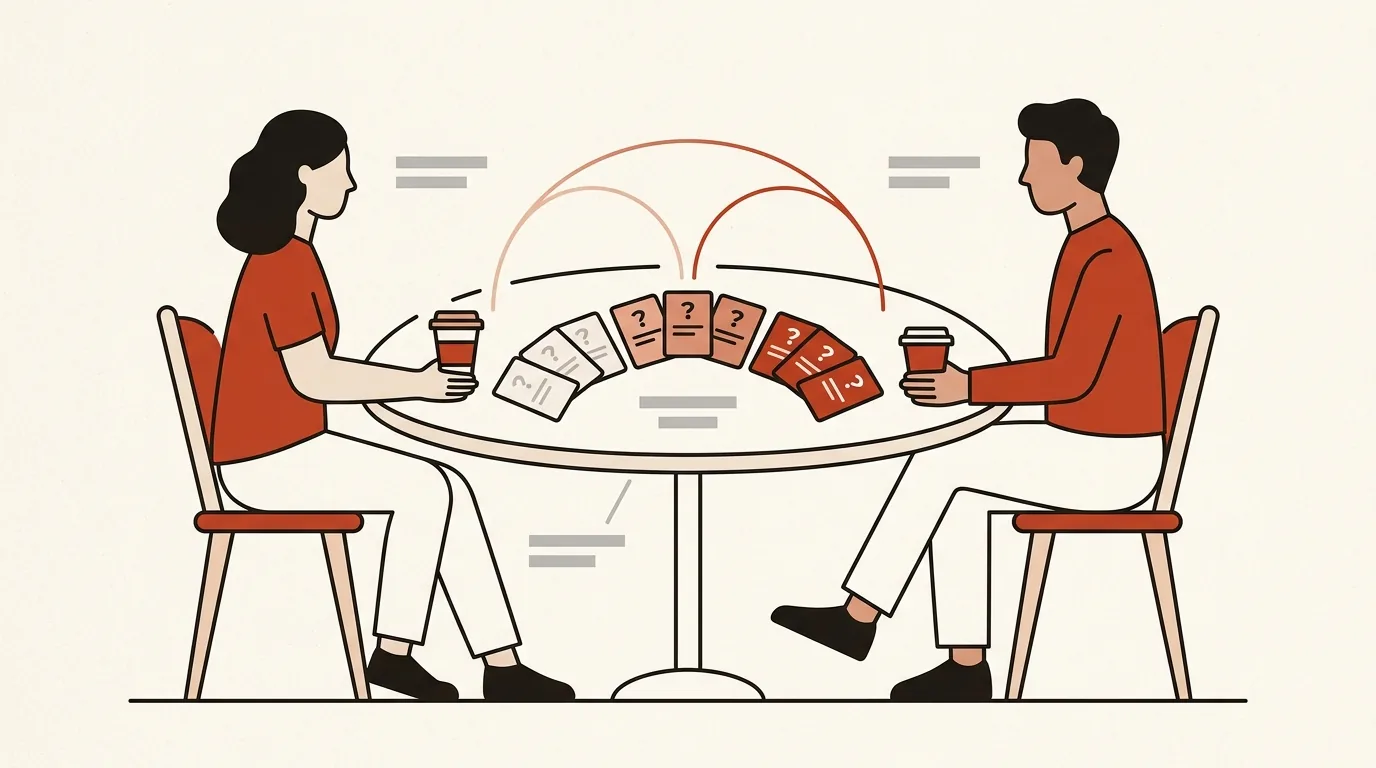
The best questions to ask on a first date are not a list you work through. They come in three tiers: light openers that are easy to answer, middle questions that reveal how someone actually lives, and a small number of deeper ones you earn later in the evening. The rule that matters more than the questions themselves: ask one, then follow the answer for two more turns before you spend another. A date that gets four questions and twelve follow-ups feels like a conversation. A date that gets sixteen questions and no follow-ups feels like a screening call, and everybody can tell the difference.
Nobody actually runs out of questions on a first date. You can find five hundred of them in ten seconds. What goes wrong is the delivery: a question gets asked, an answer arrives, and instead of picking up the thread, the asker reaches for the next question. Two people can do this to each other for ninety minutes and leave knowing each other's job title, hometown, sibling count, and nothing else. For a short stack to glance at beforehand, the free deck of first date questions deals one card at a time.
Why do first date questions make dates feel like interviews?
Because a question is a turn-taking device, and most people use it as a topic-changing device.
In a normal conversation between friends, a question is followed by an answer, then by a reaction to the answer, then by a related question that could only have been asked because of what was just said. The chain is what makes it feel like talking. On a first date, nerves compress that chain to a single link. You ask, they answer, and while they are answering you are quietly preparing the next question instead of listening to the one you already asked.
There is decent evidence that the follow-up is the part doing the work. In a set of studies on live conversations published in the Journal of Personality and Social Psychology, Karen Huang and colleagues at Harvard found that people who ask more questions, and follow-up questions in particular, are better liked by their conversation partners. They then trained a natural language algorithm to detect follow-up questions and ran it over face-to-face speed dating transcripts: speed daters who asked more follow-up questions were more likely to get agreement to a second date. The same paper found that people do not expect this. Asking questions is undervalued by the person deciding whether to ask.
That is the whole strategy in one line. Fewer questions, more follow-ups. Everything below is organised around making that easy to do under pressure.
What should the first twenty minutes sound like?
Light, specific, and mostly about the last week rather than the last decade. The opening job is not to gather information. It is to establish that answering you is enjoyable, so that a real answer feels safe forty minutes later.
Good openers share three traits. They are impossible to answer wrong. They can be answered in one sentence by a nervous person or in five by a relaxed one. And they hand back something concrete to grab onto.
Here are fifteen, each with the follow-up that does the actual work.
| Tier 1: open a thread | The follow-up |
|---|---|
| What did your day look like before you got here? | Is that a normal Tuesday for you? |
| How did you end up living here? | Would you move again? |
| What's something you've taken up recently that you're still bad at? | What made you try it? |
| What's the last thing you looked up because you genuinely wanted to know? | Did you get an answer, or is it still open? |
| What's the most useless thing you're excellent at? | Where does someone even learn that? |
| What did nine-year-old you want to be? | What did that kid get right about you? |
| Where would you take someone visiting for the first time? | What do you order when you go? |
| What's the best thing you've watched or read this month? | What made it stick? |
| What's something your family does that you assumed everyone did? | When did you find out they didn't? |
| What's your least defensible opinion about food? | Who have you had this argument with? |
| What's the longest you've gone without your phone? | Was it awful or great? |
| What are you looking forward to in the next month? | Who are you doing it with? |
| What's the strangest job you've had? | What did it actually teach you? |
| What do you do with an unexpected free hour? | When did you last get one? |
| What's something you own that you'd be irrationally upset to lose? | How did you end up with it? |
Notice that none of them are "so what do you do." That question is not banned, it is just weak. It produces a job title, and a job title produces a follow-up about the job, which is the least distinctive hour of most people's week. If you want to get at work, ask what the good day looks like rather than what the role is called.
Which questions move a conversation from small talk to real?
The escalation should be deliberate rather than accidental. That structure is not a made-up rule. The best known question set in psychology, Arthur Aron's closeness procedure from 1997, is built as three sets of twelve questions that grow progressively more intense, with participants free to reveal only what they are comfortable revealing. Worth knowing, since it gets misquoted constantly: the procedure was designed to generate interpersonal closeness in a lab, not to make people fall in love, and Elaine Aron has said so directly. Escalating structure is the transferable part. Nothing else about it is a promise.
Tier two is where a date stops being pleasant and starts being interesting. These are still safe questions. They just ask about how a person chooses rather than what they have.
| Tier 2: reveal how they live | The follow-up |
|---|---|
| What have you changed your mind about in the last few years? | What changed it? |
| What kind of tired do you actually enjoy? | When did you last feel it? |
| Who taught you the most about doing your job? | What did they actually say? |
| What do you spend money on that other people think is a waste? | What do you refuse to spend on? |
| What's a rule you keep that nobody asked you to make? | What happens when you break it? |
| What does a good week look like when nothing special happens? | How often do you get one? |
| Which friendship have you kept the longest, and how? | When did you last see them? |
| What do people get wrong about you at first? | Does it bother you or is it useful? |
| What's the bravest thing you've done that didn't look brave? | Would you do it again? |
| What did you take from where you grew up that you'd keep? | What did you leave behind? |
| What are you working on that has no deadline? | Where did it start? |
| What's a compliment you don't believe? | What's one you do? |
| What was the last thing that made you laugh out loud on your own? | Did you send it to anyone? |
| What would you do with a free year and enough money? | What's the small version you could do now? |
| What skill would you learn if it took a week instead of ten years? | Why that one? |
Tier three is not a section you move to. It is a handful of questions you spend one at a time, late, when the conversation has already gone somewhere honest on its own. Two of these in an evening is plenty. Five would be a lot, and ten would be an ambush.
| Tier 3: spend one at a time | The follow-up |
|---|---|
| What are you proud of that isn't on any CV? | Who knows about it? |
| When did you last surprise yourself? | What did you take from it? |
| What do you need from people that you're bad at asking for? | Has anyone ever just guessed? |
| What was your hardest year, and what got you through it? | What would you tell that version of you? |
| What's a decision you're still not sure about? | What would make it clearer? |
| Where do you feel most like yourself? | Who's usually there? |
| What do you want more of in the next five years, and less of? | Which one is harder? |
| Who do you call when something good happens? | And when something bad does? |
| What do you believe now that would have annoyed you at twenty-two? | What convinced you? |
| What's something you used to want that you're relieved you never got? | When did you realise? |
If you are hesitating over tier three because it feels like too much for a first date, the research points the other way. Michael Kardas, Amit Kumar and Nicholas Epley ran a long series of experiments on strangers having assigned shallow or deep conversations and found that the deeper conversations felt less awkward and produced more connection than participants predicted. People systematically overestimated the awkwardness of depth, mostly because they underestimated how much the other person would care about what they said. The barrier is a forecasting error, not a real wall.
That said, the finding is about willingness to go deep, not about speed. Tier three still comes after tier one and two, for the same reason the closeness procedure is ordered.
What should you not ask on a first date?
Shorter list than the question banks, and more useful. These do reliable damage:
- Anything about an ex. Yours or theirs. It has no good version in the first two hours. The person who answers honestly loses, and the person who deflects looks evasive.
- Income, rent, or what things cost. Money questions early read as an audit no matter how casually they are phrased.
- "So what are you looking for?" in minute four. This is a reasonable question on date two or three. Asked before you know anything, it demands a policy statement from someone who has met you once.
- Marriage and children timelines. Same problem, higher stakes. If it is a genuine dealbreaker for you, it is still better asked once there is something to break.
- Sexual history in any counted form. Not curiosity, arithmetic.
- Weight, food restriction, or anything about their body. Includes the compliment version.
- "Why are you still single?" There is no answer that improves the evening.
- Politics or religion used as a test in the first hour. Discussing them is fine when they come up naturally. Screening with them turns a date into an intake form.
- Trauma as an icebreaker. "What's your biggest fear" and "what's your worst memory" are tier three questions wearing tier one clothes. They ask a stranger to be vulnerable on demand.
- Anything already on their profile. Asking what you could have read tells them you did not.
- Follow-ups after a visible deflection. If someone answers short and changes the subject, that is a door closing politely. Let it close. You can knock again in a month.
One more that is less obvious: avoid stacking two questions into one. "Do you have siblings, and are you close with them?" gives the other person permission to answer only the easy half, and they will.
How do you answer your own question well?
Asking well is half of it. The other half is being worth asking.
Answer at the depth you asked. If you asked a tier two question and got a real answer, do not respond to it with a one-liner. Mismatched depth is how people conclude that the other person is guarded, and it is usually just nerves.
Answer second, not first. Let them go first on a question you introduced, then answer it yourself without contradicting anything they just said. If you answer first you set the ceiling, and most people will not go above it.
Be specific instead of impressive. "I got really into bread last winter and I'm still bad at it" is more interesting than a list of countries you have been to. Specific details give the other person something to grab. Impressive summaries give them nothing to say except a compliment.
Do not audit their answer. The fastest way to end honest disclosure is to evaluate it. "Huh, interesting" and a follow-up question is almost always the right move, even when you disagree.
What do you do when the answers stay short?
Diagnose before you escalate. Short answers usually mean one of three things, and they need different responses.
They are nervous. The tell is that answers are short but the body language is engaged, and they ask you things back. Fix it by going lighter, not heavier. Drop to tier one, offer a longer answer of your own first, and give it fifteen minutes. Most first dates warm up on a delay.
The setting is wrong. A loud bar, a film, a table where you are sitting side by side facing a wall. Nobody opens up while shouting. Change the venue rather than the questions. "Do you want to walk somewhere quieter" fixes more dead conversations than any question ever written.
They are not interested. Short answers, no reciprocal questions, phone checks. This is information, not a puzzle to solve. Finish the drink, be gracious, go home. A date that ends politely at fifty minutes is a fine outcome and much better than two hours of you interviewing someone who has already decided.
The failure to avoid in all three cases is speeding up. When a conversation stalls, the instinct is to fire questions faster, which is exactly what turns it into an interview and confirms whatever the other person was already feeling. Slow down instead. Ask one question, then genuinely follow it.
If you want the questions on a surface that hands you one at a time instead of a scrollable list, the First Date Questions deck is free, has fifty cards, and needs no account. Skim a few before you go, keep three in your pocket, and use the rest as a rescue kit for the first silence. Hearting the ones that landed saves them in your browser, which is more useful than it sounds when you are trying to remember what you actually talked about. If a second and third date happen, the free couples deck picks up where the first-date register stops, and question games for couples covers how to run one without it feeling staged.
FAQ
What are good first date questions?
The good ones are easy to answer, impossible to answer wrong, and specific enough to hand back a thread. "What's the most useless thing you're excellent at" works because it invites a story and cannot be failed. "What did nine-year-old you want to be" works because it reaches into a period nobody is currently defensive about. What makes them work is less the wording than the position: light questions early, questions about how someone chooses in the middle, and the deeper ones only after the conversation has already gone somewhere honest by itself. And every one of them is worth roughly two follow-ups before you move on.
What questions should you avoid on a first date?
Exes, income, sexual history in counted form, body and weight, "why are you still single", marriage and children timelines, "what are you looking for" asked in the first ten minutes, politics used as a screening test, and anything they already wrote on their profile. Also avoid the trauma questions dressed up as icebreakers, like biggest fear or worst memory, which ask a stranger for vulnerability before there is any reason to give it. If a topic gets a short answer and a subject change, that is a boundary. Respect it the first time and it stays available later.
How many questions is too many on a date?
There is no number, but there is a ratio. If you are asking a new question every two or three minutes, it is an interview regardless of how good the questions are. A ninety-minute date that covers six or seven questions properly, with real follow-ups and your own answers in between, will feel fuller than one that covers thirty. Prepare more than you need and plan to use a fraction. The extras are insurance against silence, not an agenda to complete.
What do you talk about when a first date goes quiet?
First work out which kind of quiet it is. If they are nervous, go lighter and answer something at length yourself so the pressure moves off them. If the room is loud or the seating is bad, move: suggesting a walk somewhere quieter rescues more conversations than any question. If they are genuinely not interested, read it and end the evening kindly rather than working harder. When you do restart, restart on something small and present rather than something large and abstract. What they did earlier that day, the thing on the wall, the drink in front of them. Small and concrete restarts a conversation. Big and abstract restarts the interview.