
How Many Flash Cards a Day? Do the Time Math
By Mark Fulton · · 12 min read
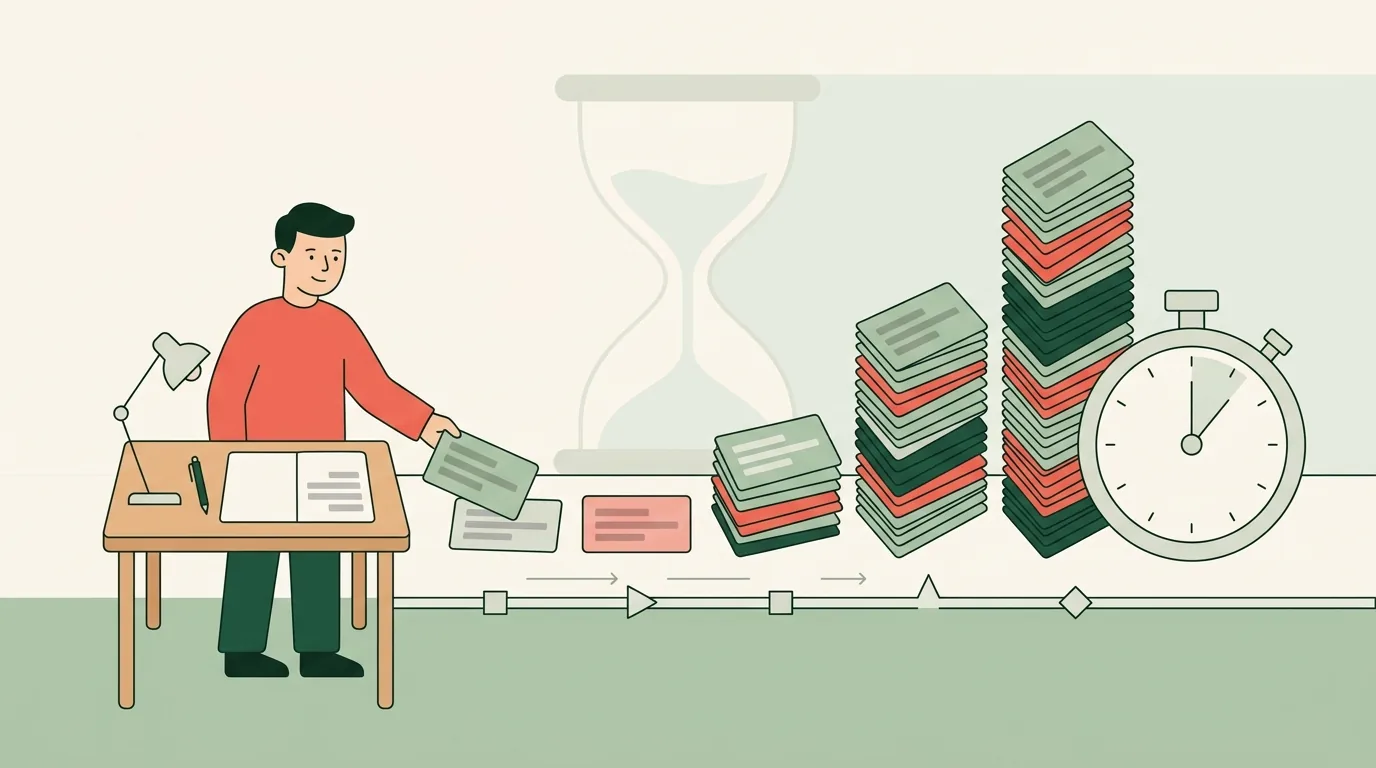
There is no correct number of flash cards per day, and any page that hands you one is guessing. What you can calculate is your own number. Take the cards that will be due, multiply by your own seconds per card, and you have the minutes the day will cost you. Then work backwards from the minutes you are actually willing to spend. As a starting point that most people can hold for a whole term, 10 to 25 new cards a day settles into roughly 50 to 125 cards touched daily once the reviews catch up, which is somewhere between 8 and 25 minutes at a middling pace. Start low, time one real session, and adjust from your own measurement instead of somebody else's recommended range.
The rest of this is the arithmetic, including the part almost nobody shows you: new cards are not a one-off cost. Each one you add today buys you several reviews over the next fortnight. That is why adding 100 cards on a Sunday feels fine on Sunday and feels impossible by Thursday.
Why is there no universal right number?
Because the number is an output, not an input. Three things decide it, and all three are yours.
The first is how long a card takes you. A multiplication fact you either know or you do not takes about two seconds. A Spanish word with a gendered article takes maybe six. A biochemistry pathway card with four blanks on it can take forty. Same "one card", twenty times the cost.
The second is how many cards are due, which is not the same as how many cards you own. A 500 card deck does not mean 500 reviews. On a spaced schedule most of the deck is asleep on any given day. What you meet each morning is a slice, and the size of that slice is set by how fast you have been adding.
The third is the time you will genuinely give it. Not the time you intend to give it in the optimistic version of your week. The time that survives a bad night's sleep and a lab report due Friday. A plan built on your best day is a plan that breaks on your average day.
Any advice that skips all three and lands on "review 60 to 150 cards a day" is really saying "here is a number that sounds plausible." It might be right for you by coincidence. You have no way to tell, which makes it useless as a plan.
How do you measure your own seconds per card?
Do one timed session and divide. That is the whole method.
Pick a deck you would actually study, run it straight through without pausing to look things up, and note two numbers at the end: how many cards you got through, and how long it took. Divide the seconds by the cards. That is your rate.
If you study on QuestionCard, the report at the end of a session hands you both numbers directly. Finish a run on multiplication flash cards or US state capitals and the summary shows cards studied, the percentage you knew on the first try, and the total time on the clock. Divide the time by the cards studied and you have your seconds per card for that deck, measured rather than assumed. Every study deck on the site is free to play with no account, so this costs you nothing but the session itself.
Two things worth knowing before you trust the number:
Measure per deck, not once. Your rate on vocabulary and your rate on formula cards will not match. If you study three subjects, you have three rates.
Measure a normal session, not a heroic one. Time a day where you are tired, because that is the day the schedule has to survive.
Once you have a rate, every question about daily volume becomes division. Fifteen minutes is 900 seconds. At 8 seconds a card that is about 112 cards. At 20 seconds a card it is 45. Same fifteen minutes, wildly different card counts, and neither of them is the "right" number for anyone but you.
How do new cards compound into future reviews?
This is the part that catches people out, so let us build it explicitly.
Assume a simple interval ladder: a card you learn today comes back tomorrow, then about three days later, then about a week later, then about a fortnight later. That is four reviews in its first two weeks. This is a modelling assumption, not a measurement. Real schedulers space cards differently, and cards you keep failing come back more often. But the shape is right, and the point of the model is the shape.
Now add 25 new cards every day and watch what the ladder does. Each row below is 25 new cards plus whatever earlier batches have come due.
| Day | Reviews due | New cards | Cards touched |
|---|---|---|---|
| 1 | 0 | 25 | 25 |
| 2 | 25 | 25 | 50 |
| 3 | 25 | 25 | 50 |
| 4 | 50 | 25 | 75 |
| 5 | 50 | 25 | 75 |
| 6 | 50 | 25 | 75 |
| 7 | 50 | 25 | 75 |
| 8 | 75 | 25 | 100 |
| 10 | 75 | 25 | 100 |
| 12 | 75 | 25 | 100 |
| 14 | 75 | 25 | 100 |
| 15 | 100 | 25 | 125 |
Day one costs you 25 cards. Day fifteen costs you 125. You did not change your habit at all. The habit compounded.
The arithmetic behind it is simple enough to redo with your own ladder. On any given day, the reviews due are the batches you introduced one day ago, three days ago, seven days ago and fourteen days ago. Early on some of those batches do not exist yet, which is why the first week feels easy. Once all four rungs are populated, you are carrying four reviews for every new card you add, and the load flattens out at five times your new card rate.
That is the general rule, and you can run it for any pace:
| New cards a day | Cards touched daily at steady state | At 8 sec/card | At 12 sec/card | At 20 sec/card |
|---|---|---|---|---|
| 10 | 50 | 7 min | 10 min | 17 min |
| 25 | 125 | 17 min | 25 min | 42 min |
| 50 | 250 | 33 min | 50 min | 83 min |
Two things to say plainly about this table. It only counts the first fortnight of each card's life, so it understates the long run: cards keep coming back at widening intervals for months, and the multiplier keeps climbing. The Anki manual's own deck options documentation puts the settled figure much higher, noting that a steady 20 new cards a day tends to produce something like 200 daily reviews once the deck matures. That is a tenfold multiplier rather than the fivefold one above, because it counts the whole ladder rather than the first two rungs.
The direction is the useful bit either way. New cards are a subscription, not a purchase.
What daily load is sustainable across a whole term?
Now run one fixed deck three ways. Say you have a 350 card deck and a term to get through it. You could introduce it at 10 a day, 25 a day or 50 a day.
| New cards a day | Days to introduce all 350 | Busiest day | Cards touched that day | Minutes at 10 sec/card |
|---|---|---|---|---|
| 10 | 35 | day 15 onward | 50 | 8 |
| 25 | 14 | days 14 to 15 | 100 | 17 |
| 50 | 7 | days 4 to 8 | 150 | 25 |
The interesting result is that going five times faster does not cost you five times the daily load. It costs about three times, because a fixed deck runs out of new cards before the ladder fully populates. The 50 a day route peaks at 150 cards around day five, then falls away sharply once there is nothing new left to add.
So why not always sprint? Because the fast route buys you a worse version of the same work. You get one week of exposure, then a wall of due cards concentrated into a narrow window, then nothing. Spacing is the entire mechanism that makes flash cards worth doing, and the meta-analysis by Cepeda and colleagues in Psychological Bulletin, which pooled hundreds of experiments on distributed practice, found that the gap producing the best retention grows as the interval before your test grows. If the exam is three months out, compressing every exposure into week one is working against the thing you are relying on.
The sustainable version is the one whose steady state fits the time you will actually give it. Work backwards. If 20 minutes is your honest ceiling and you measured 12 seconds a card, that is 100 cards a day, which means roughly 20 new cards a day at a fivefold multiplier. Set the pace there and stop negotiating with yourself about it.
The UNC Learning Center's study skills guidance makes the same argument from the other direction: it recommends spacing work across short sessions over days and weeks rather than marathon sittings, and puts a productive intensive session at around 30 to 45 minutes. A daily flash card load that regularly overruns that is not a strong schedule. It is a schedule you will quietly abandon.
For the mechanics of laying the intervals out against a real test date, the spaced repetition schedule guide walks through building the calendar backwards from the day you need the material.
What do you cut first when you fall behind?
You will fall behind. A week of illness, a trip, one weekend where it did not happen. The pile that greets you is the reason most people quit, and it is entirely survivable if you cut in the right order.
Cut new cards to zero first. This is the single most effective move and almost nobody makes it. Adding nothing new stops the pile growing while you clear it. Reviews still arrive, but the inflow has stopped.
Then cut by importance, not by order. Overdue cards are not equally valuable. The 40 cards on the topic your exam actually weights heavily matter more than 200 cards of background you added out of enthusiasm.
Then accept a lower bar for a few days. A fast pass where you are checking recognition rather than demanding perfect recall clears volume and is better than not opening the deck at all.
Then, if the backlog is still absurd, delete. A card you have failed six times and still cannot place is not a card problem you can review your way out of. It is a card that needs rewriting or removing.
What not to do is a single seven hour catch-up session. It will not stick, and it teaches you that falling behind carries a punishment, which makes the next lapse more likely to become permanent.
How do you tell overload from a badly written deck?
These feel identical from the inside. Both present as "this is taking forever and I am not retaining it." They need opposite fixes, so it is worth telling them apart.
It is a volume problem if your seconds per card is reasonable and your first-try accuracy is decent, but the session simply runs long. The cards are fine. There are too many of them. Reduce the new card rate.
It is a card quality problem if any of these show up:
- Your seconds per card is way above your own average for similar material. Long cards are usually cards that ask for several things at once.
- The same handful of cards fail over and over while the rest of the deck is comfortable. Those cards are ambiguous, or they are testing recognition of your own phrasing rather than the idea.
- You can answer the card but you could not answer the same question asked differently. The card has taught you its own wording.
- A card has more than one blank in it. Two facts in one card fail together and you cannot tell which one you missed.
Cutting volume will not fix any of those. Rewriting will. The how to make flash cards that stick guide covers the one-fact rule and the phrasing changes that usually knock several seconds off a slow card, and how to study with flash cards covers the recall habits that make the timing meaningful in the first place.
A practical check: split one slow card into two fast ones and re-time the session. If your total minutes drop, it was never a volume problem.
Frequently asked questions
How many flashcards should I review a day?
However many fit the minutes you have, at your measured rate. Time one session, divide time by cards to get your seconds per card, then divide your available minutes by that. If you want a starting point before you have measured anything, begin at 50 cards a day and adjust after a week of real timings. The point of starting low is that the number climbs on its own as reviews accumulate.
How many new flashcards a day is too many?
Too many is any rate whose steady state exceeds the time you will reliably give it. Use five times your new card rate as a rough fortnight-scale estimate of daily cards, and expect the true long-run multiplier to be higher. At 12 seconds a card, 10 new a day settles near 10 minutes and 50 new a day settles near 50 minutes. Neither is wrong. One of them is wrong for you.
How long should a flashcard session be?
Short enough that you do it tomorrow. Ten to twenty minutes is a length most people sustain daily for months. If you need more volume than that, run two separate short sessions rather than one long one, which also gets you the spacing benefit within the day. Anything past about 45 minutes tends to degrade into going through the motions.
What do you do when reviews pile up?
Stop adding new cards until the backlog is clear, then work the pile by importance rather than by date order. Give yourself a fixed daily cap while you dig out, for example 100 cards a day until you are current, and accept that some cards will be more overdue for a while. Delete or rewrite anything that has failed repeatedly instead of dragging it through the backlog again.
Get your own number
The whole method takes one session. Play any study deck free, with no account and no card limit, and read the three numbers off the report at the end: cards studied, the percentage you knew first try, and total time. Divide the time by the cards and you have the input that turns every question on this page into division.
Start with multiplication flash cards, US state capitals or Spanish essential words, or browse the full flash card deck library. If you want to time your own material rather than ours, the deck builder is free to use and gives you one deck of up to 20 cards without an account.
Then set your pace from the arithmetic, not from a number someone else made up.