
How to Study for a Test in One Day, Hour by Hour
By Mark Fulton · 2026-09-15 · 11 min read
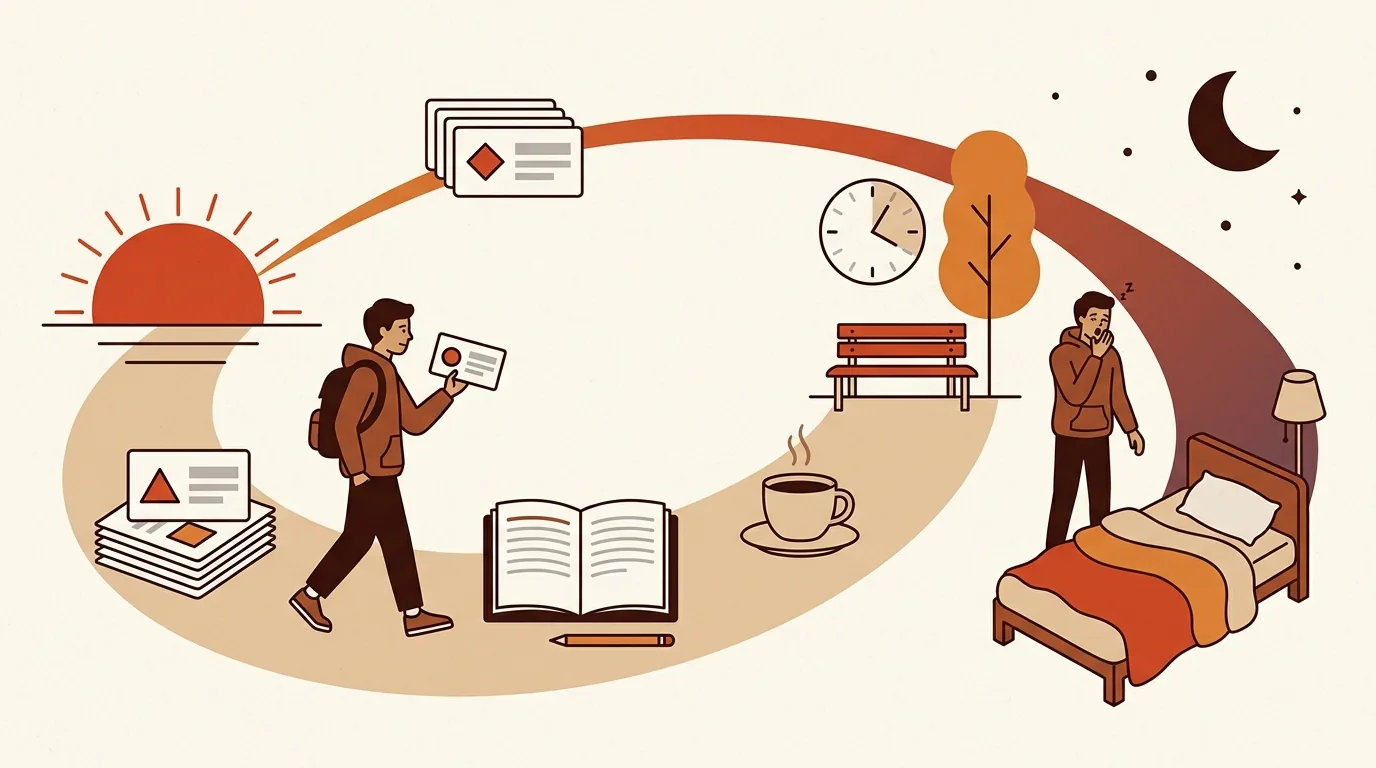
To study for a test in one day, spend the first thirty minutes deciding what not to study, then spend the rest of the day testing yourself instead of re-reading. Score every topic by how much of the test it covers and how badly you know it, work the top three in order, and after each one run a retrieval block where you answer questions from memory with your notes closed. Space three of those blocks across the day, keep flash cards for material that is genuinely memorisable (terms, formulas, dates), and practise problems for everything else. Stop by 10:30pm and sleep, because the night after studying is when the day's work gets kept. One day will not give you mastery of a whole course. It can give you the points that are most within reach, if you refuse to spend it on the wrong chapter.
Below is the plan I would follow, hour by hour, plus the reasoning behind each block so you can bend it to your own test.
What can one day of study actually achieve?
More than panic suggests, and less than you hope. It is worth being clear about both, because the most common way to waste the day is to act as if you have a week.
What one day can do:
- Recover material you once understood. If you followed the lectures and just never reviewed, a day of active recall brings a lot of it back quickly.
- Lock in a bounded set of facts. A focused deck of definitions, formulas or dates is very learnable in a day when you test yourself on it several times.
- Get you fluent on the problem types that repeat. If a past test shows the same four kinds of question every year, you can drill those four.
- Show you exactly where you stand, which is worth a lot when you walk in.
What one day cannot do:
- Build foundations that were never there. In a cumulative subject like calculus or organic chemistry, chapter six sits on chapter two. If chapter two is a blank, you will not rebuild the stack by evening.
- Produce long-term memory. The research on spacing is consistent on this. A meta-analysis of distributed practice by Cepeda and colleagues, covering 317 experiments, found that the best gap between study sessions grows as the time until the test grows. Squeezing everything into one day is the arrangement that research warns against. It can still get you through tomorrow. It will not stay with you for next term.
- Cover the whole syllabus well. You can cover all of it badly or the right part of it properly. Pick the second.
Accept that trade at 9am and the rest of the day gets much easier.
How do you triage a syllabus in thirty minutes?
Triage is a scoring exercise, not a reading exercise. Do not open the textbook yet.
Gather what tells you what is on the test: the syllabus or unit outline, any review sheet, past papers, and the topics your teacher kept returning to. Then list every topic in a single column. Most tests break into somewhere between six and fifteen of them.
Give each topic two scores:
- Weight (1 to 3): how much of the test it is likely to cover. A review sheet, a past paper or "this will be on the exam" gets a 3.
- Gap (0 to 2): how badly you know it right now. 0 means you could explain it cold. 2 means you are not sure what it is.
Multiply them. The result is your priority. Here is what that looks like for an invented biology unit test:
| Topic | Weight | Gap | Priority | Type |
|---|---|---|---|---|
| Cellular respiration | 3 | 2 | 6 | Understand + memorise |
| Photosynthesis | 3 | 1 | 3 | Understand |
| Cell membrane transport | 2 | 2 | 4 | Understand |
| Organelle functions | 2 | 1 | 2 | Memorise |
| Enzyme graphs | 2 | 2 | 4 | Procedure (read graphs) |
| History of cell theory | 1 | 2 | 2 | Memorise |
| Microscope parts | 1 | 0 | 0 | Memorise |
Your three study blocks go to the top three scores, in order: respiration, then membrane transport and enzyme graphs. Anything scoring 0 or 1 gets a single pass at the end if time allows.
The last column matters as much as the score. Memorise material becomes flash cards. Procedure material becomes a list of practice problems. Understand material becomes a set of questions you answer in writing. Deciding the format now stops you defaulting to highlighting everything.
Why does retrieval beat re-reading when time is short?
Because re-reading feels like learning and mostly is not. When you look at a page you have seen before, it is familiar, and familiarity is easy to confuse with being able to produce the answer on a blank test paper.
The clearest demonstration is a 2006 study by Roediger and Karpicke in Psychological Science. Students either re-studied prose passages or took recall tests on them, and then sat a final test after five minutes, two days, or a week. On the five-minute test, re-studying came out ahead. On the delayed tests, the students who had tested themselves remembered substantially more. The detail I find most useful: re-studying made students more confident while doing less for them over time.
Kornell and Son found the same illusion in 2009 with a flash-card-style task. Participants judged that seeing the full question and answer again taught them more than trying to recall the answer first. The recall mode was the more effective one.
The UNC Learning Center's study guidance puts it bluntly: re-reading leads to quick forgetting, and quizzing yourself is a highly effective technique. It also recommends quizzing in blocks of around 45 minutes followed by a break, which is roughly the block size used below.
On a one-day timeline, this settles the method. Every hour you spend reading should end with you closing the notes and producing something from memory. If you have not done that yet, the how to study with flash cards guide covers the recall habits that make a card session count.
What does the hour-by-hour plan look like?
This assumes a test the next morning and a full day free. If you start at noon, cut Block C and the timed practice, and keep all three retrieval passes. The passes are the part that does the work.
| Time | Block | What you do |
|---|---|---|
| 9:00 to 9:30 | Triage | Score every topic, pick the top three, label each Memorise, Understand or Procedure |
| 9:30 to 10:00 | Build the set | Turn memorisable facts into cards (one fact per card), list practice problems, write short-answer questions |
| 10:00 to 11:30 | Block A | Top-priority topic. Read only what you need to answer your questions, then answer them without notes |
| 11:30 to 11:45 | Break | Away from the desk and off your phone |
| 11:45 to 12:30 | Retrieval pass 1 | Full card set cold, then a blank-page recall of Block A: write everything you can remember, then check |
| 12:30 to 1:15 | Lunch | A real meal, not at the desk |
| 1:15 to 2:45 | Block B | Second-priority topic, same method as Block A |
| 2:45 to 3:00 | Break | Walk |
| 3:00 to 3:45 | Retrieval pass 2 | Cards shuffled, cold. Blank-page recall of A and B. Note every miss |
| 3:45 to 4:00 | Break | |
| 4:00 to 5:30 | Block C | Third-priority topic, or the problem types that repeat on past papers |
| 5:30 to 6:30 | Dinner | |
| 6:30 to 7:30 | Timed practice | A past paper section or mixed questions from A, B and C, under test conditions |
| 7:30 to 8:15 | Fix list | Only what you got wrong today. Re-learn it, then re-test it |
| 8:15 to 8:30 | Break | |
| 8:30 to 9:15 | Retrieval pass 3 | Every card, cold. Blank-page recall of all three topics. Write a one-page sheet of what you still miss |
| 9:15 to 10:00 | Light review | That one page only. Pack your bag, set two alarms |
| 10:00 to 10:30 | Hard stop | Screens off. Nothing new |
| 11:00 | Asleep |
A few notes on why it is shaped this way.
The retrieval passes are spaced on purpose. Late morning, mid-afternoon and evening give you gaps of a few hours between attempts at the same material. With only one day, those gaps are the only spacing available, so use them. If you want to see how the same idea stretches over weeks when you have them, the spaced repetition schedule guide lays out the intervals.
Keep missed cards in the deck, and do not drop the ones you think you know. Setting aside cards you feel confident about is almost every student's instinct. When Kornell and Bjork tested it in 2008, letting learners drop flash cards had a small but consistently negative effect on what they learned. On a one-day plan, every card goes through every pass.
Keep the card set small. One fact per card, and only facts. Twenty to sixty cards is a realistic ceiling for a day that also has problems and written answers in it. For the arithmetic of how long a deck actually takes, see how many flash cards per day.
Breaks are part of the plan, not a reward. A day of back-to-back 90 minute blocks with no break turns into staring at a page by 3pm.
Which material should you deliberately abandon?
Deciding what to drop is the step that separates a useful cram day from a frantic one. Drop these without guilt:
- Low-weight topics you scored as a full gap. A topic worth one question that you do not understand at all is the worst return in the day. Skip it and take the loss.
- Material whose prerequisites you never learned. If understanding topic F requires topic C and you do not have C, F is out of reach today. Spend the time on C only if C scores well on its own.
- Derivations and proofs you only need to apply. If the test asks you to use a formula, learn to use it. Knowing where it came from is for a week when you have more time.
- Rewriting or colouring your notes. Neat notes feel productive. They are copying, not recalling.
- New resources. A fresh textbook, a new video series or a classmate's 40 page guide are all tempting. Everything you need to triage is already in your own materials.
- Flash cards for things that are not facts. "Explain the Krebs cycle" is not a card. It is a blank-page question. Cards are for what has a short, checkable answer.
Write the abandoned list down. It stops you drifting back to it at 7pm when a topic suddenly feels urgent.
Should you study the morning of the exam?
Briefly, and only on what you already know. Spend 15 to 20 minutes on your one-page miss sheet and one cold pass through the cards. Do not open a new topic. A gap you find on the morning of the test will not close in the time left, and it will cost you composure you need in the room.
Eat something, leave early, and stop reviewing when you arrive. The work is done.
Frequently asked questions
Can you pass a test studying only one day?
Often, yes, especially if you followed the course and the test leans on a limited set of topics. Your chances drop in cumulative subjects where later material depends on earlier chapters you never learned. Triage honestly, study the high-weight topics by testing yourself, and you will get most of the points that one day can realistically reach.
Is cramming ever effective?
For tomorrow's test, a well-run cram day can work. For keeping the material, it is a poor method, and the research on spaced practice is consistent that spreading study across days holds up far better over time. If you must cram, test yourself rather than re-reading, and spread your practice attempts across the day instead of doing one long session.
Should you sleep or study the night before an exam?
Sleep. The NIH News in Health summary of sleep and memory research explains that sleep after learning helps strengthen and stabilise new memories, recommends 7 to 8 hours for most adults, and notes that memories are not strengthened with four hours or less. A 2007 study by Yoo and colleagues in Nature Neuroscience also found that a single night without sleep impaired people's ability to form new memories the following day. An all-nighter trades the consolidation you need for a few extra hours of tired study.
What's the fastest way to memorise notes?
Stop reading them and start answering questions from them. Turn each fact into one short question with one answer, test yourself with the answer hidden, and put the misses back in the pile. Repeat the whole set a few hours later, then again in the evening. The how to make flash cards that stick guide covers how to phrase cards so each one tests a single fact.
Turn your triage list into a deck
The "Memorise" column from your triage table is your deck. Open the free deck builder, type in one fact per card, and play it straight away in the same player the site uses. It needs no account and saves in your browser. The free builder holds one deck of up to 20 cards, which is a sensible size for your highest-priority facts. If your list runs longer, QuestionCard Plus removes the limit.
Then run your three retrieval passes against it: late morning, mid-afternoon and evening. If some of what you need is already covered, the flash card library has free decks you can play the same way.
Close the notes, answer from memory, and go to bed on time.