
Christmas Conversation Starters for a Mixed Table
By Mark Fulton · 2026-10-12 · 13 min read
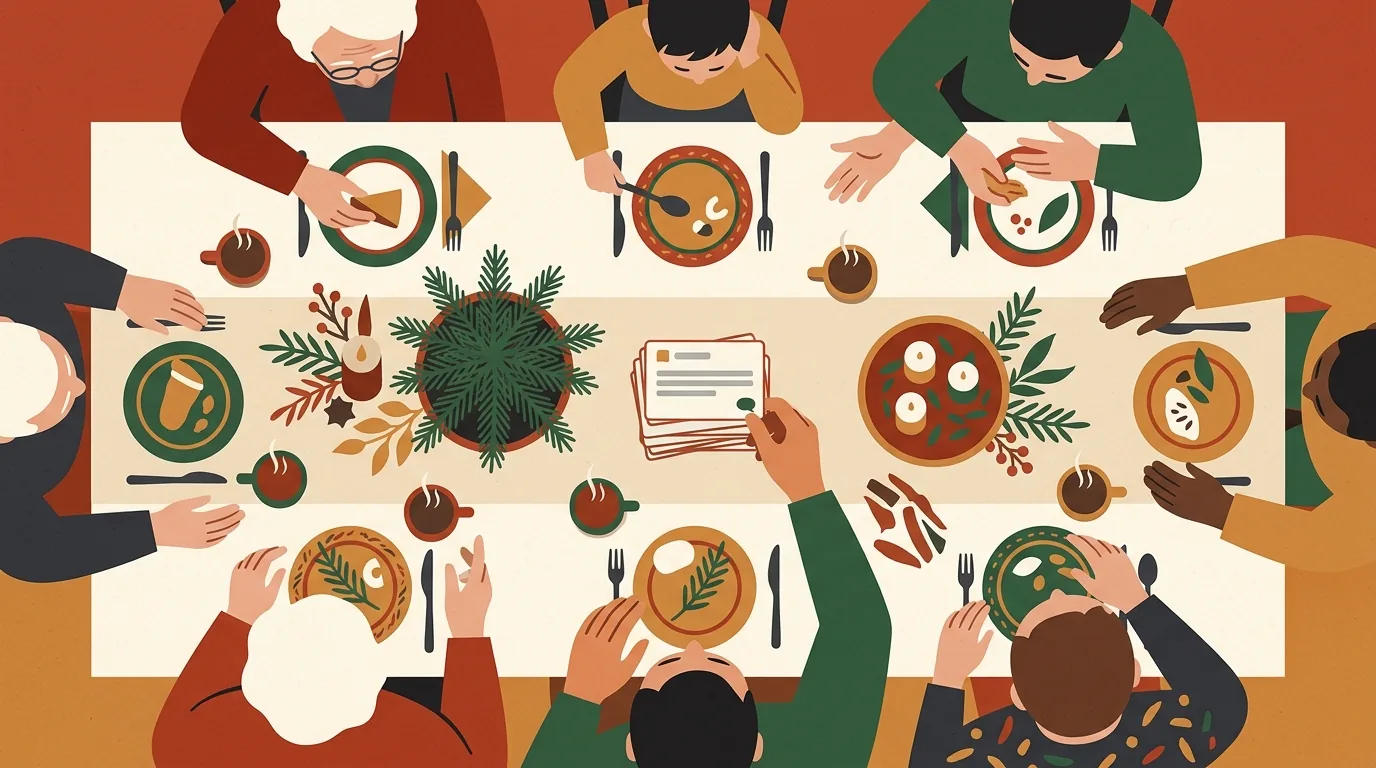
The best Christmas conversation starters are questions that work whatever anyone at the table believes: they ask about memories, food, objects and small opinions rather than about faith, politics, money or anyone's plans. Christmas tables mix ages and convictions, and the meal runs in stages, so one list read from top to bottom fails. Below are 50 questions I wrote for this post in three stages (the meal with kids present, the adults' hour after the kids leave, and the long dessert stretch), each tagged all ages or adults, plus three short redirect lines for the moment a topic turns.
A list of thirty questions is easy to find. What a mixed table needs is a way to match the question to who is actually still sitting there at 8 p.m., and a plan for the evening that does not depend on everyone behaving.
What makes a Christmas question work for a mixed table?
A Christmas table is one of the few gatherings where the guest list is set by family rather than by taste. You may have a six-year-old, a grandparent, a brother-in-law with strong opinions, a cousin who has just moved back, and one relative everyone is quietly managing. A question has to survive all of them. Four tests do most of the work.
It does not assume a belief. "What is your favorite part of the holiday?" works for someone who goes to a midnight service and someone who only comes for the food. "What does Christmas mean to you?" invites a speech, and a speech invites a rebuttal. Ask about things people can point at: a dish, a decoration, a song, a gift.
It is answerable in a sentence or two. Long answers turn the table into an audience. The questions below are built so a short, honest answer is a complete answer.
It does not require a particular life. Anything about a partner, a job, a salary, a house or a due date is a private question asked in public. The memory and object questions are safer because everyone has some.
Passing costs nothing. "I can't think of one" has to be a perfectly fine reply. A question people can decline is a question people are willing to answer.
There is a reason this matters more as the table grows older and wider. The U.S. Census Bureau reports that multigenerational households made up 7.2% of family households in 2020, and plenty of other families gather their generations under one roof only on the day itself. Either way, you are writing for a table with a wide age range and very little shared daily context.
The other principle is sequencing. The closeness procedure Arthur Aron and colleagues published in 1997, now described by UC Berkeley's Greater Good Science Center as 36 Questions for Increasing Closeness, works because the questions escalate gradually and everyone discloses at a matched pace. You cannot run that at a dinner table, but the shape transfers: start easy and concrete, let depth arrive on its own. The three stages below follow that order, and the tags tell you where each question belongs.
Which questions suit kids and grandparents together?
Stage one is the meal itself, when the youngest and oldest are both at the table and the adults are mostly busy with serving dishes. These 20 are tagged [all ages]. They are about what is visibly in the room, and they put a child and a grandparent on equal footing, because nobody has a head start on "which decoration would you save from a fire".
- [all ages] Which decoration on this tree or in this room is your favorite, and why that one?
- [all ages] What is the first Christmas smell you notice when you walk in a house?
- [all ages] If you could add one dish to this table forever, what would it be?
- [all ages] What is the best gift you ever gave someone, even if it was small?
- [all ages] Which song would you ban from December and which would you play on repeat?
- [all ages] What is the strangest thing you have ever found in a stocking?
- [all ages] If you could wrap anything in the world as a surprise, what would you wrap?
- [all ages] What is your job at Christmas, the thing that is always yours to do?
- [all ages] What is something you made by hand and were proud of?
- [all ages] What is one thing you would put in a box to open next Christmas?
- [all ages] If everyone here swapped dinner jobs, who would be worst at yours?
- [all ages] What is the quietest, calmest moment of the whole holiday for you?
- [all ages] What is the best thing about waking up on the morning itself?
- [all ages] Which smell, taste or sound means the holiday has really started?
- [all ages] What is a thing you wished for as a kid that you are glad you never got?
- [all ages] What is a tradition you would invent if you could start one tomorrow?
- [all ages] If a snowman could come to life for an hour, what would you ask it to do?
- [all ages] What is the nicest thing someone did for you this month?
- [all ages] Which person here makes the best noise when they open a present?
- [all ages] What is the one dish on this table you would defend?
For the youngest children, rewrite any year-shaped question to be present-tense and concrete. "What is the nicest thing someone did for you this month" becomes "who was kind to you this week". If you want a longer set tuned to specific ages, dinner table questions for kids is built on that rewriting method.
What do the adults talk about once the kids have gone?
By the time the table has thinned out, the room can take slightly more. Stage two is the adults' hour: 18 questions tagged [adults], still free of anything that requires a belief, a salary or a relationship status, but willing to go back a decade or two. This is where the grandparent becomes the expert in the room, because most of these have a better answer the older you are.
- [adults] What was Christmas morning like in the house you grew up in?
- [adults] Which relative was the best at making the day feel special, and how did they do it?
- [adults] What is a gift you got years ago that you still use or still think about?
- [adults] What did your family do on the day that no other family you knew did?
- [adults] Which Christmas was the most chaotic, and what actually went wrong?
- [adults] What did the holiday look like the first year you hosted, or the first year you did not?
- [adults] What is something you used to care about at Christmas and no longer do?
- [adults] What is something you used to dismiss and now secretly like?
- [adults] Who is missing from this table whose cooking you can still taste?
- [adults] What is a story about this family you suspect not everyone here has heard?
- [adults] What was the hardest thing to get hold of as a kid, and did it live up to the wait?
- [adults] What is the most useful thing a relative ever taught you in a kitchen?
- [adults] Where was the best place you ever spent a holiday that was not home?
- [adults] What small ritual do you keep alone that nobody here knows about?
- [adults] What is the best piece of holiday advice you ever received, and from whom?
- [adults] What is something you would like to still be doing at this table in ten years?
- [adults] Which room in the house of your childhood do you remember most clearly?
- [adults] What would you tell yourself at twenty-five about a December like this one?
Question 29 is the heavy one. Use it only if someone has already mentioned the person, and never as an opener. If anyone at the table is carrying a recent loss, move to a lighter question without comment.
What works in the long dessert stretch?
Stage three is the last hour: pie is out, nobody wants to leave the table, and nobody wants to clear it either. This is the hour when a serious question lands badly and a ridiculous one lands perfectly. The 12 questions below are tagged [all ages] or [adults] where it matters, and they are deliberately stupid in a way that gets people laughing rather than defending themselves.
- [all ages] Which person here would be the most dramatic reindeer?
- [all ages] If this family were a holiday movie, what would the title be?
- [all ages] What is the worst present you could give someone and still be forgiven?
- [all ages] What would you name a new holiday dessert, and what would be in it?
- [adults] Which one of us would survive longest on the leftovers alone?
- [all ages] If the family had a group chat name, what would it be?
- [adults] What is the pettiest holiday rule you secretly enforce?
- [all ages] Who gets to rule the remote for the rest of tonight, and why them?
- [adults] What is a harmless lie that kept a holiday running smoothly?
- [all ages] Which one of us would be a great mall Santa and which a terrible one?
- [all ages] If a person here had a theme song when they walk into a room, whose and what?
- [adults] What is something you would happily never see at another holiday dinner?
Skip 50 if the table has a known sore spot. It is funny at the right table and a wound at the wrong one. If you find the set is going well and want to build a few more questions of your own like it, the deck builder takes any questions you type.
How do you steer away from a topic heading badly?
You get one clean shot, usually in the first ten or fifteen seconds after the flare and before anyone has committed to a position. After that you are refereeing. All three lines below are different from the usual handoff, which is worth keeping in reserve. Say them warmly, at normal speed, and do not comment afterwards.
1. The compliment pivot. Aim a genuine compliment at the person who raised the topic, then ask them something about the food or the day.
"You always know the details. Okay, but before we lose the thread, how did you get the gravy that color?"
It works because it does not tell anyone they were wrong to bring it up. It spends the attention on something they are good at.
2. The errand. Give the heated person a small, useful job with a clear end.
"I need someone with steady hands for the pudding. Can you carry the flame while I get the lights?"
A task is hard to argue against, it physically moves the person away from the front line, and it ends in a mild round of applause. Pick a job that is harmless: clearing plates, bringing the last dish, finding a charger.
3. The photo ask. Break the room with a request that everyone can say yes to.
"Nobody move. We have not had a single group picture tonight. Everyone squeeze in, Gran, you in the middle."
A group photo is the one request that makes everyone stand up, smile and talk about where to stand. It resets attention in about thirty seconds and leaves a record of the evening that has nothing in it about the argument.
None of these fixes a real conflict, and they are not meant to. They buy the meal.
How do you run the questions without making it a game show?
A question list turns into a game show when one person stands up with a stack of cards and starts calling on people. Three habits prevent that.
Put the questions on an object, not in someone's head. A phone passed around the table, or a few cards in the middle, makes the question belong to the object rather than to the person who asked it. Nobody has to wonder whether it was aimed at them.
Let the reader answer first, then pass. Whoever draws a question reads it out, answers it, and hands the phone along. That removes the judgment call about who to ask, which is what turns a question into a comment.
Cap it at five or six across the whole evening. The point is a starter. When real conversation breaks out, the phone goes face down on the table and stays there. That is the set working, not failing.
Listening matters as much as asking. The Greater Good Science Center's page on active listening recommends paraphrasing what someone said back to them to show you were paying attention. At a Christmas table this is as simple as "so the pudding was a disaster and you loved it anyway?" It rewards honest answers and makes the next person more willing to give one.
For a closely related layout of how to run a wide-age gathering through a short, structured set of rounds, the same logic appears in family reunion questions, and the pass-and-answer rhythm itself is spelled out in thanksgiving conversation starters, written for the same kind of table a month earlier.
What works on a video call with family who can't travel?
A video call has a different problem. The table is a grid of faces, delays make interruptions hard, and the person with the best story is often the one who is muted. A few changes make the same questions work.
Go around in a fixed order. In a room, people jump in naturally. On a call, nobody can tell who is about to speak. Pick an order at the start (oldest to youngest, or alphabetical by first name) and stick to it, so each person knows when their turn is coming.
Use shorter questions. Anything that needs a long setup gets lost on a laggy connection. The all-ages stage works nearly unchanged on a call, because those questions point at objects people can hold up to the camera: a decoration, a dish, a gift.
One person holds the deck. A custom deck in our builder lives in the browser on the device where you made it, so one person on the call should share their screen or read each question aloud. Everyone else only needs to listen and answer.
Let the remote relatives choose. Ask someone who cannot travel to pick the question for the next person. It gives the person on the screen a real part in the evening instead of a place in the corner of the table.
If you would rather not build anything, deep conversation starters plays free in any browser with no account. For the dessert stretch, would you rather is the quickest one to hand around.
Build the table deck and pass one phone around
You can print these, but a phone in the middle of the table is better, because it shuffles and nobody has to cut anything out. Open the deck builder, type in the questions that suit your table, and the deck plays straight away on any phone with no account. The free tier holds one deck of up to 20 cards, which is about right for a single meal. Take the 20 that fit your stage, or build one deck for the kids' hour and swap it later.
Your deck is saved in your own browser rather than on our servers. Pass the phone between courses, let each person read and answer, and put it down when the conversation takes over.
Frequently asked questions
What are good Christmas dinner conversation starters?
Good ones are short, concrete and belief-neutral: a favorite dish, a decoration with a story, the strangest thing found in a stocking, the best gift someone ever gave. They work for a child and a grandparent without rewording. Questions about someone's plans, income, relationship or politics are the ones to avoid, because at a table they are private questions asked in public.
What questions can you ask family at Christmas?
Ask about memories, objects and traditions rather than about decisions. "What was Christmas morning like in the house you grew up in?" and "which relative made the day feel special?" give older relatives the role of expert. Keep anything that touches loss for a moment when someone raises it first, and offer a lighter question straight after.
How do you avoid arguments at Christmas dinner?
You cannot ban a topic, and announcing a ban often starts the argument early. Supply a better default before the silence opens, by putting a deck or phone of questions on the table at the start. Then keep one redirect ready: a genuine compliment followed by a question about the food, a small job for the heated person, or a request for a group photo. Use it in the first fifteen seconds.
What are fun Christmas questions for kids?
Concrete, present-tense and a little silly. "Which decoration would you save from a fire?", "what would you wrap if you could wrap anything?" and "who here makes the best noise opening a present?" all work for children. Let a child hold the phone and read questions to the adults, since reading aloud gives them a job rather than just a turn.