
How to Host a Trivia Night: A Run Sheet
By Mark Fulton · · 15 min read
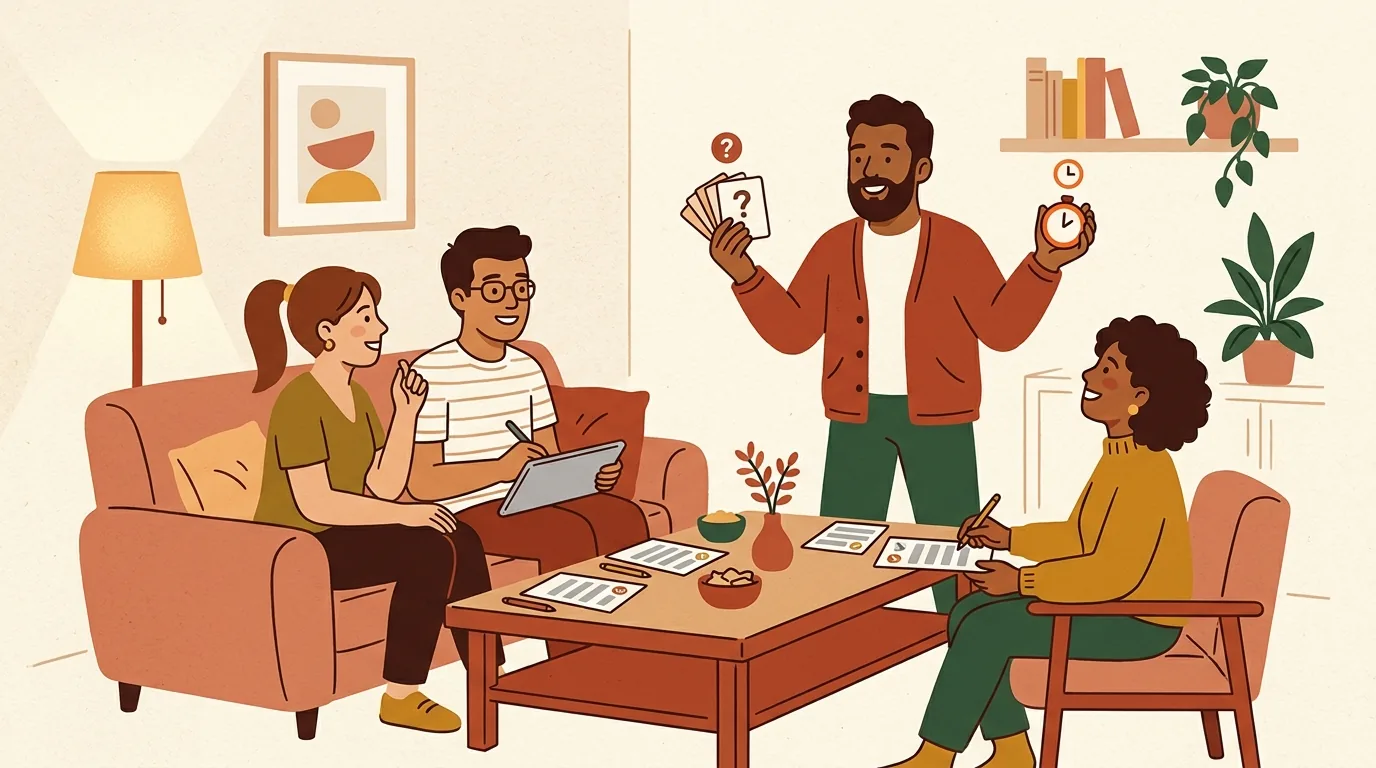
To host a trivia night at home you need four things: a fixed number of rounds, a clock you actually follow, a scoring method that survives a kitchen table, and questions you did not have to write yourself. Four rounds of eight questions fills sixty minutes. Five rounds of ten fills ninety. Teams mark each other's sheets so you never touch a spreadsheet, one person is the final word on disputes, and the questions come from a deck you open on a phone. Everything below is the run sheet, minute by minute, including what to say between rounds.
Most trivia advice is written for a venue: a stage, a microphone, a projector, a room of forty strangers, and a paid host. That is a different job. You have eight friends arriving on Saturday, a sofa, and a coffee table with a candle on it. The venue version scales down badly, mostly because it assumes someone spent a week writing sixty questions and building slides.
So here is the living-room version.
How many rounds does a home trivia night need?
Four. Four rounds of eight questions is the shape that fits a sixty minute evening without anyone checking the time, and it is enough variety that a team who knows nothing about science still has three chances to look clever.
Bigger formats exist and they work in the right room. The classic pub quiz runs five or six rounds of ten, often with a picture round bolted on, and library programmes tend to land in the same place: the American Library Association's Programming Librarian trivia night plan uses five themed rounds of ten questions with a break after the third. That is a two hour event with a staffed room behind it. At home, five rounds of ten is your ninety minute option, not your default.
The reason to cap it at four is attention, not stamina. A home group is sitting on furniture, drinking, and interrupting each other. Round five is where people start half-playing and checking their phones for real reasons. Ending while the room still wants one more round is the whole trick, and it is the single biggest difference between a night people ask you to repeat and a night that just stops.
Rules that make the round count work:
- Teams of two or three. Two is the sweet spot for a group of eight, giving you four teams and real competition. A team of five is a team where two people watch.
- One category per round, announced before the round starts. Knowing that round three is history lets a team position their history person and gives everyone something to dread or look forward to.
- Same length every round. Do not let round one run twelve questions because it is going well. The whole plan depends on rounds being interchangeable blocks.
Where do the questions come from if you're not writing them?
This is the part every guide skips, and it is the part that actually kills trivia nights. Writing sixty good questions takes a serious evening: you have to find facts, verify them, write three plausible wrong answers for each, and check that you have not accidentally made every answer the second option.
Three honest sources, in order of how much of your Friday they cost.
A ready deck you just play. This is why QuestionCard's trivia quizzes exist. Open one on a phone or a laptop, read the questions out, and the deck handles the rest. Four free decks give you a full night with no preparation:
| Round | Deck | Questions available | Feels like |
|---|---|---|---|
| 1 | General knowledge quiz | 30 | The warm-up. Everyone gets some. |
| 2 | Science and nature quiz | 28 | Space, animals, chemistry, the human body. |
| 3 | History quiz | 28 | Ancient Egypt through the space race. |
| 4 | Food and drink quiz | 25 | The friendly closer. Everyone eats. |
That is 111 questions across the four, so a night of thirty-two leaves you plenty spare for a rematch that is not a repeat. They are free and complete, with no account and no sign-up wall. Each one is multiple choice with four options, which matters more than it sounds: multiple choice keeps a mixed-ability group in the game, because a team that does not know can still reason its way to an answer.
A house round you write yourself. One round, six to eight questions, all about the people in the room or the place you live. "Which of us has been to the most countries." "What street was this house on before they renamed it." This is the round people remember, and it takes twenty minutes to write because you already know the answers. Build it in the deck builder and play it the same way as the others. The free tier gives you one deck of up to twenty cards, which is exactly one house round. QuestionCard Plus lifts that to unlimited decks and adds a print-friendly export if you would rather hand out paper, at three dollars a month billed as eighteen every six months, or fifty-nine once for lifetime access.
Never a listicle you found this afternoon. The reason is not snobbery. Recycled question sets circulate widely enough that in a group of eight, someone has seen them, and one person quietly knowing the answers ruins a round for everyone else.
The run sheet
Two versions. Pick by how long people are staying. Times are elapsed minutes from the moment you say "right, teams."
The 60-minute night: 4 rounds of 8
| Clock | Length | What happens | What the host says |
|---|---|---|---|
| 0:00 | 5 min | Teams form, names go on the top of an answer sheet | "Teams of two. Pick a name you'd be happy to hear read out in last place." |
| 0:05 | 9 min | Round 1: General knowledge, 8 questions, each read twice | "One point per answer, spelling doesn't count, and I'll read every question twice. Nobody shouts." |
| 0:14 | 3 min | Mark round 1. Sheets go to the team on the left | "Pass your sheet left. You are not marking your own, for obvious reasons." |
| 0:17 | 9 min | Round 2: Science and nature, 8 questions | "Round two is science. If your team has a doctor, this is why you invited them." |
| 0:26 | 3 min | Mark round 2, read the standings out loud | "Pass left again. Then I'll tell you where everyone stands, which is the point of doing this in halves." |
| 0:29 | 5 min | Break. Drinks refilled, no questions | "Five minutes. Get a drink, argue about question six, come back." |
| 0:34 | 9 min | Round 3: History, 8 questions | "History. Dates get a point if you're within five years, and I'm being generous because I want to be." |
| 0:43 | 3 min | Mark round 3 | "Pass left." |
| 0:46 | 8 min | Round 4: Food and drink, 8 questions | "Last round. It's food, so nobody's excused." |
| 0:54 | 4 min | Mark round 4, add up all four, final standings | "Totals please. Read me your team's number, not your working." |
| 0:58 | 2 min | Tie-break if needed, then winners | "We have a tie, so here's one question and the closest guess takes it." |
The 90-minute night: 5 rounds, with a house round
| Clock | Length | What happens | What the host says |
|---|---|---|---|
| 0:00 | 8 min | Arrival slack, teams of two or three, sheets out | "Teams of three tonight. Write your name at the top, we're doing five rounds and a break." |
| 0:08 | 11 min | Round 1: General knowledge, 10 questions | "Warm-up round. One point each. I'll read everything twice and then once more if you ask nicely." |
| 0:19 | 4 min | Mark round 1, sheets pass left | "Swap left, mark in a different colour if you've got one." |
| 0:23 | 11 min | Round 2: Science and nature, 10 questions | "Science and nature. Four options every time, so a confident guess is worth more than a blank." |
| 0:34 | 4 min | Mark round 2, read standings | "Standings after two, and I'll say now that nobody is out of this." |
| 0:38 | 10 min | Break. Food, drinks, no trivia | "Ten minutes. The second half is longer than the first, so eat something." |
| 0:48 | 11 min | Round 3: History, 10 questions | "History. Same rules. Close spellings are fine, close centuries are not." |
| 0:59 | 4 min | Mark round 3 | "Pass left." |
| 1:03 | 8 min | Round 4: The house round, 6 questions about the group | "Six questions about the people in this room. I wrote these, so complaints go to me and are dismissed by me." |
| 1:11 | 3 min | Mark round 4 | "Pass left. Yes, that one was about you." |
| 1:14 | 11 min | Round 5: Food and drink, 10 questions | "Final round, and it's food. Double points would be dramatic, so no, it's still one." |
| 1:24 | 4 min | Mark round 5, totals for all five rounds | "Add all five. Shout me the total, and I'll pretend to check it." |
| 1:28 | 2 min | Tie-break if needed, prizes, done | "Winners. And whoever finished last picks the category we start with next time." |
Two things about the sheets. Print or scribble a numbered grid before people arrive, one sheet per round per team, so nobody spends the marking break looking for a pen. And run the clock on your phone, out loud, at the end of each round: "two minutes on this one" keeps a round from drifting, and it keeps you honest about the break.
How do you score without a spreadsheet?
Teams mark each other. That is the entire method and it is what pub quizzes have done for decades: the standard pub quiz format has teams swap papers before marking, specifically so that nobody grades their own answers.
The mechanics at a kitchen table:
- One point per correct answer. No difficulty weighting, no doubles, no jokers. Weighted scoring sounds better than it plays, because it makes every marking break an argument about whether question seven was really a two.
- Sheets pass to the left after every round. Same direction every time so nobody has to be told twice.
- You read the answers out, once, at a pace people can mark to. Give the answer, pause, then move on. Do not explain the answer yet.
- The marking team writes the round total in a box at the bottom and passes it back. The owning team calls the number out to you.
- You write four numbers on a piece of paper. Four teams, four running totals, updated twice a night. That is your whole scoreboard, and if you want it visible, a sheet of paper taped to a cupboard door beats any app.
Read the standings only twice: once at the break and once at the end. Reading them after every round is a slow puncture, because a team that has been last three times running stops trying. Once at halftime is enough to create a chase without letting anyone conclude it is over.
If you want the scoring done for you instead, the free quiz decks score themselves as you play: each one ends with your score, your accuracy, your best streak, and a review of every question you missed. That is the better fit for two people on a sofa than for four teams around a table, but it means a solo player or a couple gets the same night without a single sheet of paper.
How do you handle a tie, a dispute, or a phone under the table?
Announce all three rules before round one, in about fifteen seconds. Rules announced at the start are rules. Rules invented at minute fifty are you taking sides.
The tie-break. One question, a number for an answer, closest guess wins with no points at stake. Never a knowledge question, because a knowledge question can tie again. Write three before the night and keep them in your pocket:
- How many keys are on a standard full-size piano? (88)
- How many bones are in the adult human body, by the standard anatomical count? (206)
- How many member states does the United Nations have? (193)
Both tied teams write a number, you reveal, closest takes it. If they somehow tie again, go to the second question and accept that you are having a great night.
The dispute. Name the arbiter before you start, and make it a source, not a person. "If we disagree, we look it up, and whatever the first solid reference says is the answer, and I'll call it if it's still murky." A host who is also the arbiter with no reference behind them ends up defending a question they did not write. A host pointing at a reference is just reading it out.
Two rulings worth making in advance, because they come up every time. Spelling does not count, as long as you can tell what they meant. And the answer they wrote is the answer, not the better answer they said out loud while marking. Both feel harsh once and save you twenty minutes across the night.
The phone. Do not police it. Announce it once, lightly, and let the room do the work: "phones face down, and if you look something up you have to tell us the answer before we score it." Nobody at a house party is cheating for a prize that is a bag of crisps. The reason to say anything at all is that people reach for phones out of habit in a lull, and once one table is on Google the round quietly stops being a game. Naming it removes the habit without anyone having to be the enforcer.
What's the right difficulty for a mixed-ability group?
The mistake is aiming at the strongest person in the room. Write or pick for the middle and let the hard questions be the exception, not the theme. Librarians running well-attended trivia programmes describe the same instinct: an American Libraries piece on academic library trivia nights quotes organisers keeping questions broad, with a few niche ones reserved for the diehards.
A round of eight that plays well at home looks roughly like this: two questions almost everyone gets, four that a team of two will land between them, one genuinely hard, one that is unguessable unless you happen to know it. The two easy ones are load-bearing. They are what stops a team from feeling stupid in the first ninety seconds, and a team that feels stupid stops talking.
Multiple choice does a lot of this work automatically. A four-option question with plausible wrong answers is playable by someone with no knowledge and no chance, because they can eliminate one, then argue. That argument is the actual entertainment. An open question with a blank line next to it is either known or not known, and a table of blank lines is a quiet table.
Two adjustments for a genuinely mixed room, teenagers and grandparents at the same table:
- Mix teams by age, never by ability. A team of one teenager and one grandparent covers about eighty years of pop culture and beats either of them alone.
- Skew the categories toward the durable. Geography, food, the human body, and history hold up across generations far better than "which song was number one in a year half the room did not experience." The world geography quiz works as a substitute round for exactly this reason.
How do you close the night so it ends on a high?
Announce the winners fast, then get everyone off the scoreboard.
The final marking break is the flattest two minutes of the evening, so do not stretch it. Read the totals bottom to top, name the winners, hand over whatever the prize is, and stop. Prizes should be small and slightly funny. A bar of chocolate, a bottle of something ordinary, or a trophy that is visibly not a trophy all land better than something expensive, because an expensive prize turns a party into a competition with stakes.
Then give the night somewhere to go. The energy after a quiz is high and unfocused, and if you leave it alone people start looking at coats. Two good next moves:
- Read the three best questions again, the ones nobody got, and let the room argue about them properly. This is the conversation people actually wanted during the round and were not allowed to have.
- Switch formats entirely. Trivia has a winner, so it has losers. Something with no score resets the room. A would you rather deck or any of the party question games for groups runs on the same energy with nobody keeping points, and it is the easiest handover in the evening because you are already holding the phone.
One last thing, and it is the closest thing to a secret in here: let the losing team choose the opening category next time. It is free, it costs you nothing, and it turns a defeat into an appointment.
Frequently asked questions
How long should a trivia night last?
Sixty to ninety minutes of actual quizzing, plus a break. Sixty minutes covers four rounds of eight questions with marking time; ninety covers five rounds of ten. Venue quizzes often run two hours or more, but they have a stage, a paid host, and an audience who came out specifically for that. At home, the room's attention runs out before the questions do, so plan the shorter night and keep a spare round in reserve rather than planning the longer one and losing the room in the middle.
How many questions per round?
Eight for a sixty minute night, ten for ninety. Below eight, a round ends before teams settle into it. Above ten, the marking break gets long enough that people wander off and you lose five minutes rounding them back up. Keep every round the same length so your run sheet stays accurate, and read each question twice at a pace people can write to.
What's a good team size for trivia?
Two or three. Two is ideal for a group of eight because it gives you four competing teams and everyone on every question. Three works when you have ten or more people or when abilities vary a lot, since a third person covers a category the other two do not have. Four and above is where it breaks down: somebody stops contributing, and a person who is not contributing is a person on their phone.
How do you make trivia fair when one team is much stronger?
Fix it in the team draw, not the scoring. Split the two strongest players across different teams before you start, ideally without announcing why. If the teams are already set and the gap is obvious, spread your categories wider instead of handicapping anyone: add a house round about the people in the room, which no amount of general knowledge helps with, and lean on categories where the strong team has no edge. Points handicaps sound fair and feel patronising, and the team carrying them stops trying by round three.
Ready to run it? Open the general knowledge quiz as round one and work down the trivia hub from there. Free, no account, and every deck ends with a score, an accuracy figure, and a list of every question your table got wrong, which is where next month's rematch comes from.