
Digital vs Paper Flash Cards: Which Wins When
By Mark Fulton · · 13 min read
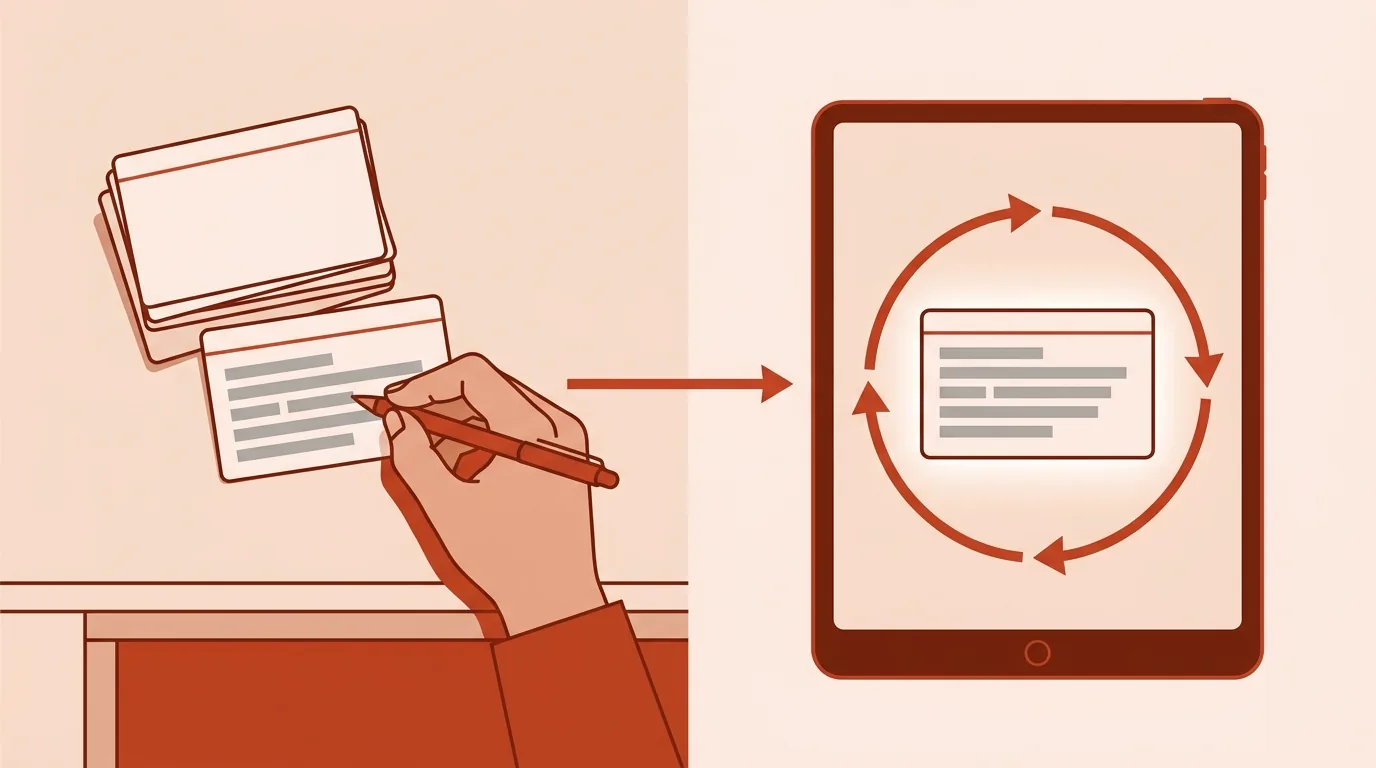
Paper wins the making of the card. Digital wins the reviewing of it. Almost every argument about digital vs paper flashcards goes wrong because it treats flash cards as one activity, when they are two: writing a card is an act of processing the material, and reviewing a card is an act of scheduling. Handwriting genuinely helps with the first. It does nothing at all for the second, and scheduling is where paper systems collapse once a deck passes a couple of hundred cards. The honest answer for most subjects is a hybrid: write the cards by hand, then type the ones that survive into a digital deck for review.
We build a flash card tool, so take the next part with the appropriate suspicion. The reason we are willing to tell you that paper beats us at something is that the alternative, pretending a screen does what a pen does, would make the advice useless. Here is where each format actually earns its place.
What does paper genuinely do better?
Three things, and they are real.
Paper forces a decision about what goes on the card. When you write by hand, you cannot paste. You cannot drag in a definition, screenshot a slide, or duplicate a card and tweak two words. Every card costs you thirty seconds of writing, which means you will not write a card you do not need. Handmade decks are smaller and better because the medium taxes laziness.
Paper is physically sortable. A stack you can split into two piles, "knew it" and "missed it," gives you an instant, tactile map of your ignorance. You can see the missed pile shrink across a week. Digital apps report the same information as a number, and a number does not sit on your desk making you uncomfortable.
Paper has no notifications. A phone is a study tool wrapped around a slot machine. That is not a small point, and no amount of app design fully solves it.
There is also a research thread suggesting the physical act of writing engages the brain differently. In a 2021 study, researchers compared paper notebooks against tablets and smartphones for a schedule-encoding task with 48 university students split into three groups of sixteen. The notebook group recorded the information in significantly less time, and during an fMRI retrieval test showed greater activation in the hippocampus, precuneus, visual cortices and language regions. Worth being precise about the size of the effect, though: overall performance across the groups was broadly comparable, and the accuracy advantage the notebook group showed was narrow and appeared on the simpler question type. It is a real signal, not a landslide.
What does digital genuinely do better?
One thing, mostly, and it is the thing that decides the argument.
Digital schedules. A digital deck knows which cards you missed on Tuesday, which cards you have nailed four times running, and which card you have not seen in eleven days. It surfaces them accordingly. Paper cannot do this without you building the schedule by hand, and the hand-built version is where paper systems quietly die. More on that below.
The supporting advantages are less dramatic but they compound. A digital deck is searchable, so fixing a card you wrote wrong takes four seconds instead of hunting through a shoebox. It reverses direction on demand, which matters because "Frankfort is the capital of which state?" and "capital of Kentucky?" are two different retrievals and exams love the one you did not practise. It is impossible to leave on the bus. It can be shared, so four people revising the same syllabus can build one deck instead of four. And it grades you against a record rather than against your mood at 11pm.
The University of North Carolina at Chapel Hill Learning Center puts the underlying principle plainly in its study guidance: spacing work "over several short periods of time over several days and weeks" beats marathon sessions, and for material you have to memorise, the advice is to make flash cards and review them periodically through the day rather than in one long memorisation session. Both formats can follow that advice. Only one of them keeps track for you.
Why does writing the card matter more than reviewing it?
Because writing the card is when you decide what the material means, and reviewing it is when you find out whether that decision stuck.
Deciding what goes on a card is genuine work. You have to split a messy paragraph into a question with exactly one answer, choose which detail is load-bearing, and phrase the front so that it demands retrieval rather than recognition. That is an editing pass over the whole subject, and it happens whether or not you ever review the deck. It is also the step most people skip when they download someone else's cards, which is why premade decks so often feel slippery: you are reviewing someone else's decisions about what matters.
Does the handwriting itself add something beyond that editing work? Possibly, and this is the part where most pages on this subject overstate their evidence, so here is the state of it.
A high-density EEG study of handwriting versus typewriting with 36 university students found that handwriting produced far more widespread brain connectivity, specifically theta and alpha coherence between parietal and central regions, patterns associated with memory formation. The authors are careful about what that does and does not show: the study measured brain connectivity, not learning outcomes. Nobody was tested on the words afterwards.
And the broader "pen beats keyboard" claim is genuinely contested. The best-known note-taking experiment supporting it was replicated and extended by Morehead, Dunlosky and Rawson in Educational Psychology Review in 2019. Their replication found that test performance "did not consistently differ between any groups," including, in their second experiment, a group who took no notes at all. A meta-analysis combining the direct replications showed small effects favouring longhand that did not reach significance. The authors concluded that declaring a winner "seems premature."
So the honest position: handwriting plausibly helps, the effect is smaller and shakier than the internet suggests, and the larger and better-established benefit is simply that making your own cards forces you to process the material. If you want that step done properly, our guide to making flash cards that stick is about the card-writing craft rather than the medium, and it applies equally to index cards and a screen.
At what deck size does paper stop working?
Roughly between 100 and 200 cards, and it stops working for a specific, predictable reason.
Below about 50 cards, paper is not just adequate, it is better. You can hold the whole deck. You can shuffle it, split it, and run the entire thing in ten minutes. No scheduling system is needed because the schedule is "do all of them."
Between 50 and 150 cards, paper still works if you run a Leitner box, the physical spaced-repetition method where cards move between numbered boxes based on whether you got them right, and each box is reviewed on a different interval. It is a genuinely good system. It also requires you to remember which box gets reviewed today, to physically move cards after every session, and to not lose the box.
Past about 200 cards, the bookkeeping becomes the study session. You are spending real minutes deciding what to review instead of reviewing. This is the point almost nobody mentions when they tell you handwritten cards are better for memory, and it is why students who start a course with a beautiful hand-lettered deck are frequently studying from a photocopy of the lecture slides by week nine. The deck did not fail because paper is bad. It failed because a 400-card manual schedule is an administrative job.
A language vocabulary set, a full anatomy syllabus, a bar exam outline, all of these blow past 200 cards in the first month. That is the handoff point.
Which format does your subject and situation call for?
Read down the branch that matches you. The handoff marker shows where a paper deck should become a digital one.
- How big will the finished deck be?
- Under 50 cards (a single chapter, a formula sheet, a vocabulary list for one unit)
- Does the material involve drawing, diagrams, or notation? → Paper. Stay on paper.
- Is it plain question and answer? → Paper. Digital adds nothing you need at this size.
- 50 to 150 cards (a module, a mid-term, one language unit)
- Will you review it for more than two weeks? → Hybrid. Write by hand, type the keepers. ← handoff point
- Is it a one-week cram for a single test? → Paper, run as a Leitner box.
- Over 150 cards (a full course, a language, a professional exam)
- Every branch → Hybrid, moving to digital-led. Write by hand while learning each new chunk, then type into a scheduled deck. Handwriting the first pass is affordable; hand-scheduling 400 cards is not.
- Under 50 cards (a single chapter, a formula sheet, a vocabulary list for one unit)
- Where will you actually study?
- Mostly at one desk → paper stays viable one size band longer.
- On trains, in queues, between shifts → digital, whatever the deck size. The best deck is the one that is with you.
- Is the exam handwritten?
- Yes, and it requires reproducing notation or diagrams → keep a paper subset for the notation, even if the bulk is digital.
- No, it is multiple choice or typed → no reason to keep paper past the writing stage.
- Do you struggle to start, or to keep going?
- Struggle to start → paper. The physical stack is a smaller commitment than opening an app.
- Struggle to keep going past week three → digital. Consistency is a scheduling problem, and scheduling is what digital is for.
| Situation | Make the cards | Review the cards |
|---|---|---|
| Single chapter, under 50 cards | By hand | On paper |
| One module, two to six weeks | By hand | Digital after the first week |
| Full course or language, 200 cards plus | By hand, chunk by chunk | Digital, always |
| Diagrams, notation, chemistry mechanisms | By hand | Paper for the visual cards, digital for the rest |
| Commuting or studying in gaps | By hand if you can, typed if you cannot | Digital |
| Shared with a study group | Either | Digital |
What does a hybrid system actually look like day to day?
It is less elaborate than it sounds. Four steps.
1. Write by hand as you learn. After a lecture or a chapter, write cards on index cards. This is your comprehension pass. Aim for one fact per card and a front that asks a real question. Expect to write fifteen or twenty cards for an hour of material, not sixty.
2. Run the paper deck for about a week. While the material is new, the whole deck needs reviewing anyway, so a schedule would be wasted effort. Shuffle, split into knew-it and missed-it piles, repeat the missed pile.
3. Type the survivors. At the end of the week, some cards are dead: you know them cold, or they turned out to be badly written, or they were never worth a card. Bin those. Type the rest into a digital deck. This retyping is not wasted time, it is a second processing pass, and it is the moment you fix the cards you wrote badly the first time.
4. Review digitally from then on. The digital deck accumulates across the whole course and handles the spacing. Your paper stack resets to empty each week and only ever holds new material.
You can run step three in our deck builder directly. The free tier covers one deck of up to twenty cards, which is enough to try the workflow on a single chapter before deciding whether it suits you. If you want the full mechanics of the review side, how to study with flash cards covers grading honestly and what to do with the cards you keep missing, and building a spaced repetition schedule covers the intervals themselves.
If you would rather see the review half working before you write anything, the ready-made decks are genuinely free and complete, with no account and no card limit: multiplication flash cards, US state capitals, the periodic table elements, Spanish essential words, or human body basics. A small number of decks are premium, such as SAT vocabulary; those play the first five cards free and then show an upgrade panel, which we would rather say plainly than have you discover halfway through.
Which subjects are the exceptions?
A few subjects break the general rule, in both directions.
Stay on paper longer than the size rule suggests:
- Chemistry mechanisms and organic structures. Drawing an arrow-pushing mechanism is the skill being tested. Recognising a picture of one is not.
- Handwritten maths proofs and derivations. If the exam asks you to produce the steps with a pen, practise producing them with a pen.
- Anatomy diagrams and labelled figures. Blank-diagram labelling is hard to replicate as a two-sided card.
- Kanji, hanzi, and any script where stroke order is assessed. Production and recognition are separate skills, and only paper practises production.
- Music theory notation. Same reason.
Go digital earlier than the size rule suggests:
- Language vocabulary. Volume is the whole game, audio matters, and 2,000 cards is normal. Paper never had a chance here.
- Professional certification and licensing exams. Large stable syllabi reviewed over months are exactly what scheduling was built for.
- Anything with a fixed exam date months away. The longer the runway, the more the spacing algorithm is worth.
- Material you share with other people. Four students, one deck.
The pattern underneath both lists: paper wins wherever the answer must be physically produced, and digital wins wherever the answer must merely be recalled, at volume, over time.
Common questions
Are handwritten flashcards better for memory?
Probably slightly, for reasons that are partly about the handwriting and mostly about what handwriting forces you to do. Choosing what goes on a card is a genuine processing pass over the material, and writing by hand makes copying impossible, so it guarantees that pass happens. The direct evidence for the pen itself is real but modest and contested: EEG work shows richer brain connectivity during handwriting than typing but did not test whether anything was learned, and the best-known note-taking result supporting longhand did not consistently replicate. Treat handwriting as a good habit with a plausible small edge, not as a law.
How many paper flashcards is too many?
Around 200 is where most people's paper systems break. The limit is not memory, it is bookkeeping: past that point you spend more time deciding what to review than reviewing. A Leitner box extends the range if you are disciplined about moving cards after every session. If you notice you are reviewing the same easy cards repeatedly because sorting them properly is too much effort, you have crossed the line.
Do digital flashcards work as well as physical ones?
For reviewing, yes, and generally better, because they handle spacing and reversal automatically and are with you when you have ten spare minutes. For the card-creation step, a typed card is easier to write badly, since pasting a whole paragraph onto the back takes one second. The fix is not to avoid digital, it is to write the card with the same discipline you would use if it cost you thirty seconds of handwriting.
Can you use both paper and digital flashcards for the same subject?
That is the recommended approach, and it is not a compromise. Use paper for the week the material is new, when everything needs reviewing anyway and the writing itself is doing work. Then type the cards that survived that week into a digital deck, which takes over the long-term scheduling. Paper handles new material, digital handles accumulated material, and neither is asked to do the job it is bad at.
The short version
Write the cards by hand. Type the keepers into the builder for review. That is the whole system, and the handoff belongs at the end of the first week or the two-hundredth card, whichever arrives first.
You can start either half right now. Open the builder and type up a chapter's worth of cards you have already written, or play a free deck first to see how the review side grades you before you commit an evening to index cards.