
Leitner System: The Five-Box Method, Explained
By Mark Fulton · · 14 min read
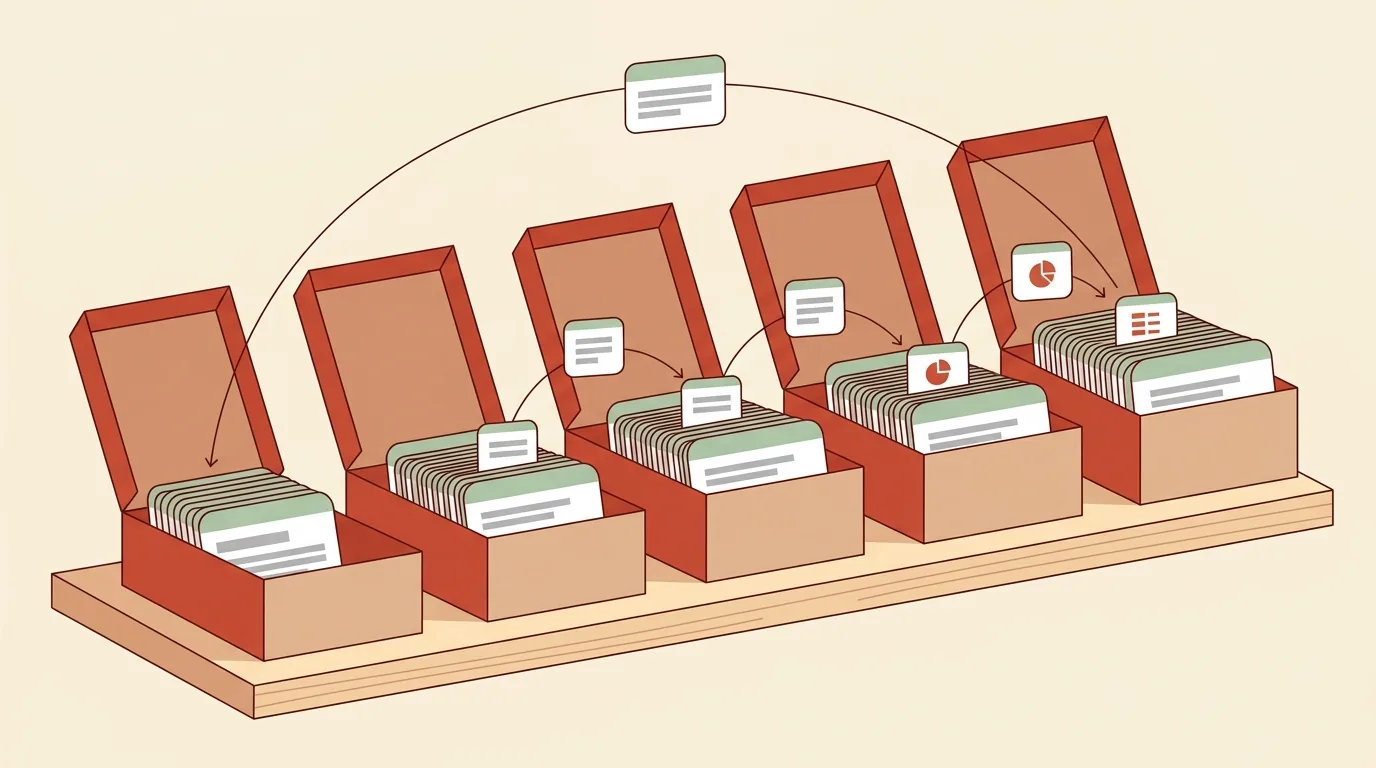
The Leitner system sorts flashcards into numbered boxes and reviews each box on a different cycle. New cards and every card you get wrong live in Box 1, which you review every study day. Get a card right and it moves up one box, where it waits roughly twice as long before you see it again. Get it wrong and it drops back down. Five boxes, reviewed on a sixteen day cycle, covers everything most people study: Box 1 daily, Box 2 every other day, Box 3 every fourth day, Box 4 every eighth, Box 5 every sixteenth. That is the whole machine. What decides whether it works is the demotion rule, not the promotion rule.
Sebastian Leitner, a German science journalist, published the method in his 1972 book on learning how to learn. His original was a physical wooden box with five compartments of increasing width, so each compartment filled up more slowly than the one before it and told you when it was time to review. Everything since is a variation on that.
Most explanations stop at "cards move up when you get them right." That is the easy half. Below is the operational half: how many boxes, which days, what happens to a card that fails after four successes, and how to run the same thing without carrying cardboard around.
How does the Leitner system actually work?
Three rules, and only three.
Every new card starts in Box 1. No exceptions, including cards you think you already know. The cost of one extra review of an easy card is a few seconds. The cost of an untested card sitting in Box 4 is that you find out it was never learned on the day it matters.
A card you get right on the first try moves up one box. First try means before any hint, before flipping back, before "oh right, I knew that." The moment you allow near misses to count as successes, the boxes stop measuring anything and the whole system turns into an elaborate way of feeling productive.
A card you get wrong moves down. How far down is the interesting question, and it gets its own section below.
The reason this works has nothing to do with the boxes and everything to do with the gaps between reviews. The University of North Carolina's Learning Center study guide puts distributed study among the most effective things a student can change, and pairs it with self testing rather than rereading. The boxes are simply a physical way of making the gaps happen automatically. A card that keeps being answered correctly earns longer gaps. A card that keeps failing keeps its short ones.
There is a second effect worth knowing about, because it changes how you feel about a hard review. Benjamin and Tullis argued in Cognitive Psychology that spacing helps largely through reminding: a later study event works because it makes you retrieve the earlier one, and the effort of that retrieval is where the benefit comes from. A review that feels effortless is a review that bought you very little. If Box 4 feels hard, the gap is doing its job.
How many boxes should you use, three or five?
Five, for anything you are studying over more than two weeks. Three, for a deck you need in under a week.
Three boxes is the version most guides teach, and the reason is honest: it is easier to explain. The problem is what three boxes do to your longest gap. With three boxes reviewed daily, every other day and weekly, a card that you know perfectly still comes back every seven days forever. Over a semester that is a lot of sessions spent confirming things you already knew.
Five boxes fixes that by giving mastered cards somewhere to go. The last box comes around every sixteen study days, which for a five day study week is a little over three weeks, and cards that clear it twice can be retired entirely.
The trade is bookkeeping. Three boxes you can run on instinct. Five boxes needs a schedule written down, which is what the next section is for. If your deck is under about 40 cards or your deadline is under a week, three boxes is the right call and the extra structure is overhead you do not need. If you are running a language deck, a professional exam, or anything you want to still have in your head next term, use five.
One thing that is not worth arguing about: box sizes. Leitner's compartments were physically sized so they filled at different rates, which is a clever solution to not having a calendar. You have a calendar. Use dates, not capacity.
What happens when a card in the last box fails?
Classic Leitner sends it all the way back to Box 1. I think that is wrong for the top two boxes, and it is the single change that makes the system pleasant to run rather than punishing.
Here is the case. A card sitting in Box 4 has been answered correctly on three separate occasions, spread over more than a week. That is not an unknown card. Missing it once, sixteen days after the last correct answer, tells you the gap stretched slightly past what that card could hold. It does not tell you the card is new. Sending it to Box 1 means re-earning three promotions, roughly two weeks of reviews, to get back to a gap you had almost cleared.
So the rule I use, and the one in the tracker below:
- Miss a card in Box 1, 2 or 3: it goes to Box 1. These cards are genuinely not learned yet, and the short gap is the point.
- Miss a card in Box 4 or 5: it goes to Box 2, not Box 1. It gets a two day gap, then a four day gap, and it is back where it was inside a week.
- Miss the same card in Box 4 or 5 twice in a row: stop moving it and rewrite it.
That last rule matters more than the other two. A card that has been answered correctly four times and then fails twice at long gaps is almost never a memory problem. It is a card problem: two facts crammed into one card, an answer that is a whole sentence, or a prompt that is ambiguous enough that you are answering a different question each time. There is a whole method to writing cards that survive long gaps, and a card failing at Box 5 is the clearest signal you will get that a card needs it.
The honest caveat: demoting two boxes instead of five is a judgement call, not a finding. What the evidence supports is that gaps should be long enough to make recall effortful and that repeated retrieval at those gaps is what builds durable memory, which a review of the practical research in Cognitive Research: Principles and Implications lays out clearly for spacing and retrieval together. Nothing in that literature prescribes a demotion depth. Mine is chosen so that one bad day does not cost you two weeks.
How do you schedule the boxes around a real week?
By numbering study days rather than naming weekdays, and by offsetting the boxes so that no two big boxes ever land on the same day.
This is the part every shoebox guide skips, and it is the part that decides whether you are still doing this in week three. If you review Box 2 on every even day, Box 3 on every fourth, Box 4 on every eighth and Box 5 on every sixteenth, then day 16 has all five boxes due at once. That day is enormous, you skip it, and the system is over.
Offsetting fixes it completely. Below is the tracker. Print it, or copy the two tables into a notes app.
The one page five-box tracker
Days are study days, not calendar days. If you skip a Saturday, the numbering just carries on to the next day you study.
| Box | What lives in it | Review it on study days | Promote when | Demote when |
|---|---|---|---|---|
| Box 1 | New cards, plus every card missed anywhere | Every study day | Right first try, go to Box 2 | Stays in Box 1 |
| Box 2 | Right once | 2, 4, 6, 8, 10, 12, 14, 16 | Right first try, go to Box 3 | Wrong, back to Box 1 |
| Box 3 | Right twice | 1, 5, 9, 13 | Right first try, go to Box 4 | Wrong, back to Box 1 |
| Box 4 | Right three times | 3, 11 | Right first try, go to Box 5 | Wrong, back to Box 2 |
| Box 5 | Right four times | 7 | Right twice in a row, retire the card | Wrong, back to Box 2 |
After day 16 the cycle restarts at day 1. Cards do not reset with it.
Laid over a Monday to Friday study week, that tracker produces this. Notice that every single day is Box 1 plus at most one other box, and day 15 is Box 1 alone:
| Mon | Tue | Wed | Thu | Fri | |
|---|---|---|---|---|---|
| Week 1 | Day 1: 1 + 3 | Day 2: 1 + 2 | Day 3: 1 + 4 | Day 4: 1 + 2 | Day 5: 1 + 3 |
| Week 2 | Day 6: 1 + 2 | Day 7: 1 + 5 | Day 8: 1 + 2 | Day 9: 1 + 3 | Day 10: 1 + 2 |
| Week 3 | Day 11: 1 + 4 | Day 12: 1 + 2 | Day 13: 1 + 3 | Day 14: 1 + 2 | Day 15: 1 only |
| Week 4 | Day 16: 1 + 2, then restart at Day 1 |
A flat session load is the whole benefit. Box 1 is the only box that varies in size, and it varies with how much new material you are adding, which is the one thing you control directly. If Box 1 is getting long, you are introducing too many new cards, and there is a way to work out your own daily number rather than guessing at it.
Two operational notes. Do Box 1 last, not first, so that cards demoted during the session get seen once more the same day. And write the day number somewhere you will see it, because the entire schedule depends on knowing which study day you are on. A sticky note on the box is genuinely enough.
What's the digital equivalent of a Leitner box?
The missed-card queue from a study session. That is Box 1, and it fills itself.
Run any deck, grade honestly, and at the end you have two piles: the cards you got on the first try and the cards you did not. The second pile is Box 1. Re-study only those, and you have run the first and most important box of the system without owning any index cards. On a study deck that is one pass and one re-run of the misses, which takes about the same time as sorting a physical box does.
The higher boxes map just as directly, they just need the day counter you were going to write down anyway:
- Box 1 is the missed-card re-run at the end of every session.
- Boxes 2 to 5 are subsets of the deck. On the days the tracker says a box is due, run that deck again and treat the cards you clear as promoted.
- Retirement is where digital wins outright. A retired card in a physical system goes in a drawer. In a deck you build yourself, you split the mastered cards into a separate deck and stop opening it until the week before the exam.
Where paper still wins is the sorting itself, because physically moving a card is a small act of processing, and there is a real case for paper on some decks and digital on others. This is a system that runs happily as a hybrid: paper boxes for the deck you wrote by hand, a card player for the decks you did not.
For your own material, the builder makes a deck you can run on the schedule above, and the free tier gives you one deck of up to 20 cards, which is enough to test whether the tracker fits your week before you commit to it. If you want the paper version, QuestionCard Plus adds a print-friendly export, so you can print a deck, cut it up, and put it in an actual box. Plus is $3 a month billed as $18 every six months, or $59 once. The free decks are complete and stay free. Premium decks show their first five cards before an upgrade panel, so you can see what you would be getting.
When is Leitner the wrong system?
Four situations, and it is worth knowing them before you spend an evening cutting card stock.
When the material is not card-shaped. Boxes are a scheduling mechanism for atomic question-and-answer pairs. Vocabulary, formulas, dates, capitals, anatomy terms, all excellent. An argument, a proof, or the reasons a war started are not one card and cannot be forced into one. Trying is how people end up with cards whose answer is a paragraph, which fail at Box 4 forever.
When the deadline is inside a week. The five box cycle needs sixteen study days to complete a lap. With five days left, cards will reach Box 2 and stop, and you will have spent your setup time on structure that never runs. Use a compressed schedule built backwards from the test date instead.
When the deck is in the thousands. At that size the per-card bookkeeping that scheduling software does stops being optional. Five boxes give a card five possible intervals. An algorithm gives it a continuous one, and across thousands of cards that difference is worth real time. Language learners and professional exam candidates hit this line; a semester of biology does not.
When you would not have studied anyway. The system is a scheduler, not a motivator. It makes the reviews you do land at better intervals. It does nothing about the reviews you skip, and a Box 1 you have not opened in nine days is just a pile of cards with a story attached.
For everything in between, which is most studying, the boxes do something software cannot: they make the schedule visible. You can see how much is in Box 1 across the room.
Frequently asked questions
How many boxes are in the Leitner system?
Leitner's original design used five compartments, and five is still the right default for anything studied over more than two weeks. Three box versions are common because they are simpler to explain, and they work fine for small decks and short deadlines, but they cap the longest gap at about a week, which means mastered cards keep coming back forever. Anything past five boxes adds bookkeeping without adding much: by Box 5 the gap is already over three weeks of study days.
How often do you review each Leitner box?
Each box gets roughly double the gap of the one below it. Box 1 every study day, Box 2 every second, Box 3 every fourth, Box 4 every eighth, Box 5 every sixteenth. The detail that matters is offsetting them so they do not all fall due together: run Box 2 on even days, Box 3 on days 1, 5, 9 and 13, Box 4 on days 3 and 11, and Box 5 on day 7 of each sixteen day cycle. That keeps every session to Box 1 plus at most one other box.
Is the Leitner system the same as spaced repetition?
Leitner is one implementation of spaced repetition, not a synonym for it. Spaced repetition is the general principle that reviews should be separated by growing gaps. Leitner is a specific way to run it by hand, with a small fixed number of intervals and a card's box standing in for its schedule. Modern scheduling software applies the same principle with a continuously adjusted interval per card rather than five buckets, which is more precise and considerably harder to do on paper.
Can you do the Leitner system digitally?
Yes, and the core of it needs no setup at all. Run a deck, then re-study only the cards you missed. That missed pile is Box 1, generated automatically and graded by you rather than by a settings screen. For the higher boxes, keep the day counter from the tracker above and re-run the deck on the days each box is due. The only piece paper still does better is the physical act of moving a card between boxes.
You do not need a box tonight. Run any deck on the flashcards hub, then re-study only the cards you missed. That single move is Box 1, automated, and it is the box that does most of the work. Add the day counter tomorrow if the first session went well, and print the tracker when you want the paper version.
Sources
- Sebastian Leitner, So lernt man lernen, 1972, the original description of the box method
- UNC Learning Center, Studying 101: Study Smarter Not Harder
- Benjamin & Tullis, What makes distributed practice effective?, Cognitive Psychology, 61(3), 2010
- Weinstein, Madan & Sumeracki, Teaching the science of learning, Cognitive Research: Principles and Implications, 3(2), 2018