
Most Likely To Questions + Rules That Fix It
By Mark Fulton · · 17 min read
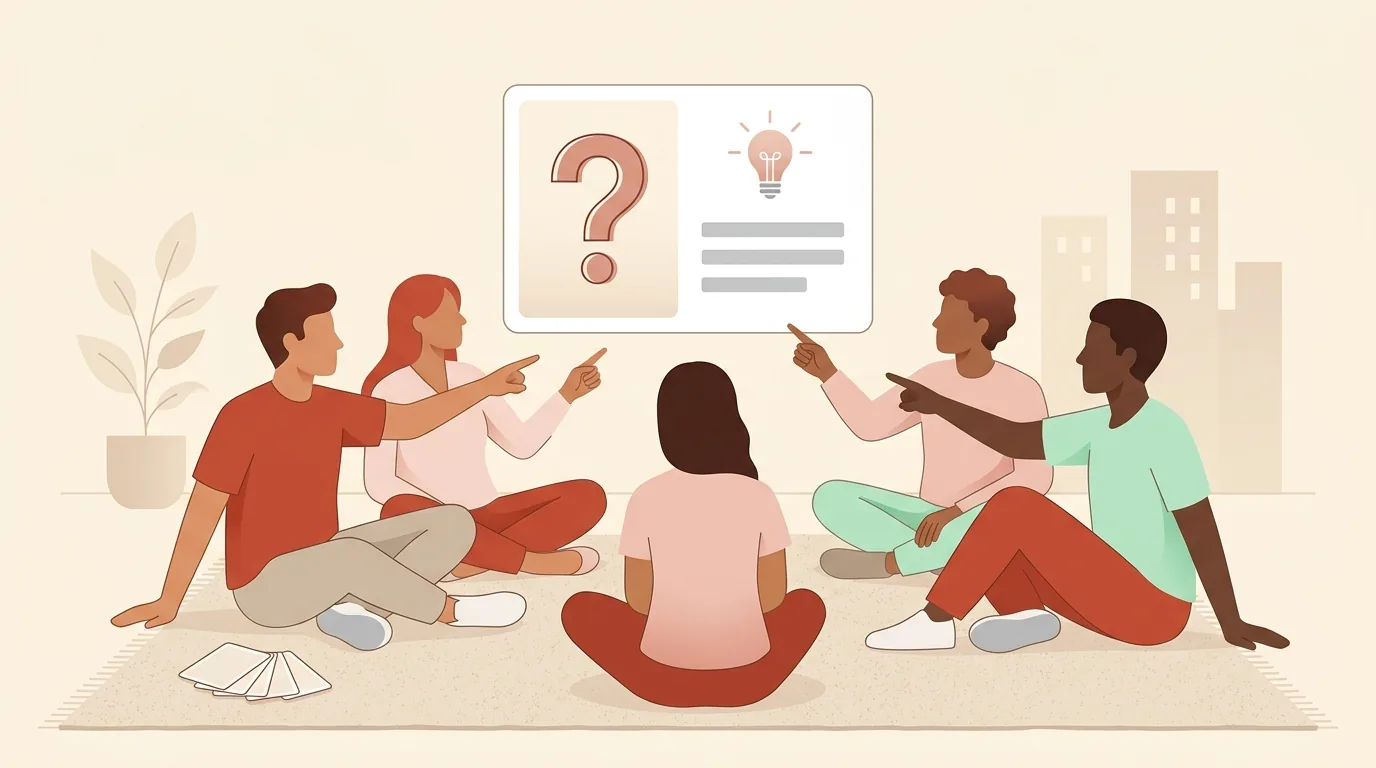
Most Likely To is one card and one instruction: read the prompt, count down, everyone points at once. The prompts are the easy part. The part that decides whether the game is fun at round twenty is the rules you set at round one, because played straight, the two loudest people in the room absorb every vote and everybody else becomes an audience. Four house rules fix that: simultaneous pointing, a cap of one vote per player per round, a reversal round where you nominate yourself instead of someone else, and team play once the group passes about ten. Below are 60 original prompts sorted by register, a table of which rule fixes which problem, and the test for telling a funny card from a quietly unkind one.
Long lists of these prompts are easy to find and they all have the same shape: two hundred questions, no instructions, and an implicit assumption that the game runs itself. It mostly does, for about six rounds. Then a pattern sets in that nobody names out loud, and the night quietly stops being for everyone. If you want the prompts on cards, the free deck of most likely to questions deals them one at a time from a single phone.
None of the 60 prompts below appear in the free Most Likely To deck on this site, so you can run the deck and this page in the same evening without a repeat.
How do you play Most Likely To?
One person reads a card that starts "who's most likely to." Everyone in the circle picks the person the prompt describes best. On a count of three, all hands go out at once. Whoever collects the most fingers has to explain themselves, and that explanation is the whole game. The card is only the setup.
Three details that most people improvise, and shouldn't:
- Points go to the person who got voted for, not the voter. Whoever ends with the highest total has been most thoroughly characterised by their friends, which is either a trophy or a verdict depending on the group. You can also play with no score at all and lose nothing.
- The reader rotates. Same reason as any other card game: when one person reads every prompt, the night becomes their sense of humour and everyone else is a subject rather than a player.
- You may abstain. Pointing at nobody is a legal move. It matters more than it sounds, because a player who genuinely has no answer will otherwise pick the nearest person, and votes cast out of politeness are what tip the game toward its failure mode.
That failure mode has a name in every group that has played this more than twice, even if nobody has said it.
Why does the same person get voted for every round?
Because the game rewards being memorable, and memorability is not evenly distributed in a room.
The first hand out anchors the rest. Somebody points, three people see it, and the prompt stops being "who is most likely to do this" and becomes "who did she pick." It happens in well under a second and it does not feel like conformity from the inside; it feels like agreement. Stack that across twenty rounds and the votes converge on whoever produced the most vivid stories in the last year. Usually two people. Sometimes one.
The quiet players are not just missing out on attention. They are being told, twenty times in a row, that nothing about them was distinctive enough to point at. That reads very differently on the receiving end than it does from the middle of the pile.
There is real research on the group version of this. MIT's Center for Collective Intelligence ran a study, reported by MIT News, on why some teams perform better than others across wildly different tasks. The strongest predictor was not the average intelligence of the members or the smartest person present. Groups where one person dominated the conversation did worse than groups where conversational turns were spread more evenly. A party game is not a work task, but the mechanism is the same: a group that lets everyone take a turn is a better group to be in, and a group that funnels everything to one voice gets less out of the people in it.
Most Likely To has this problem structurally, not accidentally. Every round asks the group to single out one person. Without a counterweight, the maths compounds.
The counterweight is rules.
Which rule variant fixes which problem?
There are four ways to run a round. They are not difficulty levels, they are different fixes, and you can switch between them mid-game as long as you say so out loud.
| Variant | How the round runs | Group size | What it fixes |
|---|---|---|---|
| Simultaneous point | Reader reads the card, counts "three, two, one," every hand goes out on one. No early pointing. | 4 to 8 | Anchoring. Nobody's vote gets steered by the first hand up, so the spread of votes is honest. |
| Secret ballot | Everyone writes a name on a slip or types it into their own phone. Reveal together, then count. | 6 to 15 | Peer pressure, and the reluctance to point at somebody you do not know well yet. Mixed groups vote much more truthfully. |
| Self-nomination reversal | The card is answered in the first person. You claim it about yourself, or you pass. Anyone who claims it owes the story. | 3 to 10 | The pile-on. Nobody can be voted for at all, so quiet players get airtime by choosing to take it. |
| Teams | Split into pairs or trios. Each team agrees on one pick and one sentence of defence. Teams vote, teams argue. | 10 to 30 | Dead air in big circles, where the same eight people talk and everybody else waits fourteen minutes for a turn. |
On top of the variant, one rule earns its place in every game: one vote per player per round, and a cap of three wins per player per game. When somebody hits three, they keep playing and keep voting, but they are out of the running. It sounds bureaucratic written down. In practice it takes one sentence to explain and it forces the room to actually think about the eighth-best answer instead of reflexively pointing at the same friend.
The reversal round is the variant worth trying first, because it is the one nobody thinks of. Run five cards where the phrasing flips:
- I am most likely to be the one who forgets the thing everybody reminded me about.
- I am most likely to say yes to a plan I already know I will regret at 7am.
- I am most likely to have a strong opinion about something I learned this week.
- I am most likely to be the last one still talking at the end of the night.
- I am most likely to be the one who worries about whether everybody had a good time.
Five of those and the shape of the room changes. People who had not spoken for ten rounds volunteer something about themselves, and the group learns things that no amount of pointing would have surfaced. Then you switch back to normal play and the votes are noticeably better distributed, because the room now has fresh material on everybody.
Which prompts are funny versus quietly unkind?
One test, and it works before you read the card aloud:
Does being voted for describe something the person does, or something the person is?
"Most likely to take a shortcut that adds forty minutes" is a thing somebody does. Being voted for is a small, specific, survivable accusation and the defence is half the fun. "Most likely to still be single in ten years" is a thing somebody is, delivered by a show of hands, and there is no defence to mount. Same game, same format, completely different social contract.
Two follow-up tests catch what the first one misses:
- The absent-friend test. Would this card still work if the person it most obviously applies to were out of the room? If it is funny only because of who is sitting there, it is not a prompt, it is a joke at someone's expense with a card in front of it.
- The Monday test. Will anyone still be turning their result over on Monday morning? If yes, the card was heavier than the game.
Anything touching bodies, money, health, competence at someone's actual job, relationship history, or a known sore spot fails all three. You do not need those cards. The funniest rounds are almost always about something tiny and precise.
Here is what that looks like in practice. All 60 prompts below were written for this post.
18 prompts for a friend group
- Who's most likely to keep a receipt for four years and produce it at the exact right moment?
- Who's most likely to answer a group plan with a spreadsheet nobody requested?
- Who's most likely to take up an instrument for six weeks and never mention it again?
- Who's most likely to be recognised by a barista in a city they have visited twice?
- Who's most likely to hold a door open so long it turns into a job?
- Who's most likely to name a car and then talk to it in traffic?
- Who's most likely to bring the wrong charger and borrow one from everybody in turn?
- Who's most likely to describe a two-hour queue as "actually quite interesting"?
- Who's most likely to carry a spare of something extremely specific in their bag?
- Who's most likely to take a shortcut that adds forty minutes?
- Who's most likely to correct a stranger's grammar out loud and then feel bad about it all day?
- Who's most likely to fall for the same obvious prank twice in one week?
- Who's most likely to keep a group chat alive single-handedly for a year?
- Who's most likely to invent a rule mid-game and defend it with total confidence?
- Who's most likely to leave a voice note that outlasts the situation it describes?
- Who's most likely to arrange a bookshelf by colour and insist it was practical?
- Who's most likely to build an entire holiday around one recommendation from a taxi driver?
- Who's most likely to be genuinely delighted by a bird?
14 prompts for coworkers
Nothing here is about anybody's competence, pay, appearance, personal life, or drinking. Every card is something a colleague would be happy to be voted for.
- Who's most likely to have the agenda ready before the meeting is scheduled?
- Who's most likely to spot the one typo on a slide that has already been shown to two hundred people?
- Who's most likely to open with "quick question" and then ask an enormous one?
- Who's most likely to know where every shared document actually lives?
- Who's most likely to keep a spare charger, a spare pen and a spare umbrella at their desk?
- Who's most likely to turn a five-line email into a diagram?
- Who's most likely to notice a new starter looking lost and fix it in thirty seconds?
- Who's most likely to have a keyboard shortcut nobody knew existed?
- Who's most likely to arrive at the offsite with the best snacks?
- Who's most likely to name a project something the whole company still says three years later?
- Who's most likely to read an entire changelog voluntarily?
- Who's most likely to stay completely calm on a call that has clearly gone sideways?
- Who's most likely to remember a decision from eighteen months ago and where it was written down?
- Who's most likely to volunteer to run the retro nobody else wanted to run?
Run the workplace version on secret ballot rather than pointing. A show of hands aimed at a colleague, in front of their manager, is a different act from the same show of hands aimed at a friend, and people know it. The Center for Creative Leadership's guide to psychological safety at work makes the underlying point plainly: people take social risks in front of colleagues only when they are confident it will not be held against them. Ballots, an easy pass, and a manager who volunteers to be voted for first will do more for that than any card you pick.
12 prompts for couples
- Who's most likely to fall asleep on the sofa first and deny it happened?
- Who's most likely to say "I don't mind" and then mind, quietly, for an hour?
- Who's most likely to reorganise a cupboard the other one had a system for?
- Who's most likely to hide the good snacks somewhere the other one already found?
- Who's most likely to start packing four days early?
- Who's most likely to start packing on the way to the airport?
- Who's most likely to remember the exact meal from the first month?
- Who's most likely to take the long way home because the light was good?
- Who's most likely to answer a question the other one was clearly asked?
- Who's most likely to cry at the trailer rather than the film?
- Who's most likely to keep a surprise secret for three weeks and then give it away a day early?
- Who's most likely to apologise first, even when it is definitely the other one's turn?
16 prompts for a big party
- Who's most likely to know somebody at a party where they knew nobody an hour ago?
- Who's most likely to spend the entire night in the kitchen?
- Who's most likely to take charge of the music without being asked?
- Who's most likely to say goodbye to every single person and take forty minutes doing it?
- Who's most likely to turn up first and help set up?
- Who's most likely to still be going when it gets light?
- Who's most likely to end up deep in conversation with the host's parent?
- Who's most likely to be the one holding everybody's coats?
- Who's most likely to start a dance that other people actually join?
- Who's most likely to fix something in the house that was not their problem?
- Who's most likely to bring a game nobody asked for and be completely right about it?
- Who's most likely to find the one quiet room and hold court in it?
- Who's most likely to take two hundred photos and send none of them?
- Who's most likely to make friends with the dog and ignore the humans?
- Who's most likely to be the reason everybody stayed an extra hour?
- Who's most likely to be first in the group chat the next morning?
How does it work for couples, coworkers, and big parties?
Same cards, three completely different games, and the difference is mechanical rather than tonal.
Couples. With two people there is no vote, so the game changes into something better: you both answer, and if you disagree you have found the interesting card. Read the prompt, both say a name, and when the answers differ, that is the round worth talking about. Keep it light for the first ten and let it get more revealing after that, in that order. Escalating gradually is the whole design behind the closeness-generating procedure Berkeley's Greater Good in Action publishes, based on Arthur Aron's research, and the principle carries over cleanly: disclosure works when both people move at the same pace, not when one card jumps straight to the deep end.
Coworkers. Cap the game at fifteen minutes, run it on secret ballot, and stop at the first prompt that makes anyone hesitate. The point of playing it at work is that people learn one small human thing about each other, and fifteen good minutes achieves that. Thirty minutes gives the game time to drift somewhere HR would rather it did not.
Big parties. Above about twelve, a single circle stops working. Each player waits too long between turns, the pointing gets sloppy because half the room cannot see everybody's hands, and people drift to their phones. Split into two circles, or switch to teams. Teams also solve the visibility problem, since a trio can confer and one person announces the pick.
If you want other formats for the same night, party question games for groups covers five of them with the group sizes each survives at, and Never Have I Ever is the natural handover once the pointing has run its course. They are worth understanding as opposites: Most Likely To is the group making a claim about one person, and Never Have I Ever is one person volunteering a claim about themselves. Mixing them without noticing is how a night slides from confession into roast with nobody deciding to.
How long should a round last?
A round should take somewhere between forty and ninety seconds. Read, count down, point, one defence, move.
If rounds are running under thirty seconds, nobody is explaining and you have turned the game into a survey. Ask the person with the most votes for a single sentence, and just one; that is the whole content of the game.
If rounds are running past two minutes, the defence has become a monologue and the other nine people have gone quiet. Set the norm early by keeping your own defence short.
For the game as a whole, twenty to thirty cards is a full session for most groups. That is roughly twenty-five minutes. Stop while somebody is still asking for one more, and do not announce a final round, because a final round makes people reach for their biggest, meanest card. Land it on something small.
Three signs you are past the peak: the defences are getting shorter, the same person keeps being the answer, or people have started prefacing their votes with "no offence." Any one of those is your cue to switch variant or stop.
Play it now
The Most Likely To deck is free, has 50 cards, shuffles on every session, and needs no account or email. Every card in it was written to pass the tests above, so being voted for is funny rather than a verdict. Free decks on this site are complete: the whole deck plays, with nothing gated partway through.
Pair it with Never Have I Ever, which is also free with 60 cards and works well as the second half of an evening. If your group has an in-joke that no general deck could ever cover, the deck builder makes your own set in a browser, one deck and 20 cards on the free tier.
A few decks on the site are premium. Those play their first five cards free and then show an upgrade panel, which we would rather tell you here than at card six. QuestionCard Plus opens all of them for $3 a month, billed as $18 every six months, or $59 once for lifetime access.
Frequently asked questions
How do you play who's most likely to?
Sit in a circle, pick a reader, and rotate the reading each card. The reader reads a prompt beginning "who's most likely to," then counts down from three so everybody points at the same instant rather than following the first hand out. The person with the most fingers aimed at them gives one sentence of defence, and the group moves on. Score by tallying votes received if you want a winner, or play with no score, which loses nothing. Abstaining is legal, and one vote per player per round keeps the totals honest.
How many people do you need for Most Likely To?
Four is the practical minimum for the pointing version, because with three there are only two possible targets per card and the game runs out of surprises inside ten rounds. Five to ten is where it works best. Two people can play it well using the both-answer variant, where you each name a person and the interesting rounds are the ones where you disagree. Above twelve, split into two circles or switch to teams, since one large circle leaves each person waiting too long between turns and half the room cannot see the hands anyway.
What are good most likely to questions for coworkers?
Ones where being voted for is a compliment with a joke attached. "Who's most likely to know where every shared document actually lives" and "who's most likely to have the agenda ready before the meeting is scheduled" both work, because the answer describes a habit rather than a judgement. Avoid anything touching pay, appearance, personal relationships, drinking, or how well somebody does their actual job, and skip anything a manager voting could turn into a performance comment. Run the workplace version on secret ballot rather than a show of hands, cap it at fifteen minutes, and stop at the first card that makes anyone pause. The 14 workplace-safe prompts above are written to that line.
How do you keep Most Likely To from getting mean?
Three rules, set before the first card. Cap each player at three wins per game, so the votes cannot pile onto one person. Use the does-versus-is test on every prompt, and bin anything that describes who somebody is rather than something they did. Run one reversal round in the middle, where everyone claims cards about themselves instead of voting, which gives the quiet players a turn and resets the distribution for the rest of the night. Then add the smallest rule of all: anyone can say "bin that one" about any card, no reason required, and the reader moves straight on. Groups that give themselves permission to reject a card almost never need to use it.