
Never Have I Ever Questions: 60 Clean to Bold
By Mark Fulton · · 15 min read
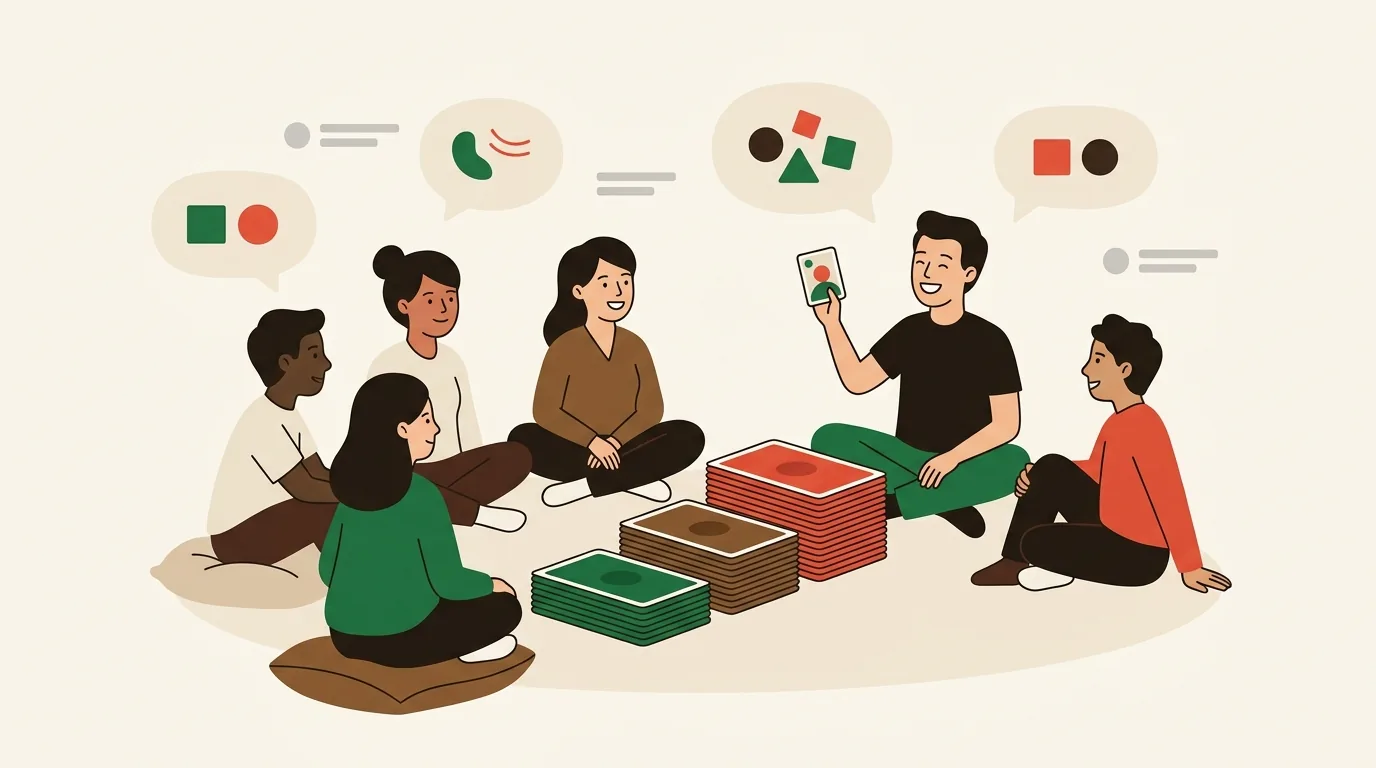
Good never have I ever questions are sorted by how much they expose, not by how funny they are. The game only fails in one way: a prompt lands that forces someone to admit something they had not chosen to share, and the room goes quiet in a way it does not recover from. So set the exposure level out loud before round one, keep every prompt inside it, and give people a way to pass without explaining. Below are 60 questions written fresh for this post in three tiers, 20 each: family-safe, party, and bold but kind. The host script that sets the tier is at the end of the tiers, and it takes about fifteen seconds to say.
Most collections of these prompts are one long scroll where "never have I ever seen a ghost" sits four lines above something that would end a friendship. Sorted by theme, maybe, but not by risk. The person reading aloud has no idea which one is coming, and neither does the room. That is the actual problem, and it has nothing to do with running out of questions. If you would rather deal from cards, the free deck of never have I ever questions shows one prompt at a time, shuffled.
None of the 60 below appear in the free Never Have I Ever deck on this site, so you can run both in one night without a repeat.
How does never have I ever actually work?
One person reads a prompt beginning "never have I ever." Everyone who has done the thing marks a point against themselves. Everyone who genuinely has not sits still. Then the room turns to whoever moved and asks for the story, and the story is the entire game. The prompt is just the excuse.
Three scoring versions are in common use, and they are functionally identical:
- Ten fingers. Everyone holds up ten fingers and drops one per admission. Last person with a finger up wins. Good for standing groups because nobody needs a table.
- Ten points. Same thing written down, better for a long game because you can pause and come back.
- Put a finger down. No winner at all, just a running count. This is the version that works for family tables, because nobody is eliminated and nobody is out of the game while everyone else keeps playing.
Reading goes clockwise. That matters more than it sounds: when one person reads every card, the game becomes their taste in questions, and everyone else is a subject rather than a player.
The last mechanic is the one people skip. Every player may pass twice per game with no explanation. Say "pass," the reader moves on, nobody comments. A pass costs nothing and buys nothing. It exists so that a prompt which happens to hit a real thing in someone's life has an exit that is not a lie and is not a confession. Without it, a person who does not want to answer has to either fake an answer or make a scene, and both are worse than the pass.
How do you pick the right tier for the group?
Ask yourself one question about the room: what is the most private thing anyone here already knows about the person they know least well? Whatever that is, stay one notch below it.
That sounds fussy, but it maps cleanly onto three tiers. There is a well-studied body of work on how closeness builds between people, and the Aron closeness-generating procedure at Berkeley's Greater Good in Action is the most usable version of it. The principle that matters here: disclosure works when it escalates gradually and both sides move together. A group that starts at maximum exposure does not get closer faster. It gets one person exposed and everyone else watching.
So the tiers below escalate. Play tier one for ten rounds before you touch tier two, even with a group you know, because ten light rounds is what earns the heavier ones.
Tier 1: family-safe (20 prompts)
Nothing here implies wrongdoing, romance, or money. Playable with grandparents, ten-year-olds, coworkers, and your partner's parents on the same night.
- Never have I ever eaten a snack in the car and hidden the wrapper before I got home.
- Never have I ever pretended to be asleep so somebody else would answer the door.
- Never have I ever lost an entire afternoon to a jigsaw puzzle.
- Never have I ever got the words to a nursery rhyme wrong in front of a child who corrected me.
- Never have I ever picked the slowest queue in a shop and stayed in it out of pure pride.
- Never have I ever been beaten at a board game by someone under ten and taken it badly.
- Never have I ever assembled flat-pack furniture and finished with parts left over.
- Never have I ever given a houseplant a name.
- Never have I ever given a pet a full human middle name.
- Never have I ever run for a bus I had no realistic chance of catching.
- Never have I ever fallen asleep during a film I personally chose.
- Never have I ever put something in a safe place and never seen it again.
- Never have I ever taken the same photograph of the same sunset four times in a row.
- Never have I ever worn mismatched socks and claimed it was deliberate.
- Never have I ever changed a recipe so much that it became a different meal.
- Never have I ever cheered out loud at a wildlife documentary.
- Never have I ever brought back a souvenir that nobody wanted.
- Never have I ever whistled a song at someone who could not identify it and kept going anyway.
- Never have I ever got lost inside a building I have visited dozens of times.
- Never have I ever kept a jar of screws with no known purpose.
Tier 2: party (20 prompts)
Adult, socially embarrassing, still nothing anyone would mind their boss overhearing. This is the tier most nights should actually be played at.
- Never have I ever left a party through the back door without saying goodbye to anyone.
- Never have I ever rehearsed a voicemail and still got it wrong.
- Never have I ever agreed to a plan three weeks out purely because three weeks felt far away.
- Never have I ever turned up at the wrong venue and worked out how wrong only quite late.
- Never have I ever pretended to recognise someone for an entire conversation.
- Never have I ever brought one bottle to a party and drunk most of it myself.
- Never have I ever changed my order because the person ahead of me made me doubt it.
- Never have I ever put something back on the shelf and then bought it online at full price.
- Never have I ever taken a work call from a place I was absolutely not supposed to be.
- Never have I ever left a group chat and then quietly asked to be added back.
- Never have I ever praised a gift so convincingly that I got asked about it a year later.
- Never have I ever joined a queue without knowing what the queue was for.
- Never have I ever hidden in a shop aisle to avoid someone I actually like.
- Never have I ever kept a plant alive out of pure spite.
- Never have I ever badly misjudged how spicy something was in front of an audience.
- Never have I ever gone to a gig for one song and left immediately after it.
- Never have I ever forgotten I was sharing my screen.
- Never have I ever agreed that I had definitely seen a film I have never seen.
- Never have I ever tried to leave a party twice and been pulled back in both times.
- Never have I ever replayed a thirty-second conversation for an unreasonable number of hours.
Tier 3: bold but kind (20 prompts)
These go somewhere real. Every one of them exposes the speaker's own pettiness, vanity or avoidance, which is the safe kind of exposure, because it is a thing they did rather than a thing they are. None of them ask about anybody's body, health, money, immigration status, sexuality, or worst day. That restraint is not squeamishness. It is what lets the tier be genuinely bold, because everyone can answer honestly without risking anything that matters.
Play these only with people who like each other, and only after the room has warmed up.
- Never have I ever been jealous of a friend's good news before I managed to be happy about it.
- Never have I ever let someone believe a compliment about me that I knew was not accurate.
- Never have I ever kept a grudge alive over something the other person has entirely forgotten.
- Never have I ever pretended to be busier than I was to avoid explaining myself.
- Never have I ever hoped a plan would be cancelled and then performed disappointment when it was.
- Never have I ever let someone else carry the blame for something small that was mine.
- Never have I ever said "no worries at all" while having several specific worries.
- Never have I ever rehearsed my reaction to news I had already been told.
- Never have I ever left a message unanswered so long that answering became impossible.
- Never have I ever changed my stated opinion in a room purely to avoid an argument.
- Never have I ever competed hard with someone who had no idea we were competing.
- Never have I ever taken credit for a decision I had argued against.
- Never have I ever gone quiet to find out whether anyone would notice.
- Never have I ever ended a friendship by simply letting it run out.
- Never have I ever been relieved that the person I was avoiding cancelled first.
- Never have I ever apologised properly for something I did not believe I was wrong about.
- Never have I ever wanted to be talked out of a decision I had already made.
- Never have I ever presented a mistake as if it had been the plan all along.
- Never have I ever felt like the least interesting person in the room and hidden it completely.
- Never have I ever loved something mainly because somebody I admired loved it first.
What does the host say before round one?
Say this out loud. Do not summarise it, do not do it apologetically, and do not skip it because the group knows each other. It takes fifteen seconds and it is the difference between a good night and one that ends early.
"Quick version of the rules. I read a card, anyone who has done it puts a finger down, and then you owe us the story. We are playing at the level of embarrassing rather than the level of secrets, so nothing here is going to ask about your relationships, your money, or anything you would not say at work. Everyone gets two passes, no reason needed, and nobody comments on a pass. If a card is bad, say so and we bin it. Starting on my left."
Four things are doing work in there.
Naming the tier out loud. People calibrate their answers to the level they think they are being asked for. If you do not name it, half the room aims high and half aims low, and the mismatch is where things go wrong.
Announcing the pass before anyone needs it. A pass rule introduced at the moment someone uses it looks like a rescue, and everybody notices who needed rescuing. Introduced at the top, it is just part of the game.
"Nobody comments on a pass." Without this line, the pass gets a "oooh, what was that one" and stops being a pass.
The bin. Handing the room permission to reject a card means nobody has to sit through a bad one out of politeness. It also improves your deck.
If you want the same setup logic for other formats, party question games for groups covers five of them and the group sizes each one survives at.
Which prompts cross the line, and how do you spot them?
There is a single test, and it works before you have read the card aloud.
Does answering honestly reveal something about who a person is, rather than something they did?
A prompt about a thing you did is a story. A prompt about who you are is a disclosure, and a disclosure made under game pressure is not consented to. Anything that would out someone's sexuality, health, immigration status, financial position, religious practice, or history of harm belongs to that person and to their timing, not to a card. The same goes for anything that turns silence into an answer: if not putting a finger down says as much about you as putting it down, the prompt is a trap regardless of how it is worded.
Two further tests catch most of what the first one misses:
- The absent-friend test. Would this prompt be fine if the person it most applies to were standing behind you? Prompts that are funny because of who is in the room are not prompts, they are jokes at someone's expense with a card in front of them.
- The Monday test. Will anyone still be thinking about their own answer on Monday morning? If yes, the prompt was heavier than the game.
You will also want a repair line, because eventually one slips through. Say "that one's bad, skip it, my fault" and read the next card immediately. Do not apologise at length, and do not turn to the person it landed on to check they are fine, because that lands the attention on them a second time. Move.
If your group has drifted toward accusation rather than confession, that is worth noticing too. Most Likely To is the format where a group points at someone, and it is a completely different social contract. Never have I ever is voluntary self-report. Mixing the two is how a night turns from confessions into a roast without anyone deciding to.
How do you play it without drinking?
Play it exactly the same way. The fingers-down and ten-points versions have no drinking in them at all, and they are the versions the game is actually better under, because a scoring system that punishes admission with a drink quietly punishes honesty. Water works. So does a bowl of something salty, or nothing at all.
If you are hosting a mixed group, put the non-alcoholic options out first and in the same quality glassware as everything else, and make the first round of the game a tier-one round. UNC Student Wellness has a plain, practical set of safe party hosting strategies for the surrounding logistics, and the NIAAA's page on building drink refusal skills is a genuinely useful read if you are the person who would rather not, or if you want to be the host who never makes anyone explain.
One structural point. A drinking version of this game has an escalating incentive to confess more as the night goes on, at exactly the point in the night when people's judgement about what to confess is worst. The dry version does not have that gradient. If you have ever watched a good game turn into a bad one around card thirty, that is usually what happened. Our Drinking Game Questions deck is written the same way, tasteful rather than explicit, and the same instruction applies there: play it with water if you want, the deck does not care.
How do you end the game before it curdles?
End it early. Every question game has a peak, and the peak is not the end. Stop the game while somebody is still saying "one more."
Three signals that you are past the peak:
- The stories are getting shorter. The prompts are still landing but nobody is elaborating. That means people are answering to keep the game moving rather than because they have something to say.
- The same person keeps being the story. One player has become the entertainment. That feels great for about six rounds and then it does not.
- Somebody has started prefacing answers. "Okay, but in my defence" means people are managing how they are perceived instead of playing.
The clean exit is to read one deliberately light card, let the laugh happen, and put the phone down mid-momentum. Do not announce a last round, because a last round makes people reach for their biggest confession, which is the exact card you did not want played. Land it on a small one.
Twenty to thirty prompts is a full game for most groups. Sixty is a night with two long breaks in it.
Play it now
The Never Have I Ever deck is free, has 60 cards, shuffles, and needs no account or email. It sits at the tier-two level throughout, which is where most rooms should play. The After Dark deck carries the bolder register for a group that has earned it: it plays the first five cards free and then shows an upgrade panel, which we would rather tell you here than at card six. QuestionCard Plus opens it along with the other premium decks, at $3 a month billed as $18 every six months or $59 once for lifetime.
If you want a second format for the same night, Would You Rather Questions for Adults has 60 more originals sorted the same way, by room rather than by theme, and it is the best handover when the confessions have run their course.
FAQ
What are good never have I ever questions?
Good ones are specific, describe a thing somebody did rather than a thing somebody is, and sit at a single consistent exposure level so the reader is not gambling with each card. "Never have I ever run for a bus I had no chance of catching" is a good prompt because it is precise enough to be a picture and light enough that admitting it costs nothing. Vague prompts ("never have I ever done something embarrassing") produce vague answers, and heavy prompts produce silence. The 60 above are sorted into three tiers for exactly this reason.
How do you play never have I ever without alcohol?
Use the ten-fingers or ten-points scoring instead of drinks. Everyone starts with ten, drops one per admission, last player standing wins. Nothing about the game requires alcohol, and the dry version is more honest, because a drinking penalty gives people a reason to under-report. For mixed groups, put good non-alcoholic options out at the same time as everything else so nobody has to ask, and open with a tier-one round.
What are clean never have I ever questions for family?
Tier one above is written specifically for this: 20 prompts with no wrongdoing, no romance, no money, and nothing a ten-year-old would have to sit out. Use the put-a-finger-down scoring rather than elimination so no child is out of the game while the adults keep playing, and let kids write two prompts of their own, which they will do better than you expect. For a longer sitting-round-a-table version, dinner table questions for kids covers the same room with a different format.
How many people do you need for never have I ever?
Four is the practical minimum. With three, every prompt has only two possible confessors and the game runs out of surprises fast. Four to twelve is the sweet spot. Above twelve, split into two circles rather than trying to run one, because in a big circle each player only speaks every twelfth card and people drift to their phones. Two people can play it, but at that size it stops being a game and becomes a conversation, which is fine, though question games for couples is built for that shape properly.