
Would You Rather Questions for Adults: 60 Fresh
By Mark Fulton · · 15 min read
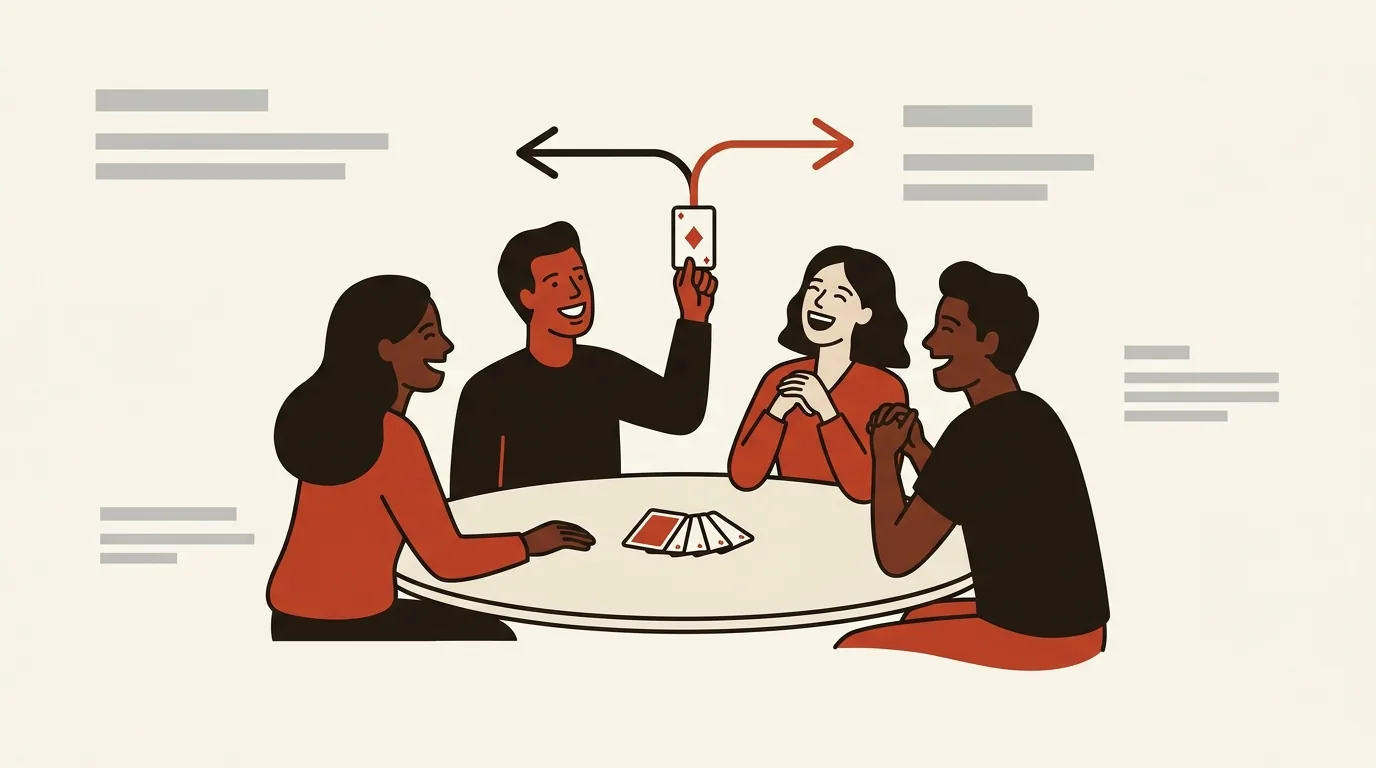
A good would you rather question for adults gives you two options you can genuinely defend, and it is calibrated to the room you are in. That second part is what most lists get wrong. Below are 60 original questions sorted into three tiers: warm ones safe for a work lunch, awkward ones that reveal something and need people who like each other, and genuinely hard ones that turn into a twenty minute argument about values. The one rule that makes any of them work is that nobody gets to just answer. They have to say why.
Would you rather is not short of supply. You can find two hundred questions in ten seconds, and about a hundred and eighty of them will be some variation on eating something disgusting or losing a body part. Volume is not the problem. The problem is that a question that kills at a house party at midnight will die at a Tuesday work lunch, and the person who reads it out will feel it die, and the game will be over. To play from cards instead of a list, open the free deck of would you rather questions: shuffled, one card at a time, no sign-up.
So this is sorted by room, not by theme. Every question here is written fresh for this post, and none of them are in the Would You Rather deck on this site, so you can use both in one night without repeats.
What makes a would you rather question good rather than just gross?
Three things, and gross is not one of them.
Both options have to be defensible. If ninety percent of a room picks the same side, you have written a survey, not a question. The test is whether you can imagine an intelligent person arguing the other way for two minutes. "Would you rather have a million pounds or a papercut" is not a question. "Would you rather be certain and wrong or uncertain and right" is, because the room will split and both halves will think the other half is being naive.
The options have to be close in weight but different in kind. Two versions of the same thing produce a shrug. Money versus time, privacy versus reputation, being respected versus being liked: these split cleanly because they force a trade between two things people actually want, rather than a choice between good and obviously worse.
It has to be answerable without a confession. This is the one gross-out lists ignore. A question that only works if the person reveals something humiliating is not a question, it is a dare in disguise. The revealing ones in the second tier below still let you answer honestly without handing the room ammunition. That distinction is why they work with people you have to see again on Monday.
The psychology behind it is not complicated, and it is well studied. Closeness between people is built by reciprocal self-disclosure that escalates gradually, which is exactly what Aron and colleagues demonstrated in their experimental procedure for generating interpersonal closeness, the study behind the widely used 36 questions exercise. UC Berkeley's Greater Good in Action still publishes that exercise as three escalating sets of questions, and the escalation is the mechanism, not decoration. You do not open with the deep one. You earn it.
Which is precisely what a good would you rather set does, disguised as a party game.
Which tier fits which room?
Three tiers, twenty questions each. Read the tier note before you read the questions out.
Tier 1: Warm
The room: anywhere. Work lunches, first meetings, a table with someone's parents at it, a car full of colleagues. Nothing here reveals anything a person would mind revealing, so nobody has to calculate before they answer.
- Would you rather have every traffic light turn green for you, or every queue you join move twice as fast?
- Would you rather your coffee never go cold, or your phone never drop below 40 percent?
- Would you rather fold a fitted sheet perfectly every time, or reverse into any parking space first try?
- Would you rather always sit by the window on a flight, or always be first off the plane?
- Would you rather have a fridge that restocks itself with food you already like, or a wardrobe that always has something clean and right for the weather?
- Would you rather every restaurant recommendation you give turn out great, or every one you receive?
- Would you rather skip any queue once a month, or get a free upgrade on any booking twice a year?
- Would you rather only ever eat breakfast food, or only ever eat food you can hold in one hand?
- Would you rather your commute be twice as long but genuinely pleasant, or half as long and genuinely unpleasant?
- Would you rather never charge a device again, or never look for a cable again?
- Would you rather work four ten hour days, or five six hour days?
- Would you rather have a desk by a window with noise, or a quiet desk with no view?
- Would you rather your handwriting always be beautiful, or your spelling always be perfect?
- Would you rather live where it never rains, or where it rains gently every night after midnight?
- Would you rather nap anywhere for exactly twenty minutes, or stay sharp all day with no caffeine at all?
- Would you rather always know which supermarket queue is fastest, or always know whether the fruit is ripe?
- Would you rather have a phone that never breaks, or headphones that never tangle, run out, or go missing?
- Would you rather every meeting end five minutes early, or every meeting start exactly on time?
- Would you rather be excellent at one hobby you already have, or passable at four you have never tried?
- Would you rather gain one extra room you do not get to choose the purpose of, or a garden twice the size?
Tier 2: Awkward
The room: people who like each other and expect to keep liking each other. Friends, a team that has shipped something together, a family that jokes. These reveal something small and true, so they need enough goodwill in the room to absorb an honest answer. Do not open a night on this tier. Get through six or eight warm ones first.
- Would you rather have everyone see your search history for one day, or your camera roll for one hour?
- Would you rather have your last five text messages read aloud at this table, or your last five voice notes played?
- Would you rather people always know when you are lying, or never believe you when you are telling the truth?
- Would you rather your inner monologue be broadcast during arguments, or during compliments?
- Would you rather be slightly overdressed at every event for a year, or slightly underdressed?
- Would you rather the group rank you on how funny you are, or on how reliable you are?
- Would you rather find out what your closest friend really thinks of your job, or of your taste?
- Would you rather be caught singing badly by a stranger, or by your boss?
- Would you rather always cry at the wrong moment, or always laugh at the wrong moment?
- Would you rather hear every apology you have ever made replayed, or every apology you were owed and never got?
- Would you rather be the person who talks too much at dinner, or the person nobody notices has left?
- Would you rather everyone know exactly what you earn, or exactly what you spend?
- Would you rather have an ex describe you to a stranger, or have your sibling do it?
- Would you rather always be the one who plans everything, or never be asked what you want to do?
- Would you rather your worst haircut photo be your profile picture for a year, or your worst email be forwarded to everyone on it?
- Would you rather be told the truth about your driving, or about your cooking?
- Would you rather forget the name of everyone you meet from now on, or have them all forget yours?
- Would you rather every compliment you receive be sincere but rare, or constant and half meant?
- Would you rather your group chat be visible to your parents, or to your colleagues?
- Would you rather know which of your friendships will not survive the next ten years, or which ones will?
Tier 3: Genuinely hard
The room: late, small, and settled. Four people on a sofa, two people on a long drive, a dinner where the plates have been pushed back. These are not party questions. They stop the game and start a conversation, which is the point, so only reach for them when you are happy for the game to end there.
- Would you rather do work you love that nobody values, or work you find dull that visibly helps people?
- Would you rather be certain about a decision and wrong, or uncertain and right?
- Would you rather your children remember you as fun, or as fair?
- Would you rather have thirty more ordinary years, or ten more of the best years you have ever had?
- Would you rather prevent one disaster you will never hear about, or take the credit for one you did not prevent?
- Would you rather always speak your mind and lose people, or hold your tongue and keep them?
- Would you rather be judged on your intentions, or on your results?
- Would you rather have a job that ends every day at five and never moves you, or one that moves you and never really ends?
- Would you rather forgive someone who is not sorry, or be forgiven by someone you never apologised to?
- Would you rather be the most talented person on a losing team, or the weakest on a winning one?
- Would you rather your best idea get built badly by someone else, or stay unbuilt and yours?
- Would you rather know what people say about you after you leave the room, or never wonder about it again?
- Would you rather have one friend who knows everything about you, or ten who each know a quarter?
- Would you rather live somewhere you love far from everyone you love, or somewhere you dislike surrounded by them?
- Would you rather be respected by people you admire, or adored by people you barely know?
- Would you rather give money to people who need it and will waste it, or to people who do not need it and will use it well?
- Would you rather be the reason someone changed their life, or never find out that you were?
- Would you rather have every difficult conversation you have been avoiding, all in one week, or never have any of them?
- Would you rather your worst decision stay private, or your best one stay unnoticed?
- Would you rather be understood by everyone and liked by nobody, or liked by everyone and understood by nobody?
How do you actually play it as a game rather than a list?
A list gets read out and answered. A game has a rule that produces argument. Here is the rule that turns one into the other, and it is the whole trick:
Nobody just answers. Everyone justifies. One sentence minimum. "A" is not an answer, "A, because I would rather be bored than useless" is. The reasons are the game. The choices are only the excuse for the reasons.
From there, three ways to run it, in order of how much structure the room needs.
Round the table. Read a question, go round, everyone answers with their reason, then let it fall apart into argument for as long as it wants to. Simple, fair, and slow. Best for six or fewer.
Split and defend. Read the question, count hands for each side, then pick one person from the larger side and one from the smaller side and give each thirty seconds. The minority speaks first, always. This is what turns a five to one split into the best question of the night rather than the flattest.
Predict, then reveal. Before anyone answers, one person guesses what a specific other person will choose. Then that person answers. Getting it wrong is more interesting than getting it right, and it is a natural bridge into most likely to, which runs on the same energy with the guessing built in. If the night is already a structured one, this format slots neatly into the break in a trivia night run sheet when the scoreboard needs a rest.
Two practical rules that stop games dying:
- Kill a question the moment the room agrees. If the split is unanimous, do not fight for it. Move on. A dead question is nobody's fault and the only mistake is defending it.
- No changing the question. "Neither" and "can I have both" are the two ways this game ends. Rule them out before you start, cheerfully, once. The constraint is the entire mechanism, and people who dodge it are not being clever, they are opting out.
How do you get quiet people answering?
You do not do it by going round the table starting with them. You do it by lowering what an answer costs.
Give them the minority side. In a split and defend round, the quiet person on the unpopular side has cover: they are not sharing an opinion, they are arguing a position. That is a completely different social risk, and people who never volunteer will happily defend a corner they were assigned.
Let them answer second, never first. The first answer sets the register for the room, and asking a reticent person to set it is the fastest way to get a one word reply. Two answers in, they know how long and how honest is expected.
Stay in tier one for longer than feels necessary. Six or seven warm questions is not a warm up, it is the mechanism. This is the escalation principle from the closeness research doing actual work: people disclose at the pace they are matched at, and if you jump three levels in question four, the quiet people simply stop playing and nobody notices until the end.
Do not react to answers with surprise. The whole thing runs on people feeling able to say a slightly unusual thing without it becoming a story about them. That is not a party trick, it is the same interpersonal risk that Harvard research on psychological safety at work describes: people speak up when they can predict that speaking up costs nothing. A room that laughs at the first honest answer has closed the game for everyone quieter than that person.
When does the game stop being fun, and how do you land it before then?
Would you rather has a natural life of about twenty minutes and about fifteen questions. Past that, three things happen: the answers get shorter, someone starts phone checking during the reasons, and somebody reaches for a shock question to bring the energy back. That last one is the real failure mode. The gross-out question is a symptom of a game that is already over, not a rescue.
Watch for the tell: the first time nobody argues after an answer. Not the first time the room agrees, the first time nobody wants to push back. That is the end, and you have roughly two questions of goodwill left.
Land it deliberately. Pick one question from the tier above where you have been playing, read it, let the argument run all the way out without trying to close it, and then stop the game there rather than reading another. Ending on the best question of the night is what people remember. Ending because everybody drifted off is what they remember instead.
If the room still has energy but this format is spent, switch mechanics rather than topics. Something with guessing or scoring resets people who are tired of choosing, and the party question games for groups that work best after would you rather are the ones where the pressure is on the guesser rather than the answerer.
Frequently asked questions
What are good would you rather questions for adults?
The good ones split the room and can be answered without a confession. Practically, that means trading two things people genuinely want against each other: money against time, privacy against reputation, being respected against being liked. Skip anything built on disgust or physical harm, because those get a laugh and then nothing, and the person who answered has not told you anything about themselves. If you want a shortcut, tier three above is the shape to copy. Every one of those has been argued both ways.
How do you play would you rather with a big group?
Do not go round the table. With more than eight people, a full circuit takes ten minutes and the last four answers are apologetic repeats of earlier ones. Use hands instead: read the question, everyone commits to a side at the same time, then take one voice from each side for thirty seconds each, minority first. That keeps the whole room involved on every question while only two people ever have to speak. Fifteen questions run that way fills about twenty five minutes and nobody sits silent through it.
What's a would you rather question that has no easy answer?
The hardest ones are the ones where both options cost you the same thing in different currencies. "Would you rather be judged on your intentions or on your results" is one, because everybody wants to say intentions and everybody privately knows they judge other people on results. "Would you rather do work you love that nobody values, or work you find dull that visibly helps people" is another. Neither has a defensible consensus answer, which is exactly why the argument runs long.
Can you play would you rather with coworkers?
Yes, if you stay in tier one and mean it. The warm tier is written so that nothing in it can be answered in a way a person would regret on Monday, which is the actual test for a work setting, not whether the question is clean. Avoid anything touching money, family, or personal history at work, including the ones that look harmless. And read the room on hierarchy: a question is a different thing when a manager is in the circle, because a junior person answering honestly is taking a risk their manager is not. If the room turns out to be up for more, that is a choice for the group to drift into, never one to steer them into from the front.
Ready to play instead of scroll? Open the Would You Rather deck and go. It shuffles, it saves your favourites, there is nothing to install and no account to make, and if the tiers above worked for you the deck is 60 more questions written the same way.