
This or That Questions: 100 for Any Room
By Mark Fulton · · 17 min read
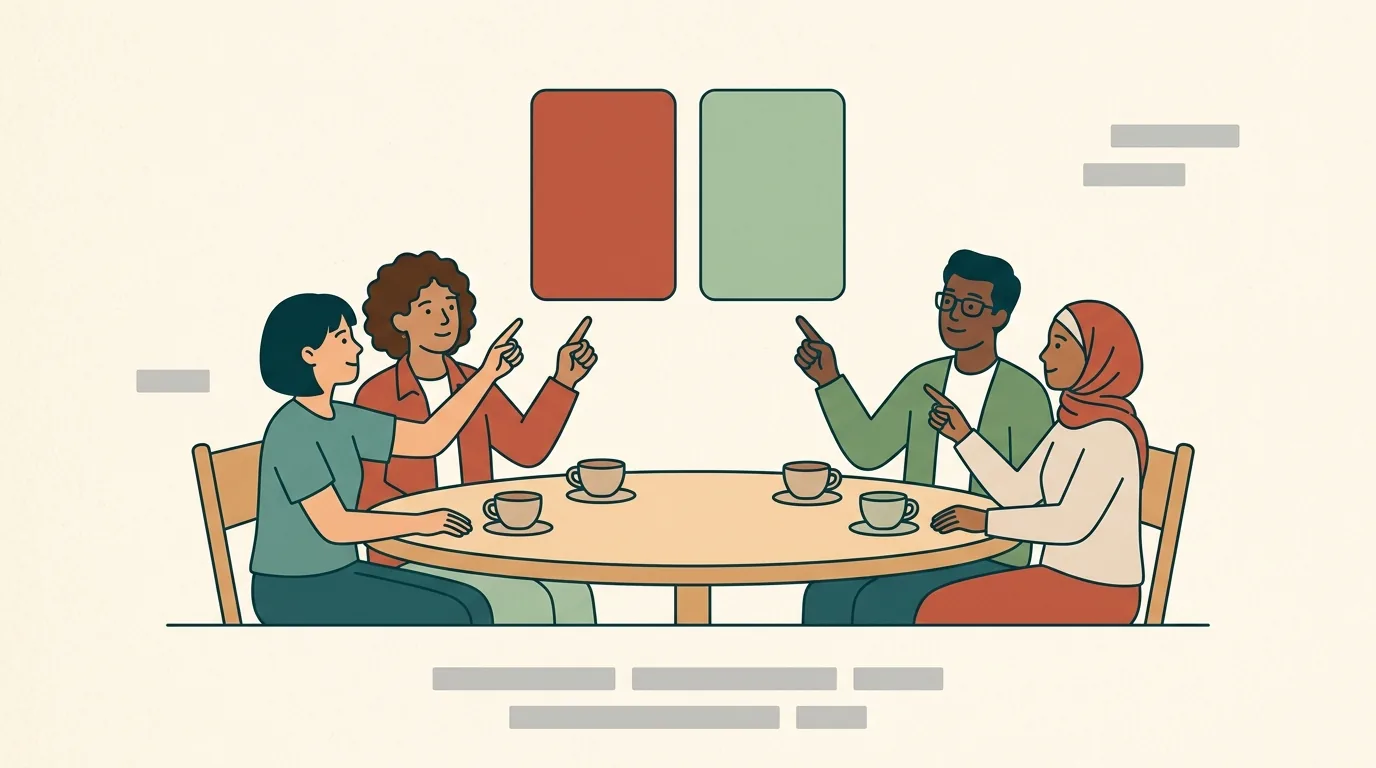
A this or that question only works when both options are genuinely defensible. If the room splits and both halves think the other half is wrong, you have a game. If nine people out of ten pick the same side, you have a survey. Below are 100 original pairs sorted by the room you are in, work, party, couples, the family car, and a hardest tier, along with the two rules that turn a list of pairs into something you can actually play: nobody explains until everyone has committed, and whoever loses the round picks the next pair.
Most this or that lists are the same list. Coffee or tea. Cats or dogs. Beach or mountains. You can read four hundred of them and never hit one that makes anybody sit forward, because those pairs are not choices, they are preferences people already know about themselves and have nothing to say about. You ask, someone says "tea", and the table waits for the next one.
The pairs below are written fresh for this post and sorted by setting, because the pair that lands at eleven at night with friends will die at a Tuesday standup, and the person reading it out will feel it die.
What makes a this or that pair worth arguing about?
Three things, and none of them is being weird for the sake of it.
Both options have to survive a defence. The test is simple. Can you picture a reasonable person arguing the other side for a full minute without sounding contrary? "Money or happiness" fails that test instantly. "Certainty now, or the better answer in a year" passes, because half the room has been burned by waiting and the other half has been burned by rushing, and both of them are right about their own experience.
The two options have to be different in kind, not different in degree. Two flavours of the same thing produce a shrug. A trade between two things people actually want produces an argument. Speed against quality. Being trusted against being liked. Control against reach. The pair is doing real work only when picking one costs you something you also wanted.
This is not a party trick, it is how forced choice works everywhere it is used seriously. Psychometricians build tests out of paired items precisely because a pair strips out the wiggle room a rating scale gives you, and the research is blunt about the condition: the format only does its job when the two options are matched in how attractive they look. When one side is obviously the better-looking answer, the pair stops measuring anything and people just pick the flattering option. Kreitchmann and colleagues found exactly that when they compared forced-choice blocks against Likert items for controlling response bias, with the well balanced blocks carrying the useful signal and the badly balanced ones losing it. Coffee or tea is a badly balanced block wearing a party hat.
The pair has to be about preference, not fact. There is a real distinction in the paired comparison literature between asking someone which cup has more sugar and asking which cup they prefer. The first has a right answer and the second reveals a person. Researchers working on models of personal preference versus impersonal judgment in pair comparison designs treat those as different animals entirely, because one is measuring the world and the other is measuring the chooser. Anything with a correct answer belongs in a trivia deck, not in this game.
Which pairs work at work and which don't?
Work is the room with the most rules and the smallest tolerance for a misfire, so it is worth being specific.
What works: anything about how people like to work. Process, pace, feedback, autonomy, meetings, tools. Those pairs are safe because the answer reveals a working style rather than a private fact, and because everyone in the room genuinely has an opinion and rarely gets asked for it. Half the value of running this before a meeting is that you find out your team splits three to two on whether they want the goal or the budget first, which is useful information you would otherwise never surface.
What does not work: money, politics, appearance, family status, health, dating, anything about drinking, and anything where the "wrong" answer would tell a manager something they could act on. "Deadline set by you or set for you" is fine. "Would you take a pay cut for remote work" is not a game, it is a negotiation with an audience.
There is a third category that trips people up: pairs that are technically safe but require a confession. If answering honestly means admitting you are bad at something in front of the person who reviews you, the pair is not safe, no matter how innocent it looks. University teaching centres have been careful about this for years with classroom icebreakers. Cornell's guidance on getting started with icebreakers keeps coming back to letting people control what they reveal about themselves, which is the same constraint a work meeting has and for the same reason. Nobody relaxes into a game that can be quoted back at them.
The twenty work pairs below all pass that filter. If you want a longer warm-up set for the same room, the 50 icebreaker questions that actually work post covers the open-ended version of the same job.
How do you play it as a game with scoring?
The basic version has no rules at all. Someone reads a pair, everyone says an answer, someone reads the next pair. That is a list being read aloud, and it runs out of energy in about six minutes.
Two rules fix it.
Rule one: no explanation until everyone has committed. Go around and take bare answers first, one word each, no reasons. Point at each option and have people move, or raise a hand, or say the word. Only when every person has landed does anyone get to say why. This matters more than it sounds, because the first person who explains their answer moves everyone after them. Commit first, argue second, and you get the real split instead of a slow drift toward whatever the loudest person said.
Rule two: the loser of the round picks the next pair. Count the split. Whichever side has fewer people is the minority, and one person from that side chooses which pair gets read next, from this list or invented on the spot. It sounds small and it changes everything, because now being in the minority is a reward instead of a mild embarrassment, and the person who chooses is motivated to find a pair that will split the room the other way. The game starts steering itself toward the pairs that actually divide people.
If you want a score, the cleanest version is minority scoring. Every round, everyone on the smaller side takes a point. Ties give nobody anything. First to seven wins. The effect of that scoring is that you stop trying to be agreeable and start trying to read the room, which is a much better game than "say what you like". Play it the other way, majority scoring, and you get a different game that is also fun with a group that knows each other well, because it becomes a test of who can predict their own friends.
Three practical notes from running this at tables. Ten seconds per pair is the right clock, long enough to think and short enough that nobody drafts a position. Twenty to thirty pairs is a full session, not a hundred, so pick a tier rather than working through the whole set. And if two pairs in a row split the same way, change tier, because the room has settled and settled rooms are boring.
100 this or that questions, sorted by room
All 100 pairs are original to this post. Every one has been checked against the "both sides defensible" test, so there are no obvious answers hiding in here.
Work: 20 pairs safe for a Monday meeting
- A meeting that runs 45 minutes and ends in a decision, or 15 minutes and a follow-up thread?
- A manager who tells you exactly what to do, or one who tells you exactly what outcome they need?
- A written status update, or a five minute standup?
- Feedback in the moment, or feedback saved for a scheduled review?
- Learn the better tool properly next month, or keep shipping with the one you already know?
- Work with someone brilliant who replies in two days, or someone solid who replies in ten minutes?
- A shared document everyone edits, or one owner who takes comments?
- A deadline you set, or a deadline set for you?
- A quiet office where nobody talks, or an open one where you hear everything?
- Be the person who spots the problem, or the person who fixes it?
- A small team where you do four jobs, or a big team where you do one job properly?
- Ship on Friday and watch it, or ship on Monday and sleep?
- Be told the budget first, or be told the goal first?
- A job that teaches you something new every month, or one you could do in your sleep by year two?
- Recorded training you can pause, or a live session you can interrupt?
- Credit shared across the team, or credit named to the person who did the work?
- Onboarding by documentation, or onboarding by shadowing?
- A calendar with no gaps and no surprises, or one with gaps and constant reshuffling?
- A client who knows exactly what they want, or one who trusts you to decide?
- Fix the root cause in three weeks, or the symptom this afternoon?
Party: 20 pairs for a loud room
- A party where you know everyone, or one where you know nobody?
- Host and control the music, or guest and control nothing?
- Everyone arrives on time, or everyone stays two hours past the end?
- A seated dinner for eight, or standing room for forty?
- A playlist picked by one person with taste, or a queue anyone can add to?
- A house where the kitchen is the room, or one where the garden is?
- Bring the food, or bring the drink?
- Games all night, or conversation all night?
- Meet three people properly, or fifteen people briefly?
- A night that ends cleanly at midnight, or one that drifts until four?
- A birthday everyone remembers, or a birthday nobody mentions?
- Karaoke where everyone is bad, or karaoke where one person is genuinely good?
- Lights low and music loud, or lights up and music under the talking?
- First to arrive, or last to leave?
- A costume theme nobody can opt out of, or no theme and no effort?
- Sit next to the funniest person, or the most interesting one?
- One photo of the whole night, or no photos at all?
- Ten close friends in one room, or forty acquaintances?
- Someone brings a guitar, or someone brings a projector?
- The night that makes one great story, or the night everyone quietly enjoyed?
Couples: 20 pairs that reveal something without a confession
- A partner who tells you the hard thing straight away, or one who waits until they have thought it through?
- Separate hobbies you are each good at, or one hobby you are both bad at together?
- Plan the trip together for months, or book it on a Thursday?
- Argue it out tonight, or sleep on it and talk tomorrow?
- One big gesture a year, or a small one every week?
- The same taste in food, or the same taste in company?
- Go to bed at the same time, or wake up at the same time?
- Know exactly what you are getting, or be completely surprised?
- Split every cost down the middle, or one pot you both spend from?
- A partner who is your closest friend, or one who brings you a whole other world?
- Do the cooking, or do everything that happens after the cooking?
- A quiet night in every week, or a loud night out every fortnight?
- Be understood without explaining, or be asked and get to explain?
- Live near your family, or near theirs?
- Say the true thing that will land badly, or hold it and keep the evening?
- Merge the bookshelves, or keep them separate?
- Travel with an itinerary, or travel with a return date and nothing else?
- A partner who remembers every anniversary, or one who notices every bad mood?
- Talk through the whole film, or no talking until the credits?
- Move for a job you love, or stay for a life you like?
Family car: 20 pairs for a long drive
- Arrive two hours early and wait, or leave two hours later and rush?
- One long driving day, or three short ones?
- Snacks chosen by whoever is driving, or by whoever is loudest?
- The direct road, or the one with the view and an extra hour?
- One playlist everyone shares, or headphones for everybody?
- Stop at the famous place, or the one nobody has heard of?
- Front seat with the map, or back seat with the legroom?
- Pack light and buy what you forgot, or pack for every possibility?
- Book every night in advance, or decide at four in the afternoon?
- The same holiday you loved last year, or somewhere new that might be worse?
- Windows down and no air conditioning, or windows up and no wind?
- A car that is quiet, or a car that is quick?
- Petrol station food now, or two hours until a proper meal?
- Take the dog, or take the space?
- Wake everyone at five to beat the traffic, or leave at ten and sit in it?
- Photos of the places, or photos of the people?
- The album everyone already knows, or the one nobody has heard?
- Navigate by phone, or by the signs?
- One big shared suitcase, or a small bag each?
- Tell the story on the way there, or save it for the way back?
Hardest tier: 20 pairs that turn into a twenty minute argument
- Trusted by everyone, or believed by the few people who matter most?
- Know roughly how long you have, or never think about it?
- Be remembered accurately, or remembered warmly?
- Always be told the truth, or always get to decide what you hear?
- A life with fewer regrets, or a life with better stories?
- Very good at one thing, or good enough at many that you are never stuck?
- Certainty now, or the better answer in a year?
- The freedom to change your mind, or the credibility of never having changed it?
- Be underestimated, or be overestimated?
- Have your work outlive you anonymously, or be known for work that fades?
- Choose your circumstances, or choose your reaction to them?
- Understand why people do what they do, or be able to change what they do?
- Somewhere you love with people you like, or somewhere you tolerate with people you love?
- Be first to try it, or the one who makes it work?
- A smaller life you fully control, or a bigger one you mostly do not?
- Be forgiven quickly, or understood slowly?
- Keep every memory exactly as it happened, or exactly as it felt?
- Say yes to everything for a year, or no to everything for a year?
- Be right in public, or effective in private?
- Start again knowing what you know now, or carry on and learn nothing more?
How is this different from would you rather?
They look like siblings and they behave differently at a table.
This or that is fast. The options are real, both are things that exist, and the answer is a word. You can run thirty pairs in eight minutes and the energy stays up because nobody has to think for long. That speed is the whole appeal, and it is why this works in a car, in a meeting, and with a group where some people are not talkative yet.
Would you rather is slow on purpose. The options are usually hypothetical, often absurd, and the fun is in the justification rather than the choice. One good would you rather can eat fifteen minutes on its own, which is exactly what you want at hour three of a long night and exactly what you do not want at the start.
The practical rule is that this or that warms a room and would you rather uses one that is already warm. Run twenty pairs from the work or party tiers to get people talking, then switch. The would you rather questions for adults post has 60 written for that second half, and the Would You Rather deck on this site is free to play with no account, so you can have both open on one phone and pass it round.
How do you write your own pairs that don't fall flat?
Once you see the structure you can write these all night. Four steps.
Start from a tension, not a topic. Do not sit down to write "food pairs". Sit down with a trade people actually feel: speed against care, certainty against upside, being known against being left alone. Then find two concrete options that sit on either side of it. The concrete part matters. "Certainty or upside" is an essay question. "Certainty now, or the better answer in a year" is a pair.
Run the minute test. Argue the side you did not pick, out loud, for sixty seconds. If you run dry in fifteen, one option is stronger than the other and the pair is dead. Rewrite the weak side until it is as attractive as the strong one. This is the same balancing that makes a paired item work in a real test, and it is where most homemade pairs fail.
Cut the qualifiers. Every extra clause gives people somewhere to hide. "A manager who tells you what to do, unless it is urgent, in which case they let you decide" is not a pair. Two options, one line, no escape hatch.
Test it on three people before you use it on twenty. You are looking for a split, not a laugh. A pair that gets a laugh and a unanimous answer is a joke, which is fine, but it will not carry a round.
When you have twenty you like, put them somewhere you can shuffle. Typing them into a note means reading them in the same order every time, and by the third session everyone knows what is coming. Building them into a deck in the deck builder gives you a shuffled stack you can pass around a table, and the free tier covers one deck of up to 20 cards, which is exactly one session. QuestionCard Plus is $3 a month, billed as $18 every six months, or $59 once for lifetime access, and it lifts the deck and card limits if you end up making a set per room.
Everything on the free decks is genuinely free and complete, no account and no email. A handful of decks are marked premium, and those show you the first 5 cards and then an upgrade panel, which we would rather say plainly here than have you find out halfway through a round.
Frequently asked questions
What are good this or that questions?
Good ones split the room. The test is whether both options can be defended by a reasonable person for a full minute, which rules out most of the pairs you find in circulation, because "coffee or tea" style questions describe a preference somebody already knows and has nothing to say about. Aim for a trade between two things people genuinely want, phrased as two concrete options in a single line, with no qualifiers. Match the tier to the room as well: a pair about feedback style works in a meeting, and a pair about regret works at midnight with people who like each other.
How do you play the this or that game?
One person reads a pair, everyone answers with one word, no explanations. Two rules make it a game rather than a list. First, nobody explains until every person has committed, because the first explanation drags everyone after it. Second, whoever ends up on the minority side picks the next pair, which rewards being the odd one out and steers the game toward pairs that actually divide people. For scoring, give a point to everyone on the smaller side each round and play to seven. Ten seconds per pair, twenty to thirty pairs a session.
What's the difference between this or that and would you rather?
This or that uses two real options and the answer is a single word, so it runs fast and works with a group that is still warming up. Would you rather usually uses hypothetical or extreme options and the value is in the justification, so one question can hold a room for fifteen minutes. Use this or that to open a night and would you rather once people are talking freely. They stack well in that order.
What this or that questions work for a work meeting?
Anything about how people like to work: pace, process, feedback, autonomy, meetings, tools, deadlines. Those reveal a working style rather than a private fact, and most people have a strong opinion they never get asked for. Avoid money, politics, appearance, family, health, dating, and anything where an honest answer could be used in a review. The 20 work pairs above are all written to that filter, and the icebreaker questions for work deck covers the open-ended version if you want a longer warm-up.